


Arbitrum has billions of dollars moving through its network.
Stablecoins, lending markets, decentralized exchanges, and tokenized assets are already operating there.
The Arbitrum DAO is earning revenue too.
But ARB holders still face a question that I think gets overlooked whenever people talk about Ethereum Layer 2 adoption.
Where does the money actually go?
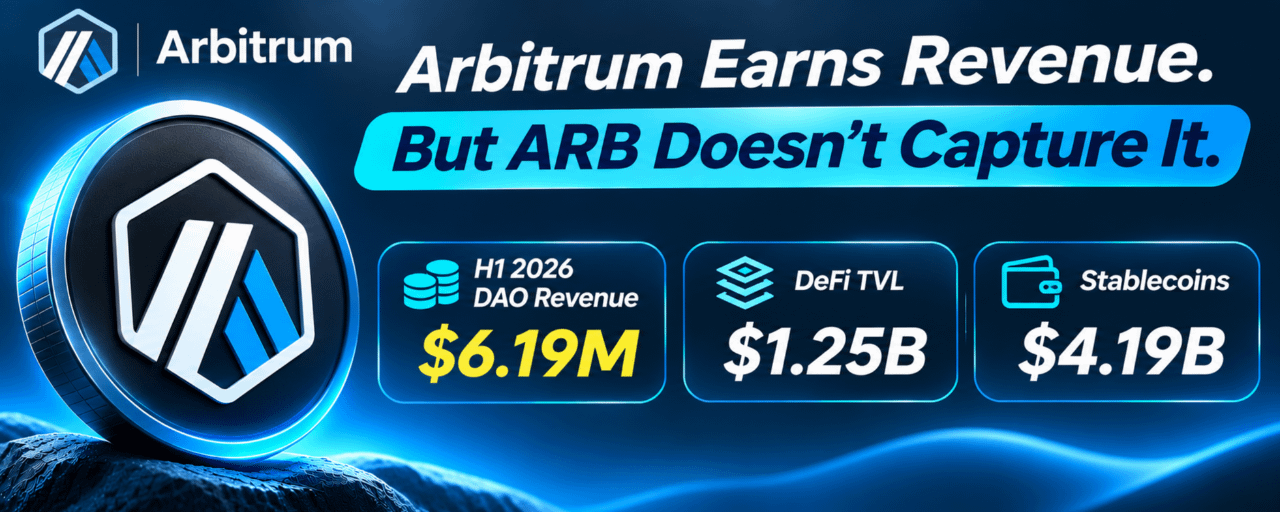
According to the Arbitrum Foundation's H1 2026 report, the DAO accrued approximately $6.19 million in income during the first six months of the year.
That income came from transaction fees, Timeboost auctions, licensing through the Arbitrum Expansion Program, and treasury management.
It's worth looking at the Expansion Program in particular.
Arbitrum technology can power other chains, allowing businesses to build dedicated networks without creating an entirely new blockchain architecture.
Robinhood Chain is one example.
Under its published agreement, 8% of Robinhood Chain's net protocol revenue goes to the Arbitrum DAO treasury, with another 2% directed to the Developer Guild.
That's an interesting business model.
Arbitrum can potentially earn money from infrastructure used outside its own main network.
But here's where the ARB investment thesis gets complicated.
ARB is primarily a governance token.
Holders can vote on proposals, direct treasury spending, and participate in decisions about how Arbitrum develops.
They don't automatically receive a share of DAO revenue.
There isn't an active mechanism that regularly uses those earnings to buy and burn ARB or distribute cash to every token holder.
So Arbitrum can become more widely adopted while the financial benefits remain inside the DAO treasury.
That's a very different arrangement from protocols that have already activated direct token buyback or burn mechanisms.
And the distinction matters when comparing token valuations.
The underlying network is still busy.
DeFiLlama recorded approximately $1.25 billion in DeFi TVL on Arbitrum on November 23, alongside $4.19 billion in stablecoins.
Daily decentralized exchange volume was around $140 million.
Those figures show there are real applications and users interacting with the chain.
They don't establish a direct relationship between that activity and demand for ARB.
Transaction fees on Arbitrum One are paid in ETH.
A user can swap tokens, borrow stablecoins, or provide liquidity without ever needing to purchase ARB.
For the governance token, economic demand depends on something different.
How valuable is influence over the DAO, its treasury, and the technology it governs?
That question is getting more interesting as Arbitrum builds relationships with financial companies and expands its licensing business.
But governance rights are difficult to value.
There's no straightforward earnings-per-token figure that tells investors what each ARB should be worth.
The supply schedule adds another layer.
ARB launched with an initial supply of 10 billion tokens.
According to DeFiLlama's unlock tracker, approximately 7 billion were circulating by November 23.
Another 92.65 million ARB is scheduled to unlock in mid-December, mainly for team-related allocations and investors.
That's additional potential liquid supply.
It doesn't mean those holders will immediately sell. But investors should monitor how released tokens move.
There's also a detail about ARB's maximum supply that often gets missed.
The DAO has the authority to approve additional token issuance of up to 2% annually.
That doesn't mean new tokens are automatically being minted every year.
It means future governance decisions can affect supply beyond the original 10 billion allocation.
For me, Arbitrum's next chapter is about making its economic model more meaningful for the governance token.
The infrastructure already has users. The DAO already earns money.
What I'd watch now is whether governance develops a credible way to connect growing treasury income with ARB demand, while keeping enough resources to support developers and network growth.
Until then, I'd be careful about valuing ARB as though holders directly own a percentage of Arbitrum's revenue.
The network and the token have different economic rights.
That's where the research gets interesting.