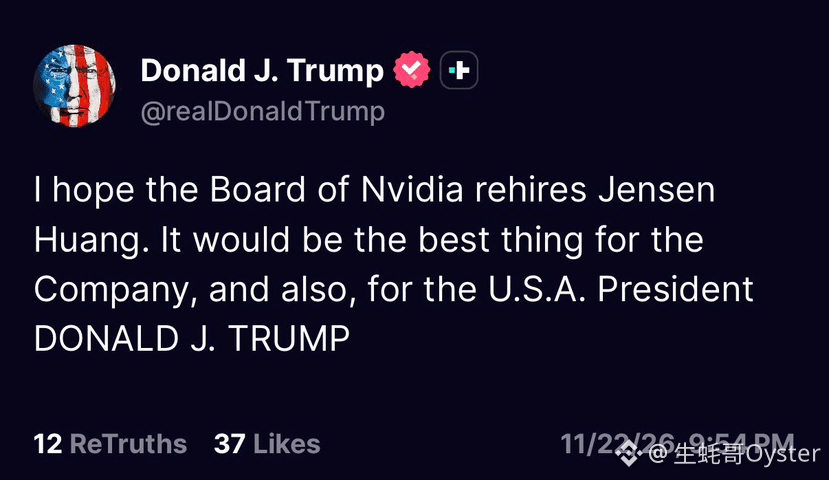

Trump once again put it bluntly:
“Bring Jensen Huang back. It would be best for the company, and best for America, too.”
This is no mere courtesy.
Trump did indeed post this on Truth Social. The original said, in essence: “I hope the Board of Nvidia rehires Jensen Huang. It would be the best thing for the Company, and also, for the U.S.A.”
Now that the AI arms race has become a nation-level contest, Nvidia is more than just a company—it is the core engine keeping America at the forefront of computing power. Jensen Huang transformed the company from a small graphics-card maker into a giant that nearly monopolizes the global high-end AI chip market. The ability to go from zero to one, then from one to a hundred, isn’t something you can replicate by simply bringing in another professional manager.
No one is perfect, and he has indeed made mistakes. An extramarital affair and poor management deserve accountability and an apology. But if a country casually shuts out someone who can still create enormous strategic value because of personal shortcomings, the loss may be more than market value—it could mean losing a window of opportunity.
Technological competition isn’t a moral debate. It doesn’t wait.
China won’t slow down because “Jensen Huang isn’t perfect,” and neither will Europe.
The truly harsh reality is this: sometimes you need that “imperfect but capable” person to stay at the table.
What Trump said is really a question for everyone:
Do we want leaders who are “morally flawless,” or leaders who can “keep America ahead”?
The answer may not be pretty, but history often sides with results.
What do you think? Should he come back and keep fighting, or should the company undergo a complete overhaul and start from scratch?