


Author: Tranks, Four Pillars
Compiled by: Foresight News TechFlow
Foresight News introduction: In recent years, the crypto market has focused on how protocols return revenue to token holders. From early dividend models to today’s popular buyback-and-burn programs, the market once treated value capture as a magic bullet for driving token prices higher. But can buybacks and burns really translate into genuine excess returns for holders?
The research firm Four Pillars conducted a quantitative analysis of 83 major tokens listed on DefiLlama, examining the actual operating data behind three mechanisms: buybacks and burns, treasury holdings, and staking rewards. The study found that for the vast majority of tokens, nominal returns were entirely offset by token unlocks and inflation over the same period. Net cumulative returns depended largely on the rate of supply growth, rather than on the mechanisms themselves.
Key Takeaways
According to DefiLlama data, among the 83 major tokens selected, 66 have introduced mechanisms that return part of protocol revenue to token holders. Of these mechanisms, 76% were officially launched in 2025 or later. Broadly, they fall into three categories: burn, hold (treasury holdings), and distribution (staking rewards).
Over the past 12 months, protocols returned approximately $2.12 billion in value to holders, with 66% coming from buyback-and-burn mechanisms. And 76% of the total value of buybacks and burns was heavily concentrated in three high-revenue protocols: Hyperliquid, Tron, and Pump.fun. This reflects the fact that large burn totals are driven by top revenue-generating projects’ preference for burns, not by greater value-accrual efficiency inherent to the burn mechanism itself.
Among the 66 tokens with a market cap above $50 million, only 16 had a positive “net accrual yield” (the return rate minus the inflation rate of circulating supply over the same period). The level of net yield does not depend on the type of mechanism chosen, but on the scale of inflationary releases and whether protocol revenue is sufficient to offset the selling pressure from newly released tokens.
An analysis of 39 tokens using burn and hold mechanisms found that the Spearman correlation between net accrual yield and 1-year price performance relative to Bitcoin (BTC) was just +0.29, indicating a weak positive relationship. This means that, at this stage, value capture is just one of many variables affecting token prices.
Value-capture mechanisms still move between narrative and fundamentals. Burns are suited to rewarding ordinary holders, treasury holdings suit protocols that still need funds to expand, and distributions with lockup restrictions suit projects that need to align long-term holders. Designing a mechanism that fits the protocol’s stage of development and clearly communicating its intent are prerequisites for turning value capture into tangible fundamentals.
The crypto market has recently paid unprecedented attention to protocols that return revenue to token holders, commonly through buybacks, burns, and fee distributions. Hyperliquid became the benchmark for this trend by using the vast majority of its revenue to buy back its native token on the open market, after which the number of protocols introducing value-return mechanisms surged.
Of the 83 core tokens selected using DefiLlama data, 66 have already introduced rules for returning part of their revenue to holders, and more than three-quarters of those rules were established after 2025. This article begins by classifying value-capture mechanisms, then examines the concentration of value returned, the actual share captured by holders, and how these mechanisms are reflected in secondary-market prices.
Three Ways to Return Value: Burns, Buybacks, and Distributions
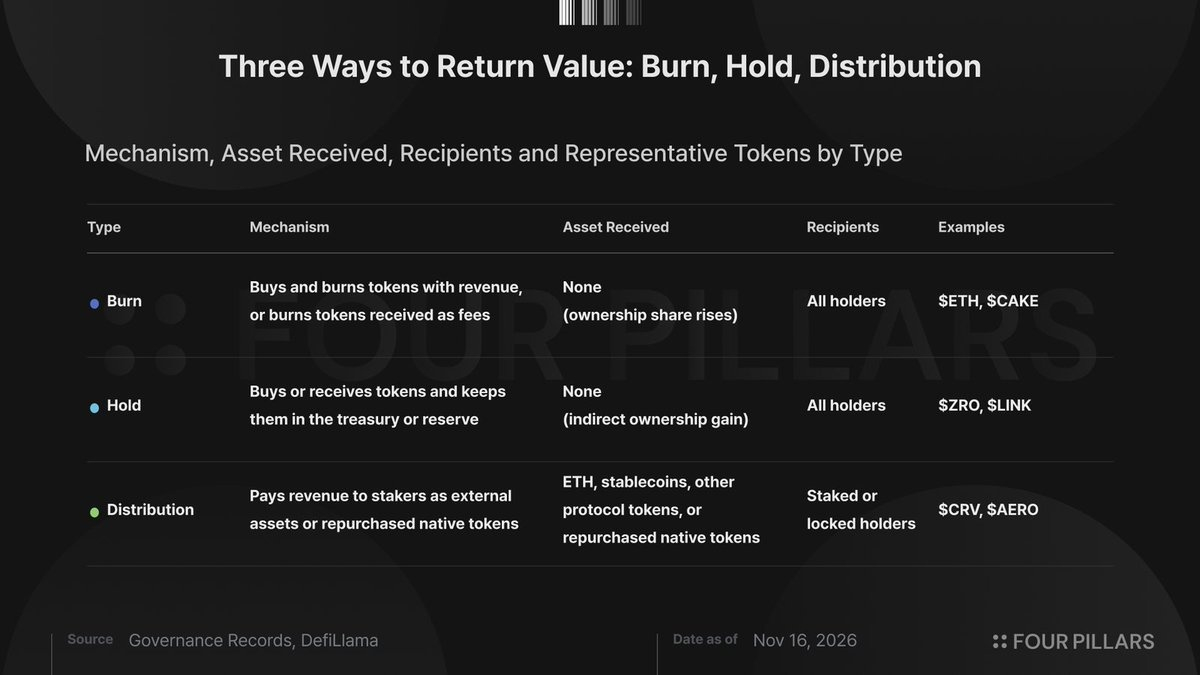
The chart above clearly distinguishes the three main types of value-return mechanisms across three dimensions: how they work, what type of assets holders receive, and who benefits:
The first is buyback and burn (Burn): the protocol uses revenue to buy back tokens on the secondary market and burn them, or sends token fees it receives directly to a burn address. Holders do not directly receive any external assets, but the reduction in total circulating supply passively increases each holder’s ownership share. Examples include ETH and CAKE.
The second is treasury hold (Hold): the protocol uses revenue to buy back its native token, or collects native tokens, and keeps them in the protocol treasury or reserve fund. Holders likewise receive no external assets directly, but benefit indirectly through an increased ownership share. Examples include ZRO and LINK.
The third is distribution (Distribution): the protocol directly distributes revenue to stakers in the form of external assets (such as ETH or stablecoins) or repurchased native tokens. Only holders who stake or lock up their tokens are eligible to receive these distributions. Examples include CRV and AERO.
As of November 2026, the 83 sample tokens selected for this study are primarily associated with protocols on DefiLlama that had annualized revenue of at least $10 million or returned at least $1 million to holders. Of these, 66 tokens were confirmed to have explicit value-return rules. Notably, a single protocol is not necessarily limited to just one mechanism. For example, Sky (formerly MakerDAO) uses its net surplus both to buy back tokens and distribute them to stakers, and to buy back and burn some tokens directly.
Value Returns Are Highly Concentrated in Three Major Burn Protocols
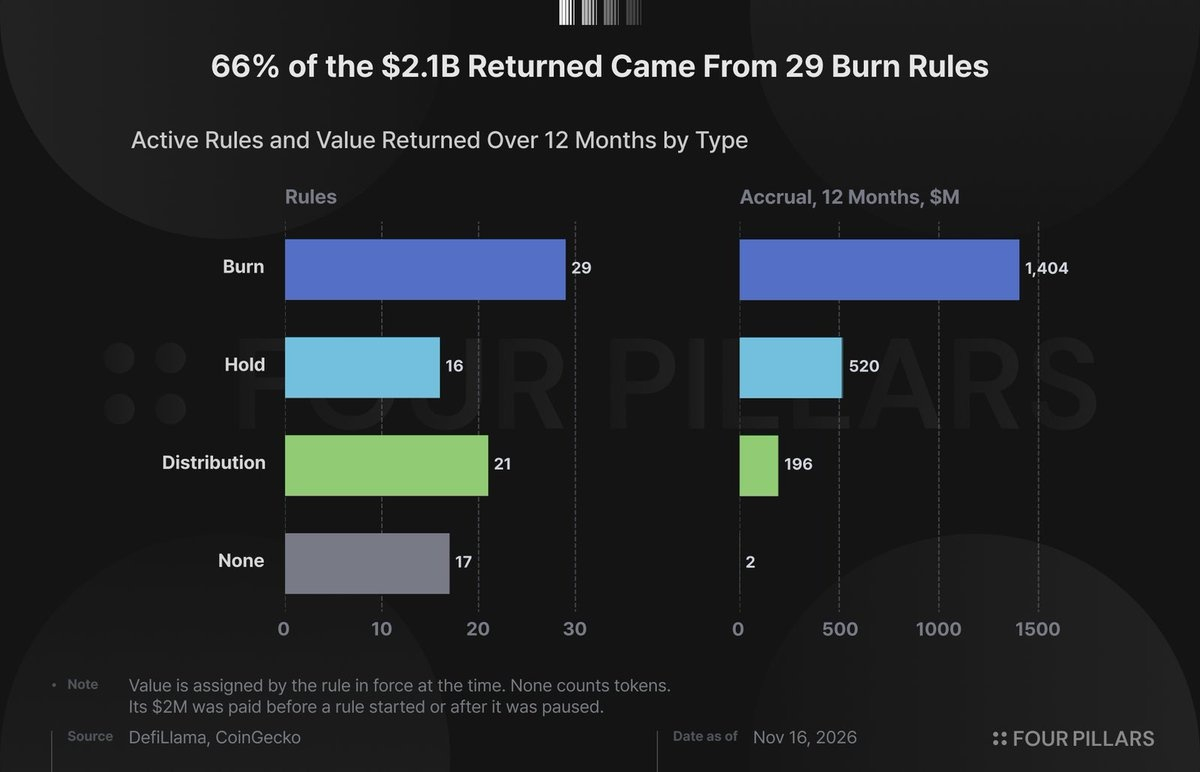
A breakdown of the specific rules for the 66 tokens shows that 29 use burns, 16 use treasury holdings, and 21 use distributions. But the value returned is heavily skewed in terms of dollar amounts. Of the $2.12 billion returned over the past 12 months, buybacks and burns accounted for $1.404 billion, or as much as 66%.
More importantly, 76% of the total burn amount came from just three mega-protocols: Hyperliquid contributed $602 million, Tron $333 million, and Pump.fun $133 million. In other words, burns dominate the data not because the mechanism captures value more efficiently, but simply because the three most profitable cash-cow protocols in the ecosystem have all chosen the burn model.
By comparison, distribution mechanisms returned just $196 million, far less than burns and treasury holdings. This is largely because distributions are mainly used by established DeFi protocols from the previous cycle of 2020–2021, such as Curve, Yearn Finance, and Convex, whereas most high-revenue projects launched after 2024 have opted for burns or treasury holdings. However, when returns are measured relative to circulating market cap, distribution mechanisms have the highest accrual yield, since this group is generally made up of high-yield, low-market-cap tokens.
At the same time, distribution mechanisms typically apply only to users who stake or lock up their tokens for the long term, rather than ordinary spot holders. For protocols that distribute native tokens, if the rewards come solely from token emissions, they cannot really be considered revenue distributions.
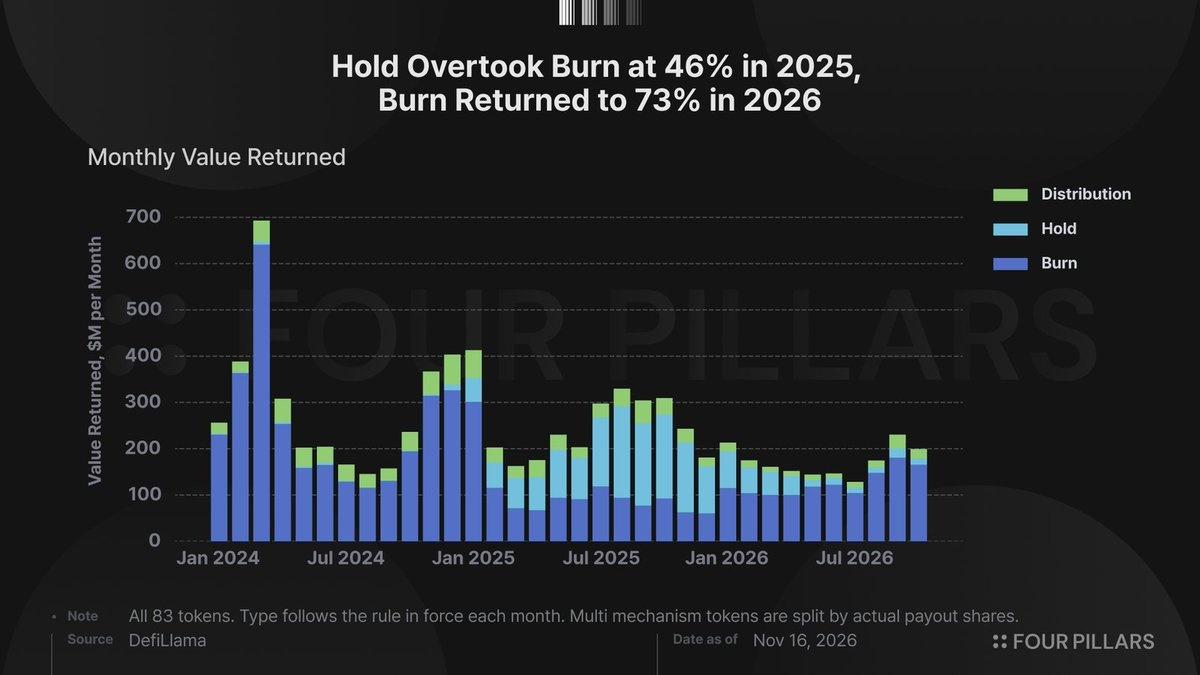
Over time, market shares for the different mechanisms have shifted dramatically from year to year. Burns dominated in 2024; in 2025, treasury holdings briefly overtook them, accounting for 46% of the total; and by 2026, amid an explosion in trading volume in the derivatives and meme sectors, burns had surged back to an overwhelming 73%.
Supply Growth Matters More Than the Amount Returned
Simply focusing on how much a protocol has returned reveals only half the picture of a token’s fundamentals. If a protocol buys back $10 million worth of tokens, but during the same period issues $50 million worth of new tokens through team vesting unlocks, early-investor sell-offs, and liquidity-mining emissions, then token holders’ interests are still severely diluted in real terms.
To remove the effects of inflation, this study introduces the “net accrual yield” metric: the protocol’s nominal return yield over the past 12 months minus the percentage increase in circulating supply over the same period.
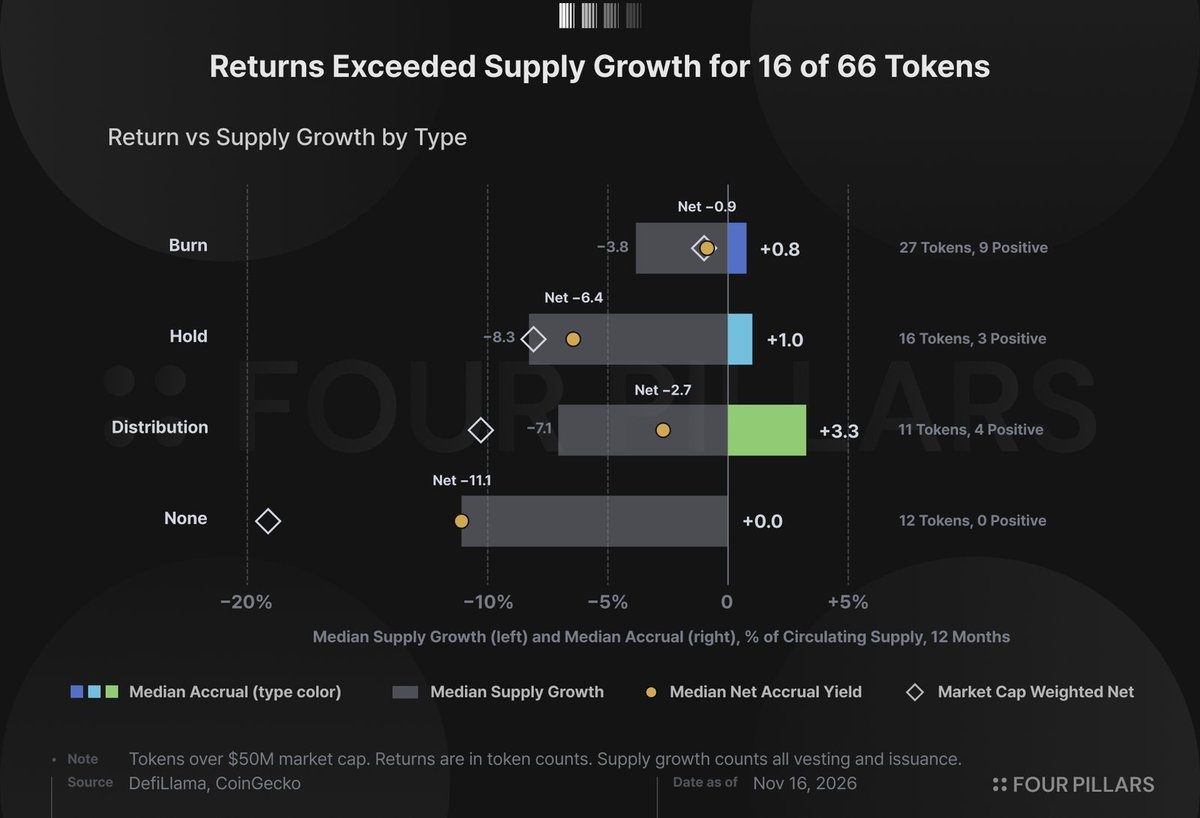
The harsh reality is that of the 66 tokens with value-return mechanisms, only 16 have managed to maintain a positive net accrual yield. This means that for the vast majority of protocols, the pace of revenue returns cannot keep up with the pace at which token unlocks flood the market. The returns supposedly earned by holders are negligible in the face of this supply surge.
By mechanism type, burn mechanisms perform best overall, with a median net accrual yield of −0.9% and a market-cap-weighted average of +0.8%; 9 of the 27 tokens in the sample achieved positive net returns. Treasury-hold mechanisms had a median of −6.4% (−8.3% market-cap-weighted), while distribution mechanisms had a median of −2.7% (−7.1% market-cap-weighted). Tokens with no value-return mechanism at all had a median of −11.1%.
The data show that the key to a positive net accrual yield is not the form of the mechanism, but the absolute scale of token supply inflation and whether the protocol’s actual profitability can cover it. Value-return mechanisms certainly have merit, especially for mature projects that have passed the peak token-unlock period and entered a stable, fully circulating phase. That is when revenue returns can truly translate into solid token fundamentals.
Net Accrual Yield Is Only Partially Reflected in Price
So, can net accrual yield directly boost a token’s secondary-market price? In a backtest of data from the past 12 months, the 16 tokens with positive net yields had a median gain of +3% relative to BTC, while tokens with negative net yields had a median loss of −24% relative to BTC—a clear divergence between the two groups.
At the individual-token level, however, even the 23 tokens in the burn camp showed extremely divergent price performance: Hyperliquid (HYPE) posted a remarkable gain of +158%, while some other tokens that also implement burns plunged by −64%. Of the 9 tokens with positive net yields, 5 failed to outperform BTC. In fact, 2 tokens saw their prices halve even though the nominal value returned amounted to 6% of their circulating market cap.
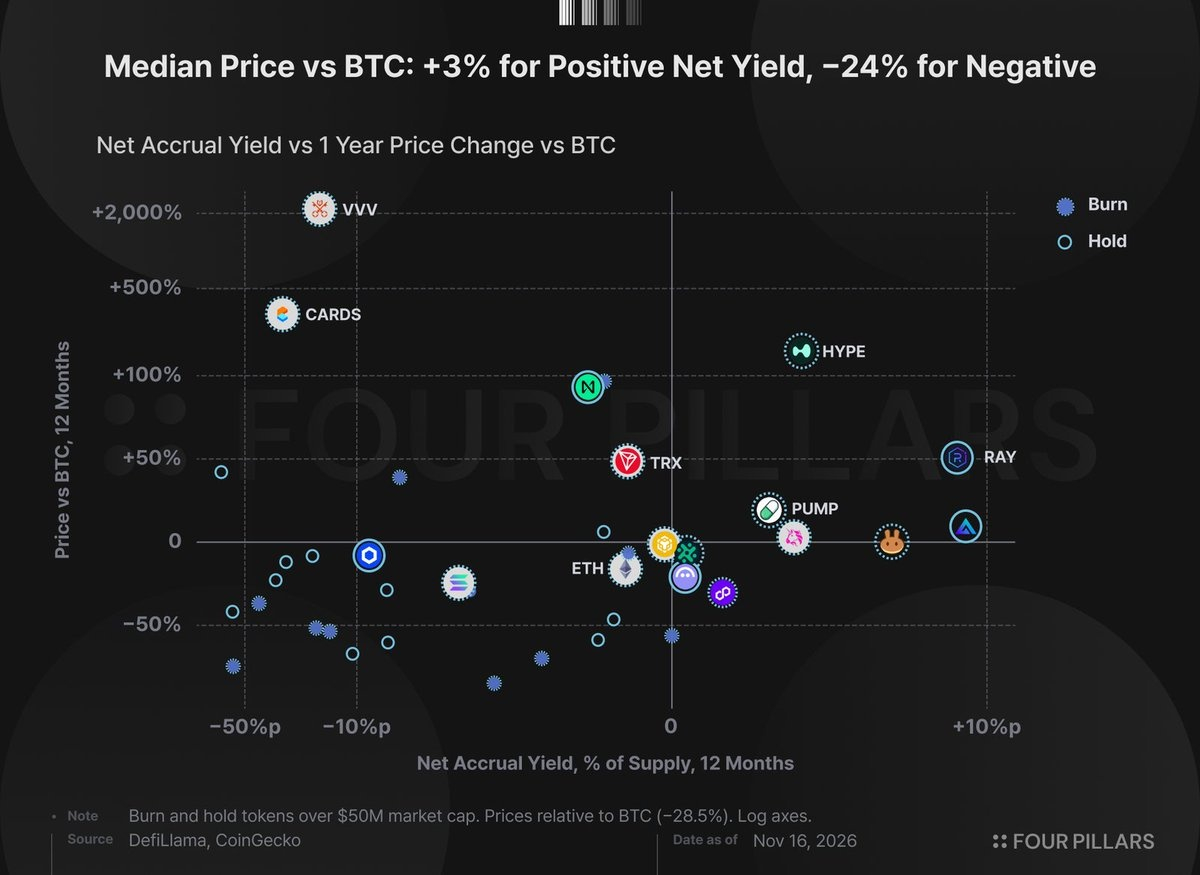
The chart above plots 39 tokens using burn and hold mechanisms, with net accrual yield on the horizontal axis and 1-year price change relative to BTC on the vertical axis. The Spearman correlation between the two is just +0.29, indicating only a weak positive relationship.
This finding shows that value returns can indeed provide some degree of support for token prices during downturns, but their influence on prices remains relatively limited. Token-price movements are still driven more by macro sentiment, sector narratives, market speculation, and unforeseen external events.
The Necessary Conditions for Moving from Narrative to Fundamentals
Token value capture still lies somewhere between narrative-driven fervor and fundamental anchoring. Early in a bull market, simply announcing a buyback-and-burn mechanism can be enough to ignite a wave of enthusiasm. But as tokens mature, the intuitive and immediate boost from buybacks and burns can often make investors path-dependent, while Hyperliquid’s dazzling performance has prompted many projects to treat this approach as a golden rule they must imitate.
However, the significance of value-capture mechanisms cannot be assessed solely in terms of short-term speculation. Behind the return of value to holders, there is an obvious conflict of interest: which mechanism best serves token holders, and which best serves the protocol’s long-term development?
From the holder’s perspective, burns are undoubtedly the most attractive mechanism. Buybacks and burns benefit all token holders unconditionally and permanently remove tokens from circulation. Treasury holdings also indirectly increase each holder’s ownership share, but whether the treasury later sells those tokens for cash depends on governance decisions. Distribution mechanisms pay out cash or tokens, but typically come with strict long-term lockup requirements; holders who receive the native token also bear the risk of its price falling.
From the protocol’s operational perspective, however, the priorities are exactly reversed. Industry giants like Hyperliquid, with abundant cash flow, high profit margins, and a solid team-token allocation structure, can afford to return almost all fees to the ecosystem. But if an early-stage project with limited revenue that still urgently needs capital for protocol development, marketing, and liquidity incentives blindly copies this approach, its future growth momentum could be drained in an instant.
In such cases, treasury holdings are instead the ideal safety net for the protocol. Accumulated token reserves can be used flexibly in the future to respond to unexpected crises, cover development expenses, or fund strategic acquisitions. Likewise, while distribution mechanisms that require users to lock up tokens limit liquidity, they deeply align holders with the protocol’s long-term governance interests and effectively deter short-term arbitrageurs from dumping their tokens and exiting.
There is no universally optimal value-capture mechanism. For highly profitable, mature protocols that have moved beyond their initial expansion phase, buybacks and burns are the natural best choice. For early-stage projects that still need capital to grow, treasury holdings provide the most robust moat. And for protocols that rely heavily on long-term community governance, distributions with lockup periods are the ideal adhesive.
What truly matters is not blindly following the latest popular model, but tailoring a suitable value-capture mechanism to the protocol’s stage of development and value orientation, and communicating the logic behind its design clearly and candidly to the market. When the wave of token unlocks subsides, real revenue can consistently cover operating costs, and holders understand and agree with the design intent, value capture can finally evolve from an abstract narrative into solid protocol fundamentals.