


Artificial intelligence is changing the way people work, businesses operate, and technology is developed. What once seemed like something from the future is now becoming part of everyday life.
One company at the center of this change is Anthropic, the creator of Claude.
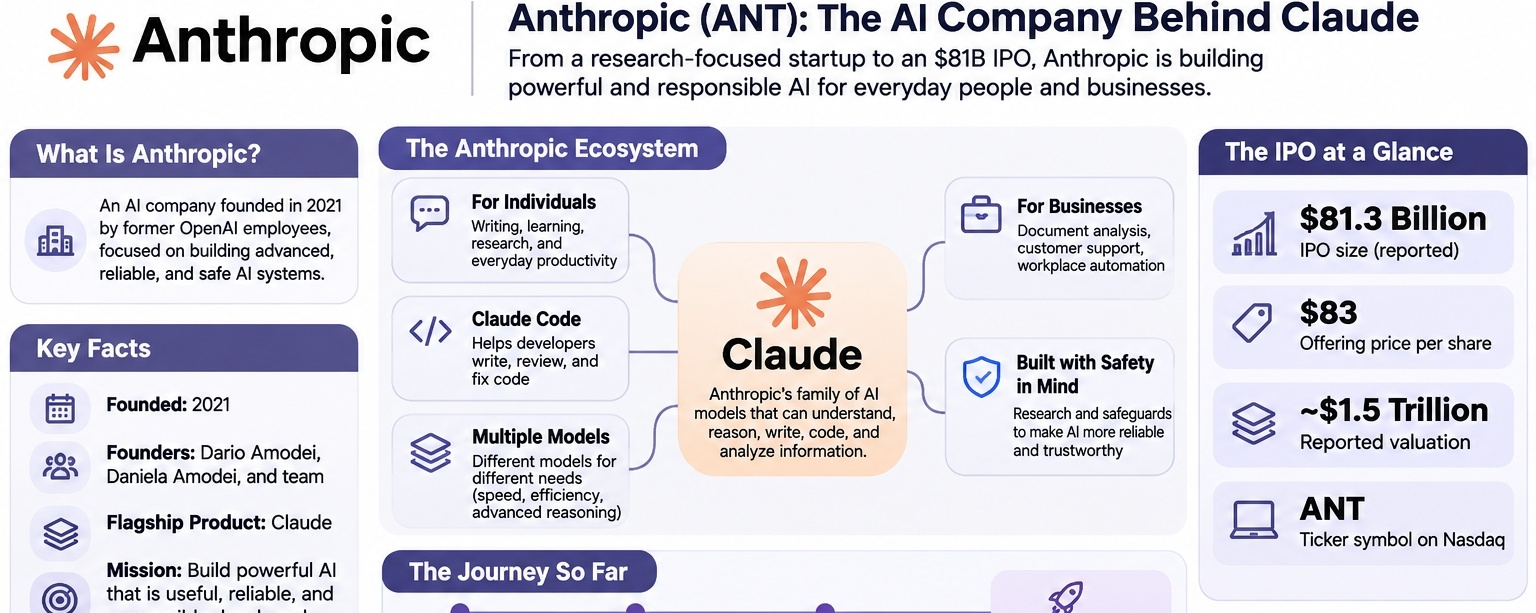
The company's reported $81 billion IPO has attracted attention from investors, technology enthusiasts, and businesses around the world. It is a major moment for Anthropic, but it also tells us something bigger about where the AI industry is heading.
Anthropic has grown from a research-focused startup into one of the most important companies in artificial intelligence. Its journey has been driven by a simple idea: AI should not just be powerful. It should also be useful, reliable, and safe enough for people to trust.
That idea has helped shape the company's products, business strategy, and growing reputation.
How Anthropic Started
Anthropic was founded in 2021 by a group of former OpenAI employees, including Dario Amodei and Daniela Amodei.
The founders wanted to build advanced AI systems while giving serious attention to how those systems behave and how they can be used responsibly.
At the time, artificial intelligence was already attracting considerable interest. But Anthropic believed that making AI more capable was only one part of the challenge.
The other part was making sure people could rely on it.
This thinking became an important part of the company's identity.
Anthropic began developing Claude, a family of AI models designed to understand language, answer questions, analyze information, write code, and help people solve complicated problems.
As Claude improved, the company started moving beyond research and building products for businesses and everyday users.
That decision helped Anthropic become a serious competitor in an industry that was growing faster than many people had expected.
Claude: The Product Behind Anthropic’s Success
Claude is the heart of Anthropic's business.
For everyday users, it can help with writing, research, learning, and organizing information. For businesses, it can assist with tasks such as reviewing documents, analyzing data, writing software, and improving customer support.
What makes Claude particularly interesting is that it can be used in many different ways.
A student might use it to understand a difficult topic. A developer might use it to work through a complicated coding problem. A business might use it to help employees manage large amounts of information.
These are very different needs, but they all create opportunities for the same technology.
Anthropic has developed different Claude models to serve different types of work. Some are designed for more demanding tasks, while others focus on speed and efficiency.
This flexibility gives customers more choice and helps Anthropic reach a wider market.
The company's success is closely connected to how useful Claude becomes in people's daily lives. The more practical value it provides, the stronger the reason for customers to keep using it.
Claude Code and the Changing World of Software Development
One of Anthropic's most important products is Claude Code.
Software development is a natural area for AI because writing and maintaining code often involves time-consuming tasks.
Developers spend hours understanding existing software, fixing errors, reviewing code, and making changes across large projects.
AI tools can help with much of this work.
Claude Code is designed to assist developers with practical programming tasks, allowing them to work with codebases, identify problems, and make changes more efficiently.
For businesses, this could mean faster development and less time spent on repetitive work.
For developers, it offers a way to focus more on solving problems and less on tasks that can be automated.
This is also an important business opportunity for Anthropic.
When a company adopts an AI coding tool and makes it part of its everyday workflow, that tool can become difficult to replace. It may become something employees rely on throughout their working day.
That creates an opportunity for Anthropic to build long-term relationships with business customers.
Of course, the competition is strong. Other technology companies are developing their own coding tools, and Anthropic will need to keep improving Claude Code to remain competitive.
Why Anthropic’s Revenue Growth Matters
Anthropic's financial growth is one of the main reasons investors have become interested in the company.
According to reported financial figures, its revenue increased significantly throughout 2025 and 2026.
Its annualized revenue run rate reportedly reached approximately $81 billion in October 2026.
A revenue run rate is an estimate based on recent business performance. It does not mean the company has already earned that amount during a full year, but it gives an indication of the pace at which its business is growing.
Anthropic has also attracted a growing number of enterprise customers.
This is important because businesses often need more than a basic AI assistant. They may require AI tools that can handle large workloads, integrate with existing software, and support their employees across different departments.
For Anthropic, these customers represent an opportunity to build lasting commercial relationships.
The growth also suggests that businesses are becoming more comfortable paying for AI products that provide real value.
Instead of treating AI as something to experiment with, many companies are beginning to see it as a tool that can help them work more efficiently.
That change is a major part of Anthropic's business opportunity.
What Makes the $81 Billion IPO So Important?
Anthropic's reported $81.3 billion IPO is a major milestone for the company.
According to reports surrounding the offering, Anthropic raised approximately $81.3 billion through its public listing, with shares priced at $83 and trading under the ticker symbol ANT on Nasdaq.
The reported valuation of approximately $1.5 trillion reflects the expectations investors have for the future of artificial intelligence.
For years, direct investment in Anthropic was largely limited to private funding rounds and institutional investors.
A public listing changes that. It allows a much broader group of investors to participate in the company's future.
But the size of an IPO does not tell the whole story.
Investors will now be looking closely at how Anthropic performs as a public company. They will want to see whether revenue continues to grow, whether expenses remain manageable, and whether the company can eventually generate sustainable profits.
In other words, the IPO is a major achievement, but it is also the beginning of a new challenge.
Anthropic now has to prove that the confidence investors have placed in it is justified.
The Technology Partnerships Behind Anthropic
Building advanced AI systems requires enormous computing power.
It takes specialized chips, large data centers, electricity, and sophisticated infrastructure to develop and operate modern AI models.
Anthropic has established partnerships with major technology companies to help meet these needs.
These relationships give the company access to computing resources and cloud infrastructure that would be difficult and expensive to build entirely on its own.
They also help Anthropic serve more customers as demand for Claude increases.
However, there is another side to this arrangement.
As Anthropic grows, it becomes increasingly dependent on the availability and cost of the infrastructure it needs.
The company must manage these relationships carefully to make sure it can continue expanding without allowing computing costs to become a major obstacle.
This is one of the less visible but extremely important parts of running an AI business.
The Expensive Side of Building AI
Anthropic's growth is impressive, but building advanced AI is not cheap.
Developing powerful models requires substantial investment in computing infrastructure, research, specialized hardware, and skilled employees.
Even after a model has been developed, running it for millions of users creates ongoing costs.
Every request requires computing resources. As more people use Claude, Anthropic must make sure it has enough infrastructure to handle the demand.
This creates a difficult balance.
The company needs to keep investing in better technology, but it also needs to make sure its business can eventually become profitable.
Reports surrounding Anthropic's IPO have highlighted the enormous cost of computing and infrastructure.
These expenses are a reminder that strong revenue growth does not automatically mean a company is making a profit.
For Anthropic, one of the biggest challenges will be finding ways to serve more customers while making its technology more efficient.
This is a challenge shared by much of the AI industry.
The companies that succeed will not necessarily be the ones that spend the most money. They will also need to turn that investment into products that people are willing to pay for over the long term.
Competition Is Getting Tougher
Anthropic is operating in one of the most competitive areas of technology.
OpenAI, Google, Meta, and several other companies are developing advanced AI systems of their own.
Each is trying to build better products, attract customers, and make its technology a regular part of how people work.
The competition is not limited to large technology companies.
Open-weight AI models are also giving developers more options. Some businesses are exploring ways to build their own AI systems rather than relying entirely on external providers.
This means Anthropic cannot depend on its current success alone.
It will need to keep improving Claude, making its products more useful, and finding ways to deliver value at a competitive cost.
For customers, competition can be a positive thing. It gives them more choices and encourages companies to improve their products.
For Anthropic, however, it means that staying ahead will require constant innovation.
The AI industry is moving quickly, and today's advantage may not last forever.
Why AI Safety Still Matters to Anthropic
Anthropic was founded with a strong focus on AI safety, and that remains an important part of its identity.
As AI becomes more capable, its potential uses continue to expand.
It can help people work more efficiently, support research, and solve complicated problems. But it can also make mistakes, produce misleading information, or behave in ways that people do not expect.
For businesses, these concerns are especially important.
A company using AI to analyze documents or support important decisions needs to know that the technology is dependable.
Anthropic's approach includes research into how AI models behave and how their outputs can be made more reliable.
The company is also structured as a public benefit corporation, reflecting its stated intention to consider public benefit alongside commercial success.
Maintaining that commitment while operating a large, publicly traded company will not always be easy.
Investors will expect growth, customers will expect reliable products, and the company will need to keep investing in responsible AI development.
Balancing these priorities will be an important part of Anthropic's future.
What Anthropic’s IPO Means for the Future of AI
Anthropic's public listing is about more than one company's financial success.
It reflects the growing role of artificial intelligence in the global economy.
Businesses are increasingly exploring how AI can help employees work faster, automate repetitive tasks, and manage complicated information.
That creates opportunities for companies building the technology behind these tools.
Anthropic is positioned in several important areas, including AI assistants, software development, and enterprise automation.
If demand for these products continues to grow, the company could benefit from a much larger market.
But there are still important questions.
Will businesses continue increasing their spending on AI? Can companies like Anthropic reduce the cost of running advanced models? Will customers remain loyal as new products enter the market?
The answers will help determine how the AI industry develops over the coming years.
For Anthropic, the opportunity is significant, but so is the responsibility.
It must continue building useful products while managing the financial and technological challenges that come with operating at this scale.
Conclusion
Anthropic's reported $81 billion IPO marks an important moment in the development of artificial intelligence.
The company has grown from a research-focused startup into a major AI business, with Claude at the center of its expansion.
Its success reflects a growing demand for AI tools that can do more than answer questions. Businesses want systems that can help them complete real work, improve productivity, and solve problems more efficiently.
Anthropic has made meaningful progress toward meeting that demand.
But its next chapter will be about more than growth.
The company will need to manage the high cost of AI development, remain competitive, and show that its technology can create lasting value for customers and investors.
Its commitment to responsible AI development will also remain important as its products become more widely used.
The IPO has brought Anthropic into a new stage of its journey. The real test will be whether it can turn its current momentum into a business that continues to grow and deliver value over the long term.
For the AI industry, its story is a reminder that the future of artificial intelligence will be shaped not only by how powerful the technology becomes, but also by how useful, affordable, and trustworthy it proves to be.