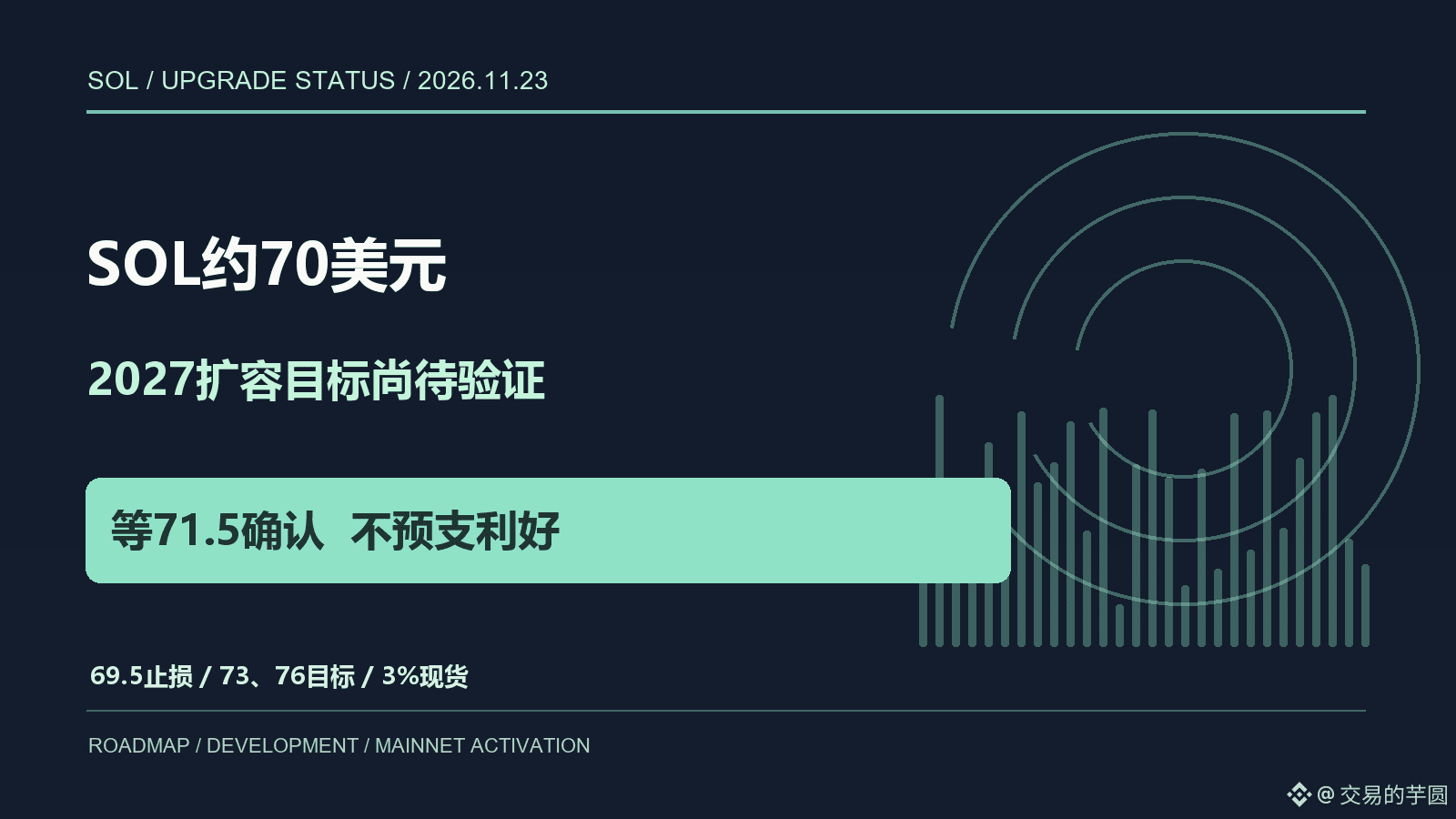
SOL’s 2027 capacity expansion sparks debate | Official upgrade page still lists development items | I’m waiting for confirmation near $70
My view is that the engineering direction is positive, but future capacity targets should not be treated as throughput already achieved today. The trending topic on Binance Square is #SolanaSets2027RoadmapToDoubleComputeCapacity, with discussion focused on the claim that computing capacity will “double” in 2027. After checking the Solana Foundation’s network upgrade status page, the distinction is clearer: sBPFv3 and deeper program calls, planned for release with Agave 4.4 this November, are still marked “In Development”; Agave 4.5, planned for December, is also still in development and is expected to raise the number of accounts a single v1 transaction can reference from 64 to 96. By contrast, Alpenglow in Agave 4.3 and some optimizations in Agave 4.1 are listed on the official site as already running on mainnet. Roadmaps, client versions, and network features that have actually been activated should not be conflated into a claim that “everything launches today.”
What does this mean for SOL? A higher account limit can help complex transactions bundle multiple steps into a single transaction, while deeper program calls give applications more flexibility to compose. But developers need to adapt, validators need to upgrade, and the features still have to complete the activation process. The “Optimized Token Program” already live on the official site says that certain token operations save 95% to 98% of compute units; that does not mean the actual transaction volume of the entire chain will immediately increase by the same percentage. Trending discussions often mix up compute capacity per second, per-block limits, and ordinary transfer fees, but these three metrics measure different bottlenecks. I’ll first look at the official upgrade status, actual on-chain usage, and network stability, then assess whether the capacity expansion is translating into sustained demand.
The market reaction so far offers no clear directional signal. At the time of writing, SOL/USD on Kraken was around $70.23, with a 24-hour low of $68.59 and high of $71.29. The price is near the upper end of the range but has not broken out. Farside’s U.S. SOL fund data for November 20 showed combined net outflows of $5.9 million, indicating that interest in the trending topic has yet to translate into net institutional inflows. My levels to watch are a confirmed break above $71.5, short-term support near $69.5, and the lower end of the range at $68.5. If the price moves above $71.5 but then falls back below $69.5 on an hourly close, I’ll withdraw my short-term bullish view; if $68.5 gives way, capital preservation comes first.
If I were trading this myself: I would stay out for now. The only direction I’d consider is a small, unleveraged spot long, with an initial position equal to 3% of total trading capital. The entry trigger is an hourly close holding above $71.5, followed by a retest of $71–$71.5 that holds, with no sudden security rollback announcement on the official upgrade page; otherwise, I’ll remain in cash. I’d take half off at the first target of $73, then half of the remainder at the second target of $76. I’d close the rest entirely if an hourly close falls back below $71.5. The hard stop is $69.5, where I’d exit the entire position. If the price breaks below $68.5 before entry, I’ll cancel this bullish plan. This plan is based only on observable prices and risk; a 2027 projection should not be counted as today’s gains in advance.
#SolanaSets2027RoadmapToDoubleComputeCapacity #SOL
The above is only my personal market observation and does not constitute investment advice.