Miners are going through the toughest day on record—and the numbers keep getting worse.
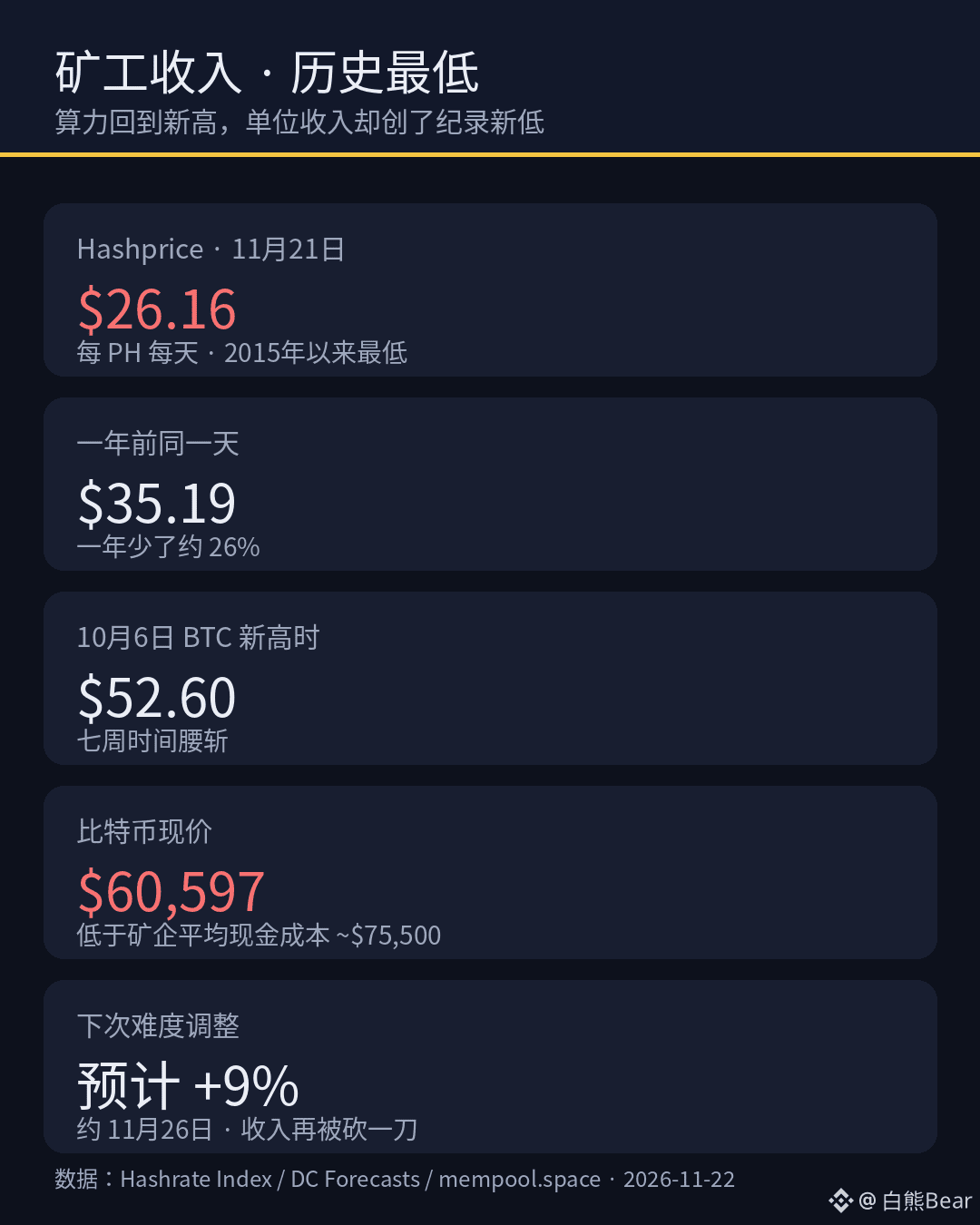
On November 21, hashprice fell to $26.16/PH/day. Hashrate Index reported that figure, while DC Forecasts independently calculated $26.20—two sources, almost exactly the same. It’s the lowest level since records began in 2015, well below the previous low of $27.72 on June 30.
The year-over-year comparison stings even more: on the same day last year, hashprice was $35.19, meaning miners’ revenue per unit of computing power is down about 26% in a year. On October 6, when Bitcoin hit a record high of $126,296, hashprice was still $52.60. In seven weeks, it was cut in half. Bitcoin plunged to around $55,100 on Saturday before bouncing back. It’s now at $60,597, but hashprice hasn’t followed suit—the difficulty adjustment hasn’t had time to catch its breath, and revenue is already pinned to the floor.
Breaking down the numbers, the squeeze is coming from three directions. First, the halving: in April 2024, the block subsidy was cut to 3.125 BTC. The day before the halving, hashprice was still $104. Second, transaction fees have all but disappeared. The average block contains 3.142 BTC, of which fees account for just 0.017 BTC—less than 0.5%. Miners are now almost entirely reliant on the block subsidy. Third, competition hasn’t let up. Difficulty is 134.82T, far above the roughly 86T at the time of the halving. Difficulty was just lowered by 9.13% on November 14, giving miners a brief respite, but hashrate promptly climbed back to 1.065 ZH/s. Blocks are averaging 9.1 minutes, faster than the 10-minute target.
The toughest part is that even the latest-generation machines are left with only single-digit profits. At an electricity rate of $0.10 per kWh, an S23 Hydro 3U nets $6.29 a day, a Sealminer A4 Ultra $4.92, and an S23 XP $4.12. Those figures are after electricity costs; older machines aren’t even worth calculating for—they should simply be switched off. CoinShares estimated that publicly listed mining companies have an average cash cost of about $75,500 per bitcoin. With Bitcoin at $60,597, it’s already below that cost line. Miners either have to shut down or sell their coins to stay afloat.
And the next blow is already on its way: the next difficulty adjustment is expected around November 26, with an estimated increase of about 9%—another cut to revenue that’s already at a record low. The strangest thing is that hashrate hasn’t fallen along with the price. On November 14, hashrate briefly dropped to 912 EH/s, and people thought a wave of shutdowns had begun. But within days, it bounced back. Some miners are holding on; others are waiting for someone else to go under first.
My take is that miner selling pressure is one of the easiest sources of selling to overlook in the coming weeks. Historically, extreme hashprice levels often show up near cycle bottoms. But a bottom doesn’t form in a single day—it takes a wave of miners exiting the market. Mining machine prices have fallen by as much as roughly 30%, which shows that some miners have left; it just hasn’t been the major wave yet.
I’ll be watching three things next: how much difficulty rises around the 26th; whether hashrate turns down again, which would signal a wave of shutdowns; and whether publicly listed miners accelerate their coin sales. I’ll also be watching to see whether transaction fees can recover from their current share of 0.5%—a figure that’s practically nothing.
Do you think miners holding on through this downturn is a signal to buy the dip, or proof that the bottom hasn’t come yet?
$BTC #比特币挖矿 #MinerRevenue
On November 21, hashprice fell to $26.16/PH/day. Hashrate Index reported that figure, while DC Forecasts independently calculated $26.20—two sources, almost exactly the same. It’s the lowest level since records began in 2015, well below the previous low of $27.72 on June 30.
The year-over-year comparison stings even more: on the same day last year, hashprice was $35.19, meaning miners’ revenue per unit of computing power is down about 26% in a year. On October 6, when Bitcoin hit a record high of $126,296, hashprice was still $52.60. In seven weeks, it was cut in half. Bitcoin plunged to around $55,100 on Saturday before bouncing back. It’s now at $60,597, but hashprice hasn’t followed suit—the difficulty adjustment hasn’t had time to catch its breath, and revenue is already pinned to the floor.
Breaking down the numbers, the squeeze is coming from three directions. First, the halving: in April 2024, the block subsidy was cut to 3.125 BTC. The day before the halving, hashprice was still $104. Second, transaction fees have all but disappeared. The average block contains 3.142 BTC, of which fees account for just 0.017 BTC—less than 0.5%. Miners are now almost entirely reliant on the block subsidy. Third, competition hasn’t let up. Difficulty is 134.82T, far above the roughly 86T at the time of the halving. Difficulty was just lowered by 9.13% on November 14, giving miners a brief respite, but hashrate promptly climbed back to 1.065 ZH/s. Blocks are averaging 9.1 minutes, faster than the 10-minute target.
The toughest part is that even the latest-generation machines are left with only single-digit profits. At an electricity rate of $0.10 per kWh, an S23 Hydro 3U nets $6.29 a day, a Sealminer A4 Ultra $4.92, and an S23 XP $4.12. Those figures are after electricity costs; older machines aren’t even worth calculating for—they should simply be switched off. CoinShares estimated that publicly listed mining companies have an average cash cost of about $75,500 per bitcoin. With Bitcoin at $60,597, it’s already below that cost line. Miners either have to shut down or sell their coins to stay afloat.
And the next blow is already on its way: the next difficulty adjustment is expected around November 26, with an estimated increase of about 9%—another cut to revenue that’s already at a record low. The strangest thing is that hashrate hasn’t fallen along with the price. On November 14, hashrate briefly dropped to 912 EH/s, and people thought a wave of shutdowns had begun. But within days, it bounced back. Some miners are holding on; others are waiting for someone else to go under first.
My take is that miner selling pressure is one of the easiest sources of selling to overlook in the coming weeks. Historically, extreme hashprice levels often show up near cycle bottoms. But a bottom doesn’t form in a single day—it takes a wave of miners exiting the market. Mining machine prices have fallen by as much as roughly 30%, which shows that some miners have left; it just hasn’t been the major wave yet.
I’ll be watching three things next: how much difficulty rises around the 26th; whether hashrate turns down again, which would signal a wave of shutdowns; and whether publicly listed miners accelerate their coin sales. I’ll also be watching to see whether transaction fees can recover from their current share of 0.5%—a figure that’s practically nothing.
Do you think miners holding on through this downturn is a signal to buy the dip, or proof that the bottom hasn’t come yet?
$BTC #比特币挖矿 #MinerRevenue