BTC Reclaims $60,000 | OCC Stablecoin Applications Still Not Open | I’m Waiting for Breakout Confirmation
My stance is cautiously bullish, but I won’t treat the regulatory process as ready-made buying pressure. The trending topic on Binance Square is #BTCReboundsAbove$60KAmidWhaleDipBuying, with discussion focused on whales buying the dip and BTC returning to the $60,000 mark. I’m more interested in whether sustained spot demand can support the rebound. BTC/USDT is currently around $60,950 on Binance Spot, up about 1.4% over the past 24 hours, with a range of $58,769 to $61,670. The rebound is a real price movement, but whether whales continue to be net buyers requires more verifiable on-chain or disclosure evidence; it can’t be inferred directly from a trending topic.
Another fact worth watching closely this week is the US Office of the Comptroller of the Currency (OCC) request for comment on application materials for stablecoin licenses. A correction notice in the Federal Register dated October 29 states that comments must be received by November 23. The OCC website also makes clear that it is not yet accepting applications or requests for exemptions from payment stablecoin issuers. It must first receive approval from the Office of Management and Budget for the information collection, after which the OCC will issue a separate announcement. In other words, the comment deadline is a step in the administrative process. It does not mean licensing starts that day, much less that any particular institution has already been approved. The effective date of the OCC’s final rule issued in October is January 18, 2027; it should not be described as taking full effect today.
Why does this matter for BTC? If compliant dollar stablecoins gradually gain a clearer framework for issuance and redemption, that could improve dollar liquidity on trading venues and expectations for institutional access. But reserve assets are primarily there to back stablecoin redemptions; they won’t automatically flow into Bitcoin. BTC’s move back above $60,000 shows that risk appetite has partly recovered from last week’s sharp drop. The price has yet to decisively break above the 24-hour high of $61,670, so I see this as a period for monitoring the rebound, not as confirmation of a trend reversal. If regulatory applications continue to be delayed or dollar liquidity tightens, prices could quickly give back their gains even if attention keeps increasing.
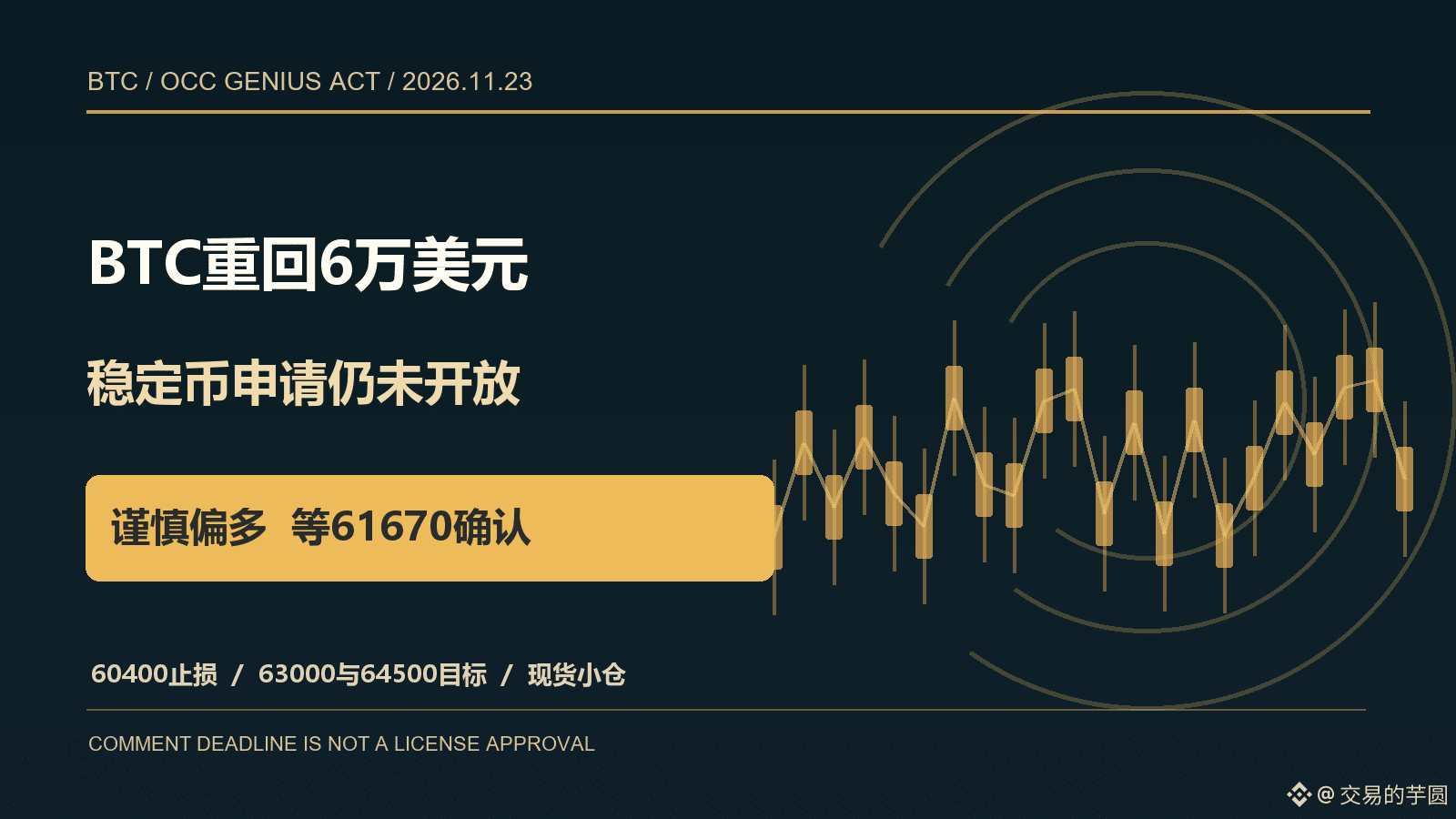
If I were trading this myself, I wouldn’t chase the price right now. I’d only consider a trend-following spot long, with each position capped at 8% of total capital and no leverage. My trigger would be BTC breaking above $61,670 on increased volume, then pulling back and holding above $61,300; I’d enter in two tranches. I’d first target $63,000 and sell half there, then target $64,500 with the stop-loss on the remaining position moved near the entry price. I’d set the initial stop-loss at $60,400. If the daily price closes back below $60,000 or quickly falls below $60,400 after the breakout, I’d close the entire position. If the trigger isn’t met, I’d stay flat. The point of this plan is to limit losses if my judgment is wrong, not to guess which candle marks the bottom.
This is solely my personal market observation and does not constitute investment advice.