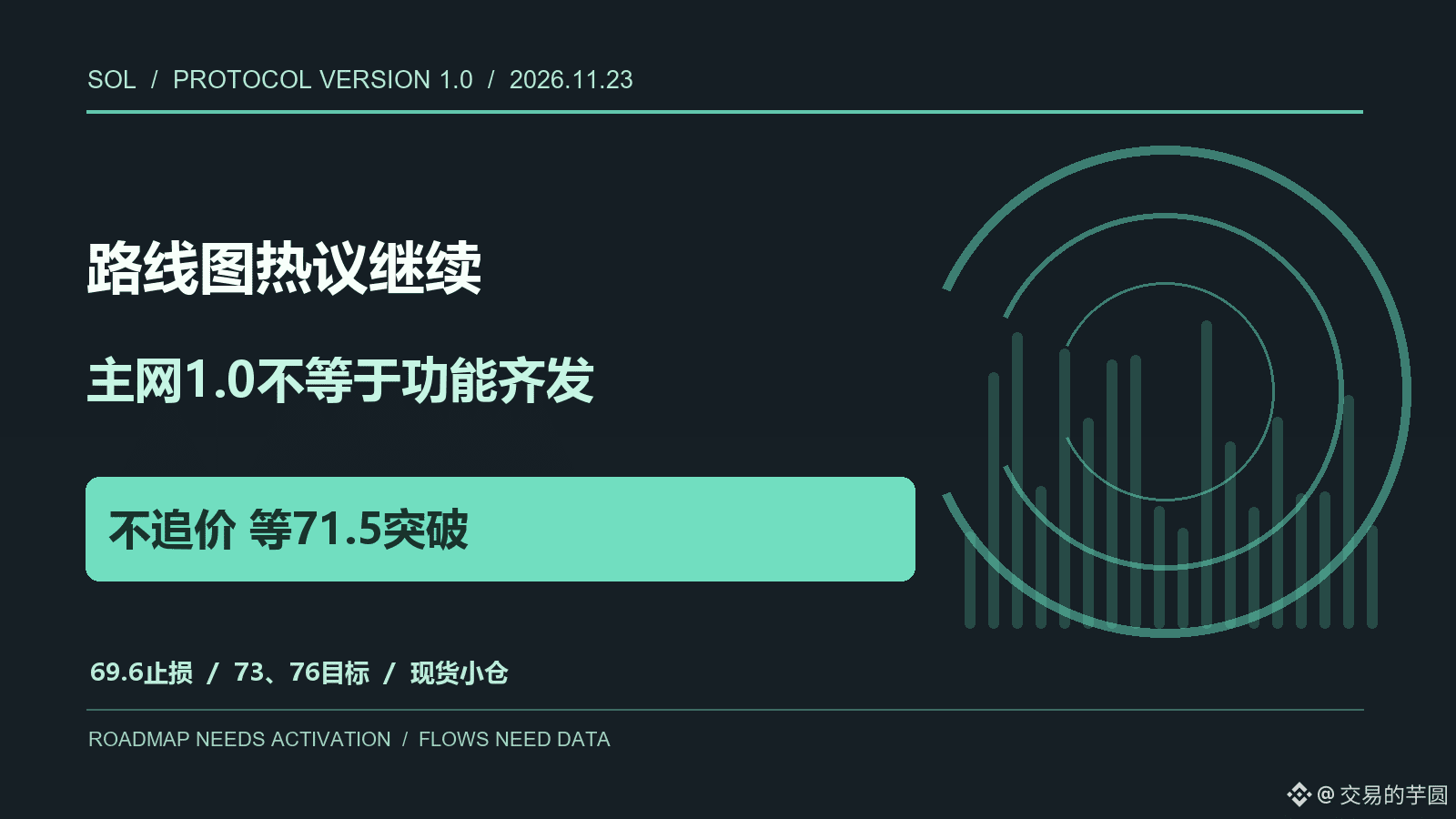
SOL roadmap discussion continues|Mainnet 1.0 marks a protocol naming milestone|Reconfirmation above 71.5
My stance is to watch cautiously and not treat a roadmap headline as network computing power that has already increased today. Discussion of the trending topic on Binance Square, #SolanaSets2027RoadmapToDoubleComputeCapacity, is still gaining momentum. This time, I’m checking a more fundamental question: Solana Foundation’s official statement on November 16 said that Solana 1.0 formally drops the “mainnet beta” name, establishing a shared protocol version for the network that is independent of validator client software versions such as Agave and Firedancer. For ordinary users, it is still the same network; SOL, accounts, assets, applications, and transaction history are all unchanged. The Foundation also explicitly stated that announcing a protocol version does not mean all related improvements are activated at the same time.
Why is this detail worth noting? When different clients implement the same consensus rules on a blockchain, a protocol version can help node operators confirm compatibility more clearly and reduce the misconception that “one client upgrading means the whole network has upgraded.” The Foundation distinguishes Alpenglow, which is already live on mainnet, and the independent client Firedancer from the roadmap ahead: the former are developments on the existing network, while Rotor, Constellation, and others still depend on their respective client releases, node deployments, and feature activations. “Double computing capacity in 2027” in the trending topic describes a future goal. It cannot be presented as meaning throughput has already doubled today, much less automatically imply that demand for spot SOL has doubled.
A faster, more stable network can benefit payments and tokenization experiments, but user transaction volume, on-chain fees, and returns for SOL holders are not the same thing. If applications remain limited to demos or testing, short-term prices will not necessarily benefit. The Solana Foundation’s Breakpoint recap mentions the 2027 roadmap, corroborating the direction and current status described in the 1.0 statement, but offers no guarantee of returns. Farside’s figures showing approximately $5.9 million in net outflows from U.S. SOL funds on November 20 also remind me not to treat a technical narrative as a return of institutional capital.
SOL/USDT on Binance is around $70.73, nearly flat over 24 hours, with a range of approximately $68.74 to $71.43. The price has not broken above the upper end of the range, so confirmation is still pending. I regard 71.5 as the confirmation level and 69 as the defense level. If the price falls below 69 and cannot recover within four hours, the rebound thesis is invalidated; if the official upgrade tracker shows Rotor or Constellation being pushed back, the technical catalyst also needs to be reassessed.
If I were trading this myself, I would not chase the price right now. The only direction I would consider is a small spot long, with no more than 2% of total capital allocated to a single trade. The entry trigger is SOL/USDT breaking above $71.5 and holding near $71.2 on a retest, while the order book spread remains normal; if that trigger does not occur, I stay out of the market. The first target is $73, where I would sell half; the second target is $76, where I would sell half of the remaining position. I would set the initial stop loss at $69.6 and close the entire position if a four-hour candle closes below $69.6 after entry; if 69 is lost first, the long setup is canceled outright. Even if the topic gains more attention, I would not increase leverage. I would wait for actual feature activation and confirmation from capital flow data before revising my view.
Sources: Solana Foundation’s official 1.0 statement and Breakpoint recap, Binance spot market data, and Farside fund flow table. #SolanaSets2027RoadmapToDoubleComputeCapacity #SOL
The above is only my personal market observation and does not constitute investment advice.