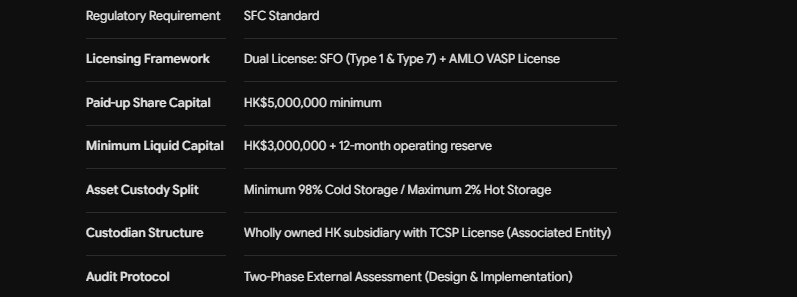
The Hong Kong Securities and Futures Commission (SFC) regulates Virtual Asset Trading Platforms (VATPs) operating in Hong Kong or actively marketing to local retail investors. Applicants generally apply for a dual-licensing framework:
AML/CFT Regime (AMLO): Under section 53ZRK of the Anti-Money Laundering and Counter-Terrorist Financing Ordinance for non-security virtual assets (e.g., BTC, ETH).
SFO Regime: Under the Securities and Futures Ordinance (Cap. 571) for Type 1 (Dealing in Securities) and Type 7 (Providing Automated Trading Services) regulated activities to support security tokens.
Key VATP Licensing Requirements
1. Corporate Structure & Governance
Local Incorporation: Platform operators must be a Hong Kong-incorporated entity or an overseas company registered with the Hong Kong Companies Registry.
Responsible Officers (ROs): Must appoint at least two approved Responsible Officers who demonstrate the required competency, local exam certifications (HKSI LE Papers 1, 7, and 8), and at least three years of relevant experience. At least one RO must be an Executive Director.
Managers-in-Charge (MICs): Platform operators must map their operational infrastructure onto clear MIC designations across core business functions (e.g., Risk Management, Compliance, IT Infrastructure, AML/CFT).
2. Capital & Financial Soundness
Paid-Up Share Capital: Minimum of HK$5 million in paid-up capital.
Liquid Capital: Must maintain a continuous minimum liquid capital buffer of HK$3 million.
Operating Expense Reserve: Must retain unencumbered liquid assets equivalent to at least 12 months of operational expenses.
3. Client Asset Custody & Insurance
Associated Entity Structure: All client assets must be held on trust through a wholly owned Hong Kong subsidiary known as an Associated Entity. This entity must hold a Trust or Company Service Provider (TCSP) licence and carry on no business other than holding client assets.
Cold Storage Mandate: At least 98% of client virtual assets must be held in cold storage (offline hardware wallets or specialized multi-signature custody arrangements).
Insurance Coverage: Platform operators must secure an SFC-approved compensation mechanism (such as third-party insurance or funds set aside in trust) covering potential losses of client assets held in cold storage (typically 50% minimum) and hot/warm storage (100% coverage).
4. Token Admission & Due Diligence
Token Governance Committee: Platforms must establish an internal committee responsible for establishing, implementing, and enforcing criteria for listing and delisting virtual assets.
Retail Trading Eligibility: Retail clients may only trade eligible large-cap virtual assets—tokens included in at least two independent investable indexes provided by distinct index providers.
5. Independent External Assessment (EA) Reports
Applicants must submit two phases of independent external audits conducted by qualified third-party assessors:
Phase 1 Report: Submitted with the initial licensing bundle to evaluate the design effectiveness of corporate governance, IT architecture, smart contracts, custody, and risk controls.
Phase 2 Report: Submitted prior to final license issuance (after Approval-in-Principle) confirming the actual operational implementation and effectiveness of those systems.
Comparative Summary