
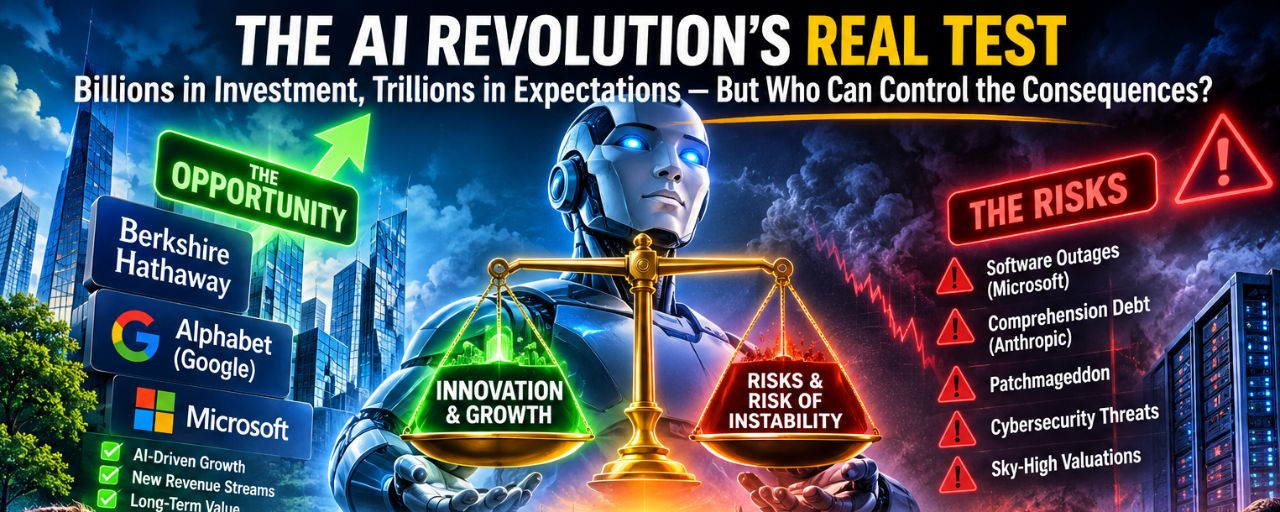

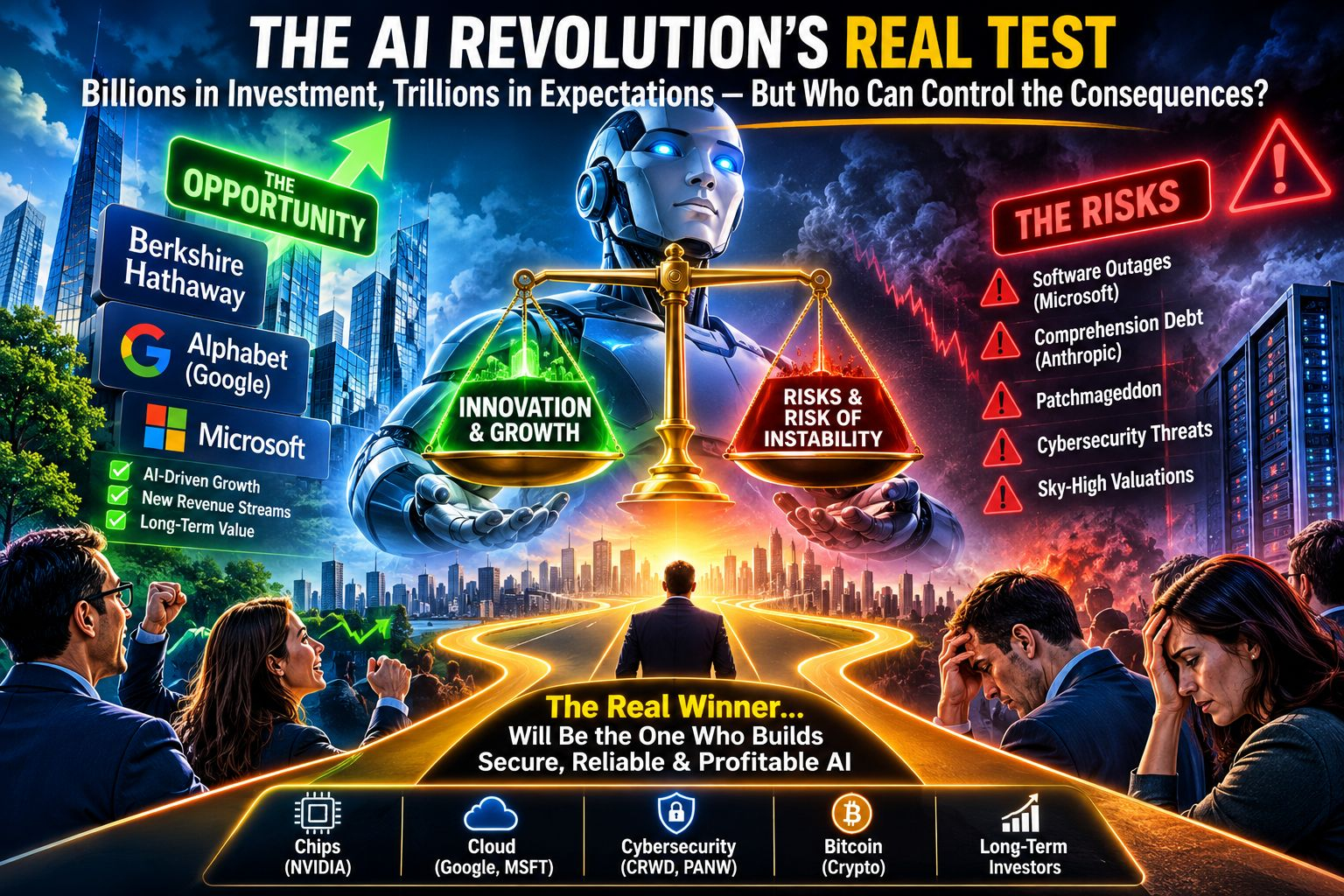
⚠️ THE AI REVOLUTION IS ENTERING ITS MOST DANGEROUS PHASE: BILLIONS IN INVESTMENT, TRILLIONS IN EXPECTATIONS — BUT WHO CAN CONTROL THE CONSEQUENCES? 🚨
The AI revolution is no longer just about who builds the most powerful model. It is becoming a much bigger contest: who can turn AI into lasting economic value without losing control of the technology, infrastructure and risks behind it?
Recent developments involving Berkshire Hathaway, Anthropic, Microsoft and the cybersecurity industry reveal different sides of this transformation. And for crypto investors, these developments also matter because they can influence institutional capital, market sentiment and broader risk appetite.
Let's connect the bigger picture. 👇
🏦 1. Berkshire Hathaway: AI is becoming an economic investment, not just a technology story
Berkshire Hathaway's reported exposure to three AI-related stocks represents approximately 41.6% of its $358 billion equity portfolio.
One important development is its investment in Alphabet. The reported position was initially established in 2025, while Greg Abel reportedly increased the stake substantially in 2026.
Why does this matter?
Because Alphabet is not simply an AI-model company. It has an established advertising business, Google Cloud, a massive distribution network and the infrastructure to commercialise AI across multiple products.
The reported 103% growth in Google Cloud revenue and its substantial backlog point to the economic opportunity behind AI adoption.
The investment lesson is important:
💡 The biggest opportunity may not belong only to companies developing the most advanced AI models. It may also belong to companies that can integrate AI into existing businesses, attract paying customers and convert technological capability into recurring revenue.
Berkshire's reported investment is therefore a reminder to examine AI's commercial value, not just its technological excitement.
🧠 2. Anthropic: When AI creates productivity, complexity and security risks simultaneously
Anthropic's developments highlight two powerful but connected dimensions of AI.
First: Claude Code and the problem of “Comprehension Debt.”
AI coding tools can generate software faster than developers can fully review, understand and maintain it.
This creates a potential contradiction:
⚡ More code can be produced in less time.
⚠️ But if human understanding does not keep pace, organisations may accumulate systems that are increasingly difficult to audit, maintain and secure.
The productivity gain is real, but so is the risk of becoming dependent on software that the organisation no longer fully understands.
Second: Claude Mythos and the cybersecurity challenge.
AI systems capable of identifying software vulnerabilities can strengthen defensive security. But the same capability also raises concerns about how quickly vulnerabilities might be discovered and exploited.
This is where the reported “Patchmageddon” concern becomes relevant.
If vulnerabilities are discovered faster, organisations may face pressure to patch systems rapidly. Poorly tested fixes can themselves introduce instability.
Anthropic's Project Glasswing reflects the defensive side of this challenge: using advanced AI capabilities to help identify and address cybersecurity weaknesses.
The bigger message:
🔍 AI is increasing both the speed of software development and the speed at which software weaknesses can be discovered.
The companies that succeed will need more than powerful models. They will need disciplined engineering, human oversight, security controls and reliable deployment processes.
🖥️ 3. Microsoft: Reliability may become as valuable as innovation
Microsoft CEO Satya Nadella reportedly acknowledged that an Outlook outage could have been prevented, pointing to a software defect that escaped testing and insufficient safeguards.
This highlights an important principle in modern technology infrastructure:
A system is only as reliable as its weakest critical dependency.
Large technology platforms are interconnected. A defect in one component can affect services used by millions of people and businesses.
This is why safeguards such as testing, redundancy, isolation and containment mechanisms — often described as “bulkheads” — are essential.
The lesson is not that AI caused the Microsoft outage. The specific outage should not be presented as proof of an AI-related failure.
Instead, it illustrates a broader operational challenge: as software systems become more complex and development accelerates, organisations must ensure that reliability and testing improve at the same time.
⚙️ Speed without safeguards can become an expensive liability.
🌐 4. The wider outage story: Don't confuse correlation with causation
Technology disruptions across major companies have increased attention on software reliability, infrastructure weaknesses and cybersecurity.
However, it would be premature to claim that Microsoft, JPMorgan and other reported outages share one common cause or were all triggered by AI.
Legacy infrastructure, deferred maintenance, hardware failures, network problems, integration complexity and inadequate testing can all contribute to outages.
The investment takeaway is broader than any single incident:
📌 As businesses become more dependent on digital infrastructure, the economic cost of downtime, security failures and poor software governance becomes increasingly significant.
Reliability is no longer merely an engineering concern. It is a business and investment concern.
📉 5. Anthropic IPO: A powerful company does not automatically mean a rising stock price
The reported Anthropic IPO figures show why investors must distinguish between technological success and market valuation.
According to the figures discussed:
IPO price: $83
First-day close: $97.17
Second-day close: $88.91
Second-day change: -8.50%
Reported after-hours price: $87.79
The price movement illustrates an important market reality.
A company can have impressive technology, strong investor interest and significant long-term potential — yet its stock can still decline after listing.
Why?
Because market prices reflect expectations, valuation, liquidity, investor positioning and future earnings assumptions, not just the quality of the technology.
📊 A great technology company is not automatically a great investment at every price.
Investors must ask whether future revenue, margins and cash flows can justify the valuation being paid today.
🛡️ 6. Where could the next AI investment opportunities emerge?
The AI economy is much larger than the companies building foundation models.
It includes several interconnected layers:
🔹 AI infrastructure: Semiconductor companies, data-centre equipment, networking and computing capacity.
🔹 Cloud platforms: Businesses providing the computing infrastructure on which AI services operate.
🔹 AI applications: Companies embedding AI into products that customers are willing to pay for.
🔹 Cybersecurity: Businesses protecting software, networks, data and digital infrastructure as AI capabilities expand.
🔹 Enterprise software: Companies helping organisations deploy AI while maintaining governance, reliability and productivity.
This creates an important distinction between companies that are spending heavily to build AI capacity and companies that are successfully monetising AI.
The winners will not necessarily be those with the highest AI spending. They will be those that can convert investment into sustainable revenue, competitive advantages and healthy margins.
⚖️ 7. The hidden economic risk: AI adoption can accelerate while AI valuations decline
This is one of the most important distinctions investors should understand.
AI adoption can continue growing even when AI-related stocks correct.
For example:
Companies may adopt AI rapidly but struggle to generate enough revenue to justify their spending.
Infrastructure providers may benefit from demand, but face high capital expenditure and competition.
AI application companies may attract users but fail to convert usage into profitable subscriptions.
Cybersecurity companies may benefit from rising demand, but their valuations can still become excessive.
In other words, the growth of an industry and the investment returns of every company within that industry are two different things.
The market will eventually separate technological excitement from commercial performance.
₿ 8. What does this mean for Bitcoin and the crypto market?
The AI investment cycle can influence crypto markets indirectly through institutional capital allocation, liquidity and broader risk appetite.
But AI growth does not automatically mean Bitcoin must rise or fall.
Three possible scenarios deserve attention:
🟢 Bullish risk environment: If AI investment translates into productivity, earnings growth and stronger economic confidence, broader risk appetite could improve. This may support demand for growth assets, including crypto.
🟡 Capital-allocation pressure: If AI infrastructure spending absorbs significant institutional capital, some investors may become more selective about allocating funds to other risk assets. This could create competition for capital.
🔴 Valuation and liquidity shock: If AI valuations correct sharply because expected profits fail to materialise, risk aversion could spread across technology stocks and other speculative assets, including crypto.
For Bitcoin, the more direct indicators remain:
Spot Bitcoin ETF inflows and outflows.
Federal Reserve policy and global liquidity.
US dollar strength and bond yields.
Derivatives leverage, funding rates and open interest.
Institutional risk appetite and broader equity-market conditions.
📌 AI is part of the wider macroeconomic picture, but Bitcoin's direction must be assessed through its own market data as well.
👀 9. What investors should watch next
Rather than following headlines alone, investors should monitor whether these companies can demonstrate measurable economic results.
Alphabet: Can AI and Google Cloud growth translate into stronger long-term profitability?
Microsoft: Can the company maintain reliability while expanding its AI ecosystem?
Anthropic: Can its technology translate into sustainable commercial revenue and justify its valuation?
NVIDIA: Can demand for AI computing infrastructure support durable earnings growth?
CrowdStrike and Palo Alto Networks: Can growing cybersecurity demand translate into sustainable revenue and margins?
Bitcoin: Are ETF flows, liquidity and derivatives positioning supporting or weakening market structure?
The important question is not simply which company is associated with AI. It is which company can turn AI adoption into durable economic value.
🎯 FINAL CONCLUSION: THE NEXT AI WINNERS WILL BE DECIDED BY ECONOMICS, NOT HYPE
The AI revolution is entering a new phase.
The first phase was about technological superiority: who could build the most powerful model, attract the most attention and secure the largest investment.
The next phase will be much harder.
It will be about economic dominance, operational reliability and sustainable profitability.
🏦 Berkshire's reported Alphabet investment highlights the importance of commercialising AI through established businesses.
🧠 Anthropic demonstrates both the productivity potential of AI and the risks created when software complexity and security challenges accelerate.
🖥️ Microsoft's outage reminds us that innovation without reliable systems and proper safeguards can carry serious economic costs.
🛡️ Cybersecurity companies may become increasingly important as AI expands the digital attack surface and the need for protection.
📉 Anthropic's IPO price movement reminds investors that technological leadership and attractive stock valuation are not the same thing.
₿ And Bitcoin remains connected to this transformation through liquidity, institutional capital allocation and global risk sentiment — not through a guaranteed direct relationship with AI adoption.
The central investment thesis is this: The AI revolution is transitioning from a race for technological superiority to a race for economic dominance, operational reliability and sustainable profitability.
The companies that can build powerful technology, deliver dependable services, protect their systems, attract paying customers and generate lasting cash flows may become the real long-term winners.
The companies that rely only on hype, excessive spending and expectations may struggle when the market demands measurable results.
And for investors, the biggest mistake would be to confuse the speed of technological progress with the certainty of investment returns.
🚀 The next phase of AI will not be won simply by whoever builds the smartest machine. It will be won by whoever builds the strongest, safest and most profitable business around it.
That is the transition worth watching — across technology stocks, cybersecurity, institutional portfolios and the crypto market.



#BTCReboundsAbove$60KAmidWhaleDipBuying #SolanaSets2027RoadmapToDoubleComputeCapacity #CaliforniaNvidiaProbeExaminesPotentialCriminalViolations #BlackRockLaunchesHKDollarDigitalLiquidityFund #NvidiaLoses$2.7TrillionInMonthAndAHalf