Is Binance Earn’s impact on stablecoin borrowing demand in the BNB Chain ecosystem much greater than expected?
After Binance’s promotional campaign offering boosted flexible savings rates following the hack ended this morning, borrowing rates for $USDT and $USDC on ListaDAO @ListaDAO fell accordingly—much more sharply than I expected.
-
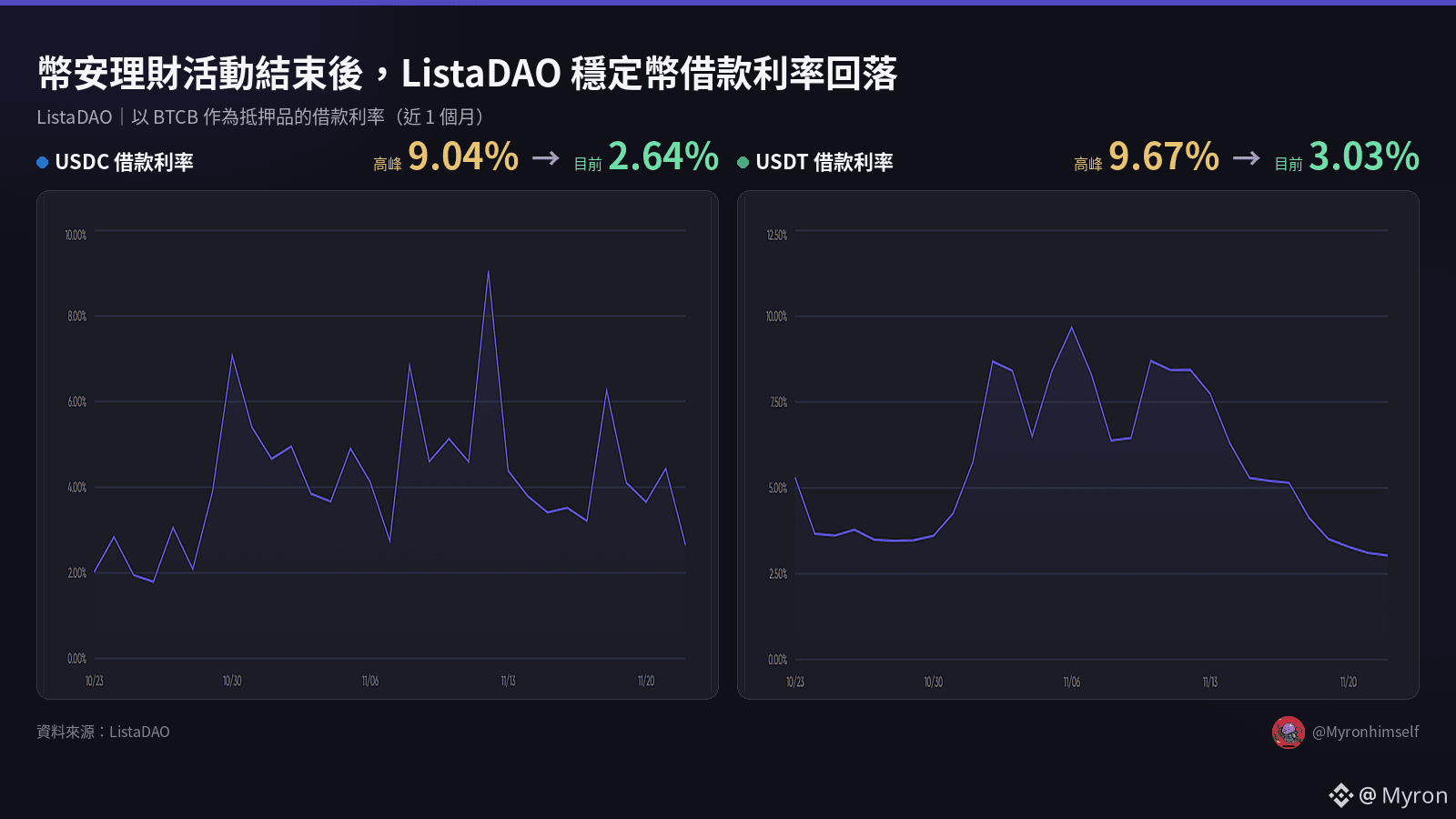
The change was most apparent in the rates for borrowing USDT/USDC against $BTCB collateral on ListaDAO.
$BTCB is ListaDAO’s second-largest collateral asset ($192m), behind only $slisBNB ($381m). The collateral values of both assets are significantly higher than those of other assets.
Recently, thanks to Binance offering flexible savings at around 10% APR, the utilization rates for USDT/USDC borrowed against BTCB on ListaDAO were both above 90%.
Looking at borrowing rates:
> The USDC borrowing rate peaked at 9.04% and is now 2.64%.
> The USDT borrowing rate peaked at 9.67% and is now 3.03%.
USDT’s lower liquidity means its utilization rate is still around 50%; meanwhile, driven by a wave of repayments, USDC utilization has fallen sharply to around 30%.
This shows that BNB Chain is indeed highly tied to changes in Binance’s Earn products, and that the connection between the exchange and the public blockchain is closer than I expected.
-
Binance launched a follow-up promotion today, but both the limits and rates have been reduced. The spread versus on-chain borrowing costs isn’t significant enough, so the borrowing activity on ListaDAO described above is unlikely to continue.
However, the borrowing rate for $USD1 has remained steady in the 1.5%–3% range, making it relatively more manageable. The only catch is that arbitrage opportunities would span multiple chains and exchanges, making things a little more complex.
I still think it’s worth keeping an eye on. After all, as the broader market weakens, bargain-hunting activity will gradually emerge, further increasing demand for BTC as collateral.
-
• The above content does not constitute investment advice. Readers should conduct their own independent research.
• The borrowing rate chart is from ListaDAO.
#ListaDao #BTCB #slisbnb