#sxt $SXT @SpaceandTime
Oh my god, guys, I’ve been building my own AI arbitrage system lately, and the more I research, the clearer one question becomes: If all on-chain data is public, why do we still need a “computation receipt”?
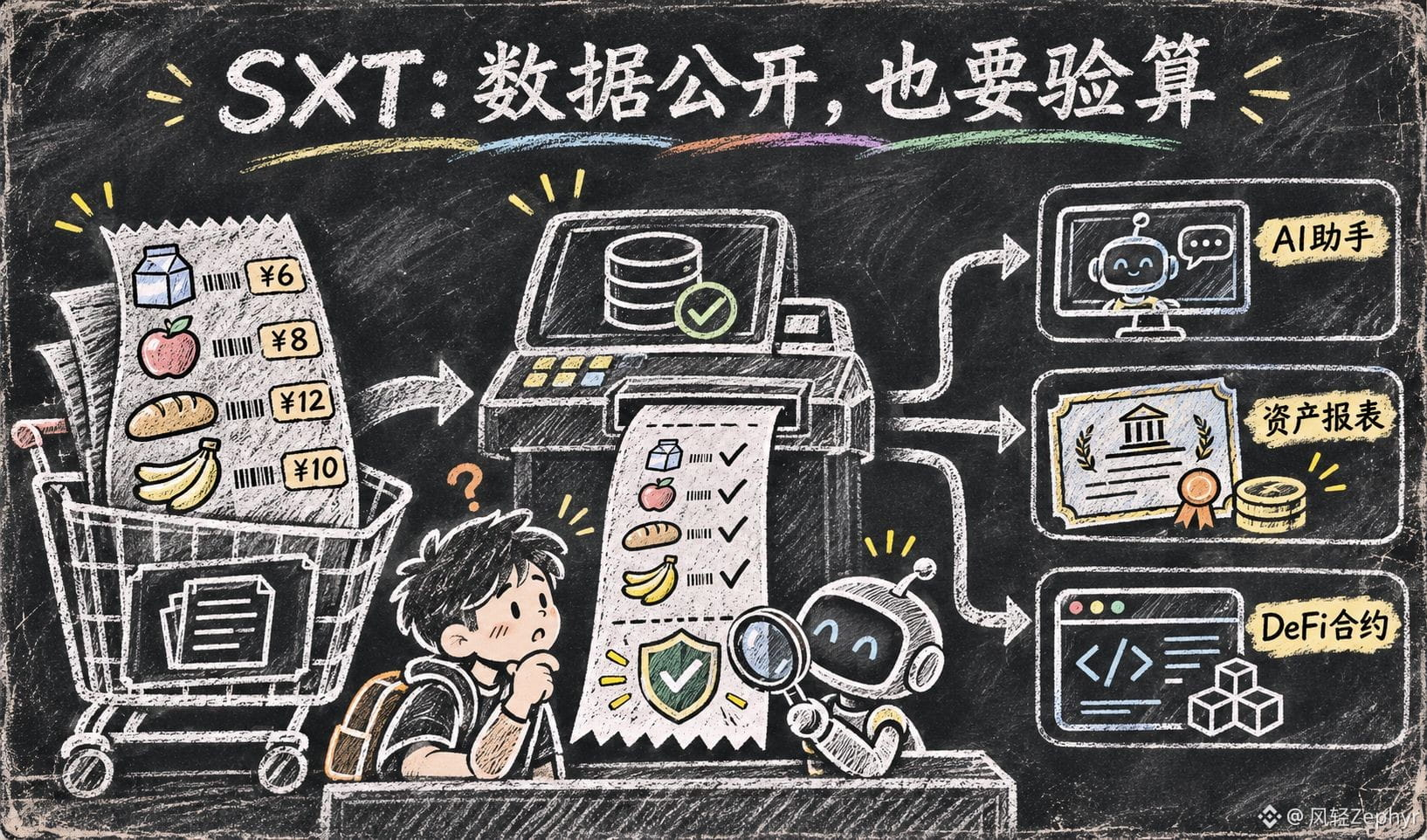
At first, I thought the same thing: Anyone can see records on the blockchain, so how could an app get the wrong answer? Then I was chatting with a friend, who used a supermarket as an example. That made it click: Every item has a price tag, but at checkout, it can still be missed, scanned twice, or have the wrong number entered. Public prices don’t necessarily mean the final receipt is correct. It’s the same on-chain: Even when tens of thousands of transactions are right there, a program can still make mistakes while filtering and totaling them.
What Space and Time does is like equipping a database with a “cash register that can double-check its own work.” Proof of SQL sounds pretty technical, but in plain English, it means that when the database gives you an answer, it also provides a verifiable computation receipt showing which data it used, what rules it followed, and that nothing was secretly changed along the way.
For example, a DeFi platform—that is, a financial application running on-chain—might want to lower fees for users who have made their payments on time for the past 30 days. That requires searching through a lot of historical records. A regular API might simply reply, “This user qualifies,” and the platform would just have to trust it. Space and Time, by contrast, provides the answer and proof together to the smart contract. Once the proof passes verification, the contract executes the rule.
This approach can also provide data to AI agents that automatically read information and perform tasks, or help tokenized assets—that is, bonds, funds, and other assets represented by on-chain tokens—verify their net asset values and holdings. But proving that “this calculation followed the rules” doesn’t actually guarantee that the original off-chain data was accurate. What’s really worth watching next is real-world applications, verification speed, and operating costs. That’s what users care about most.