Beginner Lesson 49: Market Orders and Limit Orders—Which Should You Choose?
Many beginners casually tap market order when placing a trade, thinking that getting filled quickly is all that matters. When volatility is low, the price difference is often barely noticeable. But once the order book starts moving faster, the price you see may not be the price you actually get filled at. That gap is what people commonly call slippage. Market orders prioritize getting filled as soon as possible; limit orders prioritize getting filled at a price you can accept. Both have their uses, but in the wrong situation, slippage can eat into your plan right away.
I. First, understand the difference between the two
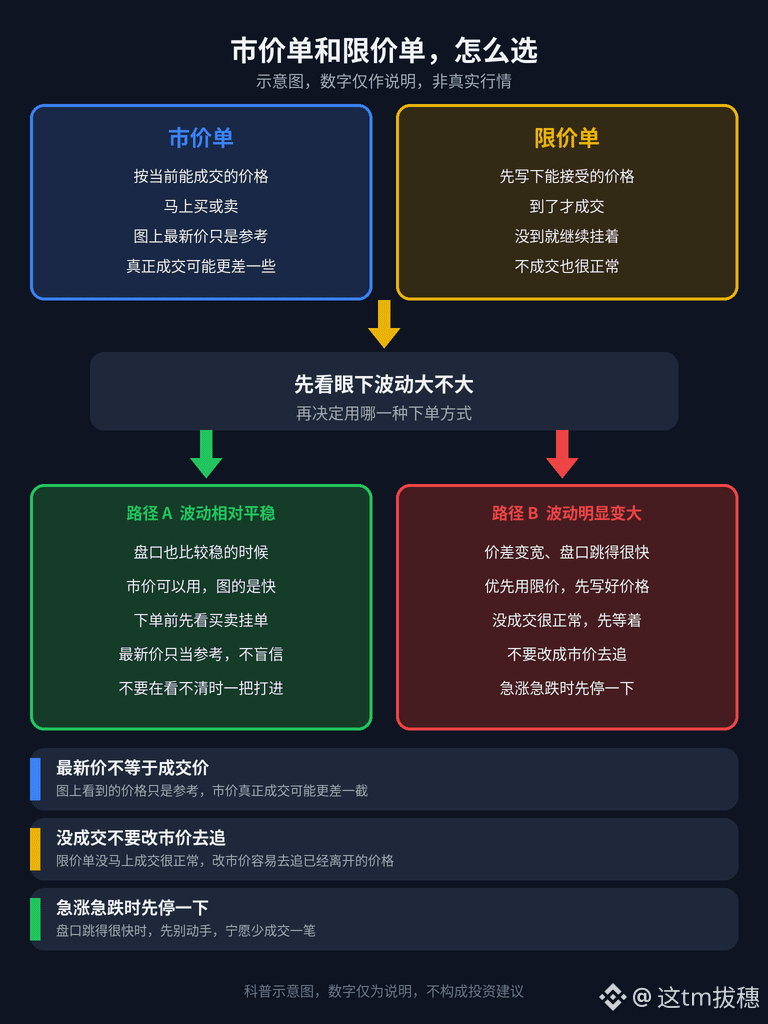
1) Market order: Buy or sell immediately at the best available price. The latest price shown on the chart is only a reference; your actual fill could be worse.
2) Limit order: You set the price you’re willing to accept. The order fills only if the market reaches that price; otherwise, it stays open. It’s perfectly normal for it not to fill.
3) Conditional orders and take-profit/stop-loss orders determine when an order is triggered. Market and limit orders determine how it is filled after being triggered. Don’t confuse the two.
For example, in Binance spot market activity around 14:07 on November 21 (Taipei time), $BTC was down about 9.87% over 24 hours, while $ETH was down about 10.30%, indicating notably high market volatility. At the same time, popular coin $KERNEL (KernelDAO) was up about 6.47% over 24 hours, with a trading volume of around 14 million USDT. Its high for the day was about 0.0638, its low about 0.0402, and its latest price about 0.0428. It had surged past its high earlier in the day before pulling back sharply. In fast-moving conditions like these, if you chase a high price with a market order, your fill may be worse than you expect, and a pullback can come quickly. Setting a limit order at a price you can accept at least helps you avoid jumping in blindly when you can’t read the order book clearly.
Before you continue, ask yourself: When you place an order, do you usually use a market order or a limit order? Comment 1 if you use market orders, or 2 if you use limit orders.
II. How to choose in practice
When liquidity is relatively good, volatility is fairly stable, and you simply want to get filled quickly at a price close to the order book, a market order can work—but first, check how many orders are available on both the buy and sell sides. When volatility rises noticeably, spreads widen, or you already have a clear buy or sell range in mind, prioritize limit orders. When prices are surging or plunging and the order book is moving rapidly, pause before acting; don’t use a market order to chase a price that has already moved. It’s normal for a limit order not to fill immediately. Don’t change it to a market order and chase the price just because you’re impatient. It’s better to miss a trade than to increase slippage when you can’t clearly see the price.
III. Common beginner pitfalls
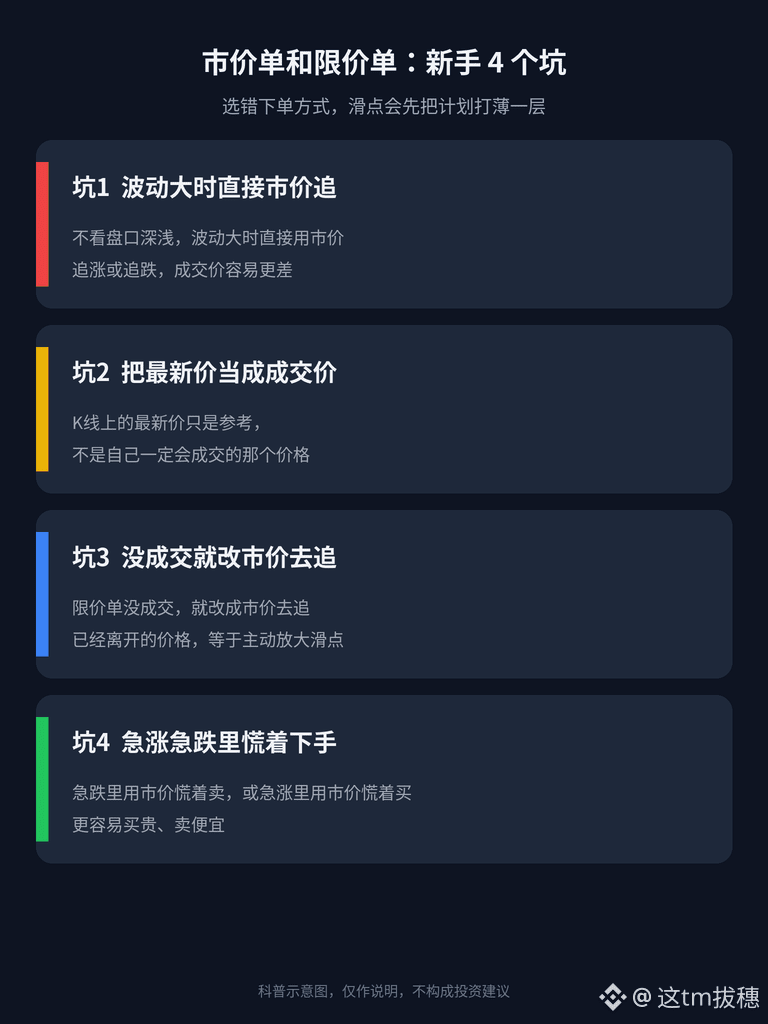
1) Ignoring order book depth and chasing a rising or falling price with a market order when volatility is high.
2) Assuming the latest price on the candlestick chart is the price your order will definitely fill at.
3) Switching an unfilled limit order to a market order to chase a price that has already moved away.
4) Panic-selling with a market order during a sharp drop, or panic-buying with a market order during a sharp rise, thereby increasing slippage yourself.
In short: Market orders prioritize speed; limit orders prioritize a price you can accept. Market orders can work when volatility is stable; when volatility rises, prioritize limit orders. If your order doesn’t fill, don’t switch to a market order to chase the price. Pause before placing an order during a sharp rise or drop.
A specific question: Next time volatility rises noticeably, would you choose A, prioritize a limit order and set an acceptable price in advance, or B, continue using market orders for speed? Just reply with A or B in the comments.
The content above is for educational purposes only and does not constitute investment advice. Crypto assets are highly volatile, and futures trading carries even greater risks. Please only participate with money you can afford to lose.
#新手入门 #技术分析 #BinanceSquare