SOL says its computing capacity will double next year, while ETH’s upgrade could be delayed until May: I compared the 2027 ledgers for both chains
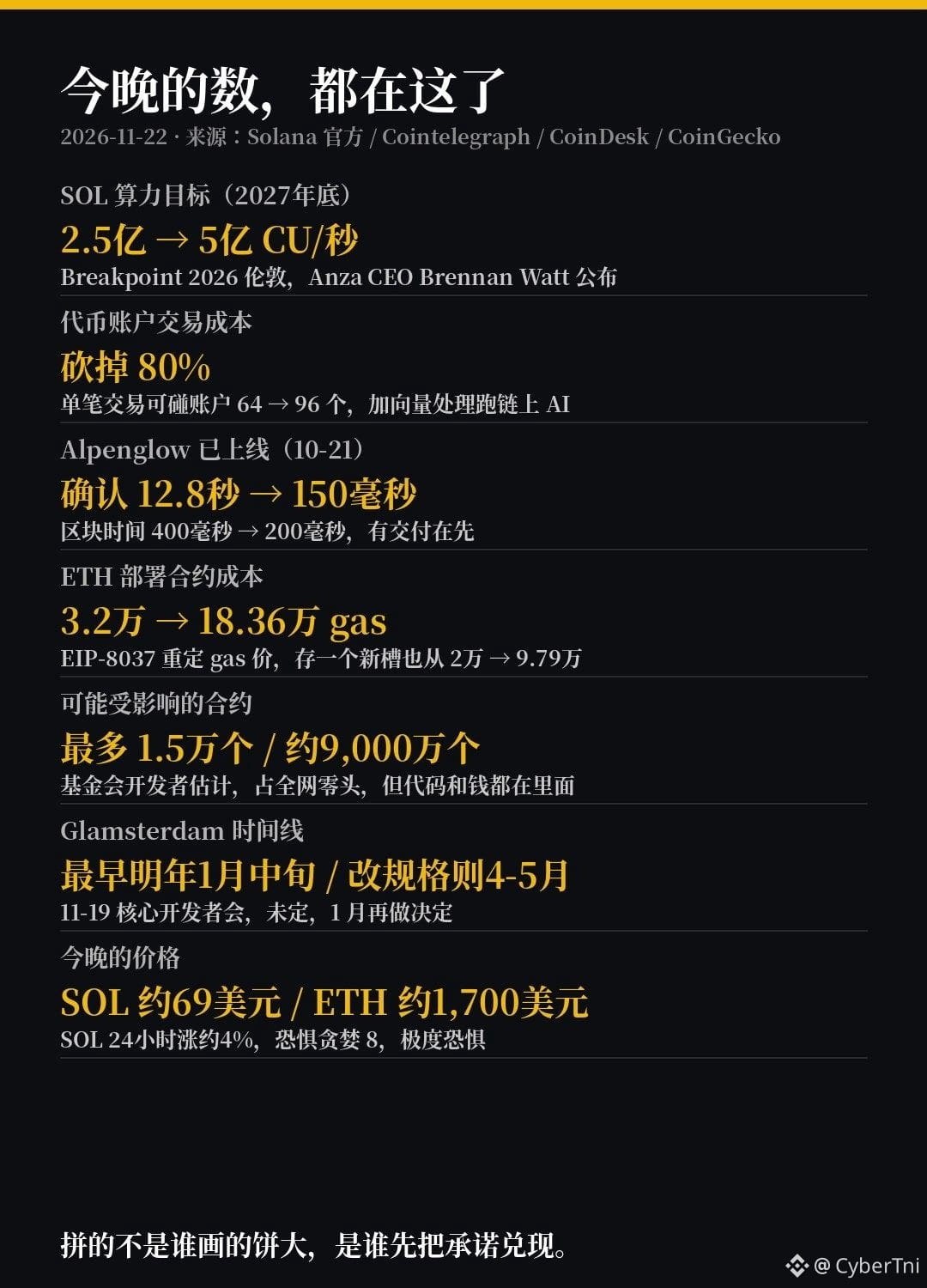
First, let’s clear up a misconception. Many people think a more ambitious roadmap is always bullish, and a delayed upgrade is always bearish. The news over the past couple of days points in the opposite direction. On November 19, the same day Solana unveiled its 2027 roadmap at Breakpoint in London, Anza’s Brennan Watt said computing capacity would rise from 250 million to 500 million CU per second, transaction costs for token accounts would be cut by 80%, the number of accounts a single transaction can touch would increase from 64 to 96, and vector processing would be added so AI models could run directly on-chain. That same day, Ethereum core developers met, and Glamsterdam’s upgrade could be delayed until May next year.
Let’s look at three figures. First, Solana has good reason to be confident in these numbers: Alpenglow went live on mainnet on October 21, cutting confirmation time from 12.8 seconds to around 150 milliseconds and block time from 400 milliseconds to 200 milliseconds. Second, Ethereum’s delay isn’t due to laziness; it’s because developers don’t want to break anything. EIP-8037 and EIP-8038 would reset gas prices, raising the cost of deploying a contract from 32,000 gas to 183,600. Foundation developer Marius van der Wijden said up to 15,000 contracts could be affected. That’s a tiny fraction of the roughly 90 million contracts across the network, but money and code are at stake, so it’s better to be slow than wrong. Third, the timeline: under the current specifications, mainnet deployment could happen as early as mid-January next year. If the specifications are revised in January, it would slip to February or March; major changes could push it to April or May. No decision has been made yet.
Honestly, I can’t take Solana’s “doubling of computing capacity” at face value as bullish. The roadmap sets a target, not a delivery date, and it won’t be realized until the end of 2027. There are too many unknowns in between. I can understand Ethereum’s approach a little better: slowing down the upgrade is a bearish narrative in the short term, but in the long term it means defusing the risks in 15,000 contracts first.
As for prices, $SOL was around $69 during the day, up about 4% over 24 hours, while $ETH hovered around $1,700. BTC just bounced back to $60,000 from $55,000, and the Fear and Greed Index showed 8 on the homepage of the square, leaving the market stuck in extreme fear for several days.
People holding SOL and ETH haven’t had much to cheer about on their balance sheets this week. I’ve been schooled by both chains in turn this week too: when prices rise, everyone shouts the loudest; it’s only when they fall that you realize what matters with roadmaps and upgrade timelines isn’t who promises the most, but who delivers first. Believe it or not.
#Solana公布2027路线图拟将计算容量翻倍 #ETH #CryptoNews