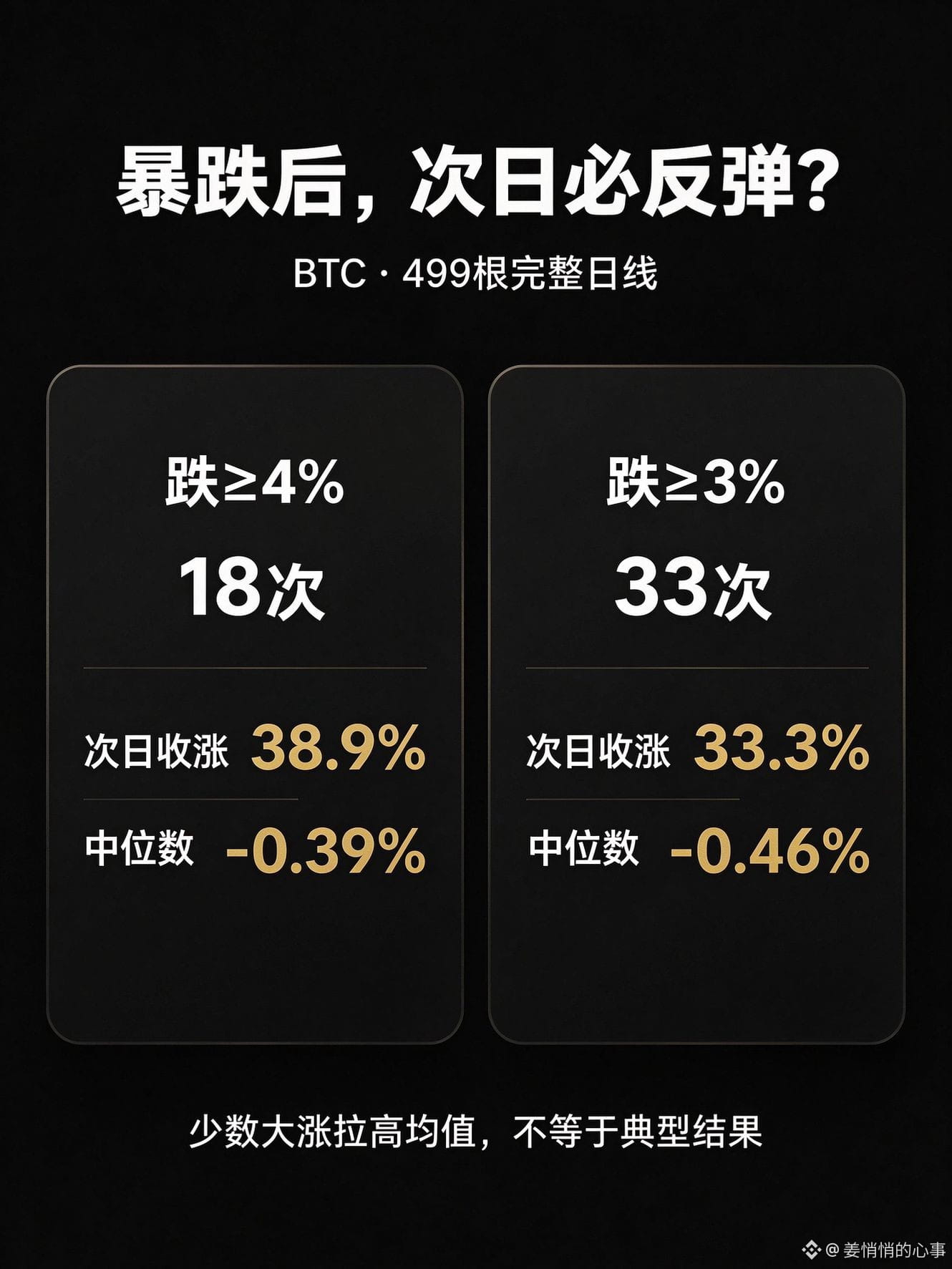
Is a Rebound Really More Likely the Day After a Sharp Drop? I Ran the Numbers on 499 Daily Candles
BTC rebounded today, and I was originally going to write about “recovery after a sharp drop.”
Before writing, I checked what usually happens the day after a sharp drop—and the results made me delete the word “reversal.”
The data covers 499 complete UTC daily candles from Binance, from 2025-07-11 to 2026-11-21. Today’s still-open candle is not included.
There were 18 instances of a daily drop of 4% or more:
The next day closed higher just 7 times, or 38.9% of the time.
The median next-day return was -0.39%, while the average was +0.39%.
There were 33 instances of a daily drop of 3% or more:
The next day closed higher 11 times, or 33.3% of the time.
The median next-day return was -0.46%, and the average was -0.80%.
What caught my attention most wasn’t the win rate, but the group with drops of 4% or more: the average return was positive, while the median was negative.
Put simply, a few big rebounds made the average look better, but that wasn’t the typical experience. This is the opposite of the intuition that “it went up a lot after the last big drop, so it should go up this time too.”
BTC closed down 4.90% on 11-20 and up 2.14% on 11-21, making it one of the 7 instances out of 18 that closed higher the next day. This was a real rebound, but one rebound can’t rewrite the statistics.
Of course, 18 and 33 instances aren’t large samples, and they don’t prove that prices will fall tomorrow.
They only disprove the claim: “It’s already fallen so much, so it’ll probably bounce the next day.”
Have you ever quietly equated “it fell a lot” with “it should go up tomorrow”? I used to. Now I run the numbers first.
Source: Binance API for 500 daily candles; calculations exclude the currently incomplete candle. Returns are based on close-to-close prices.
A review of publicly available data and personal observations only; not investment advice.
#BTC #回测 #验证室 $BTC