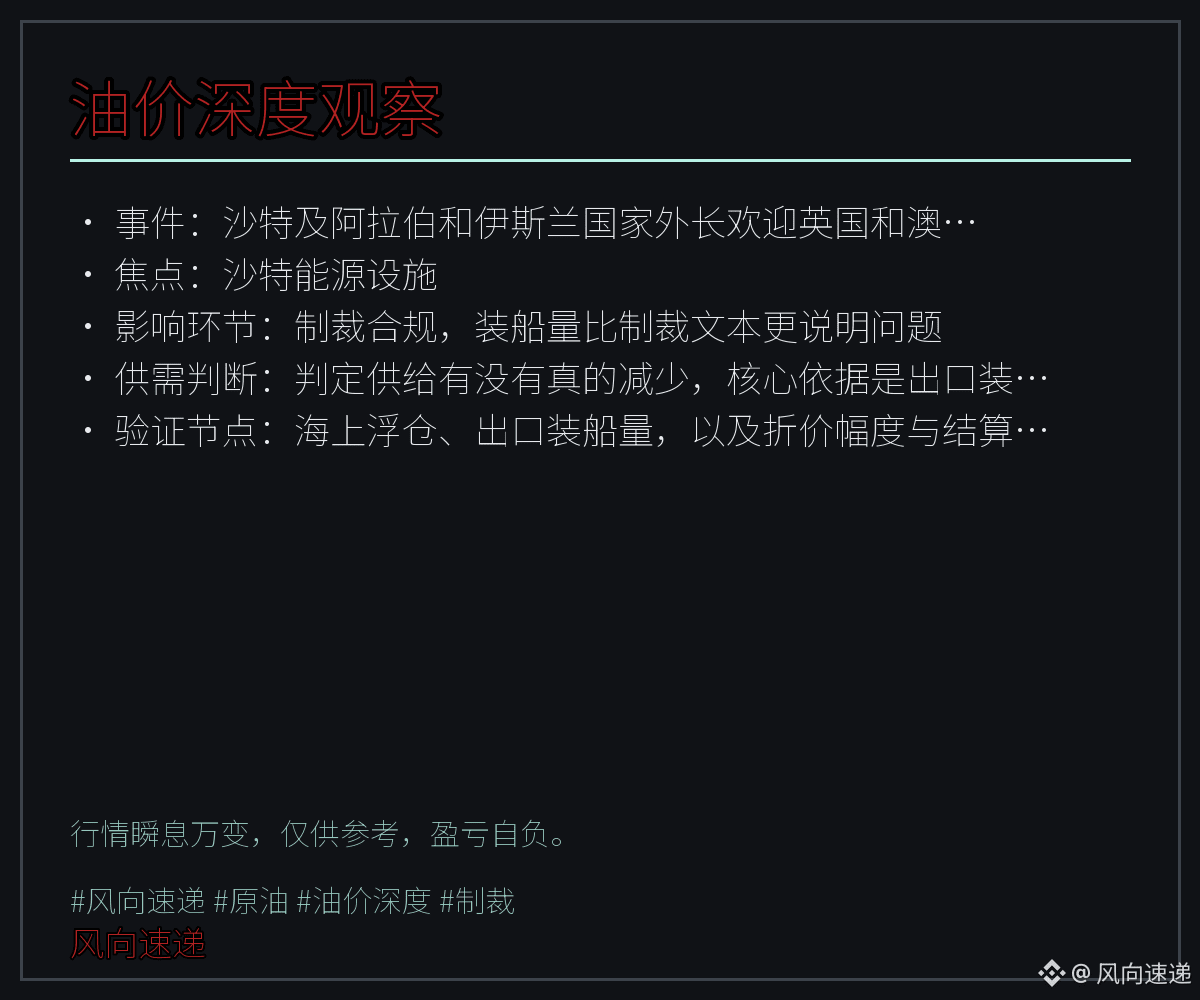
In-Depth Oil Price Watch
【Key Event】
The foreign ministers of Saudi Arabia and other Arab and Islamic countries welcome the UK and Australian governments’ measures targeting illegal Israeli settlements in the occupied Palestinian territories… (6 hours ago)
【Who Is Influencing Oil Prices】
Israel tightens energy trade rules. Attention is focused on Saudi energy facilities. The sanctions affect whether crude oil can be smoothly settled, insured, and brought into port. Sanctioned output may not disappear, but its destination and discount will be reshaped.
【Transmission Chain】
When restrictions are enforced, shadow fleet capacity, insurance, and payment channels are constrained first. Buyers turn to alternative sources, driving up the premium for compliant crude.
Sanctioned crude typically trades at a larger discount, widening global price spreads and creating differences in refineries’ feedstock costs.
【Supply, Demand, and Pricing】
The key indicator for determining whether supply has actually fallen is the volume of export loadings; the sanctions text itself only indicates a change in rules.
WTI is currently trading near $83.41, with a 24h change of +0.30%. Price movements are limited, and the market response is currently mild. Further data will be needed to confirm how much of this news is priced in. Sanctions news often triggers a one-off jump, after which the market recalibrates based on the actual strength of enforcement.
【What to Watch Next】
Track offshore floating storage, export loading volumes, and changes in discount levels and settlement channels.
【Conditions That Would Invalidate This Thesis】
If exemptions are expanded or enforcement is lax, the compliance premium will fall and trade flows will adjust again.
Markets change rapidly. For reference only; you are responsible for any gains or losses.
#风向速递 #原油 #油价深度 #Sanctions