
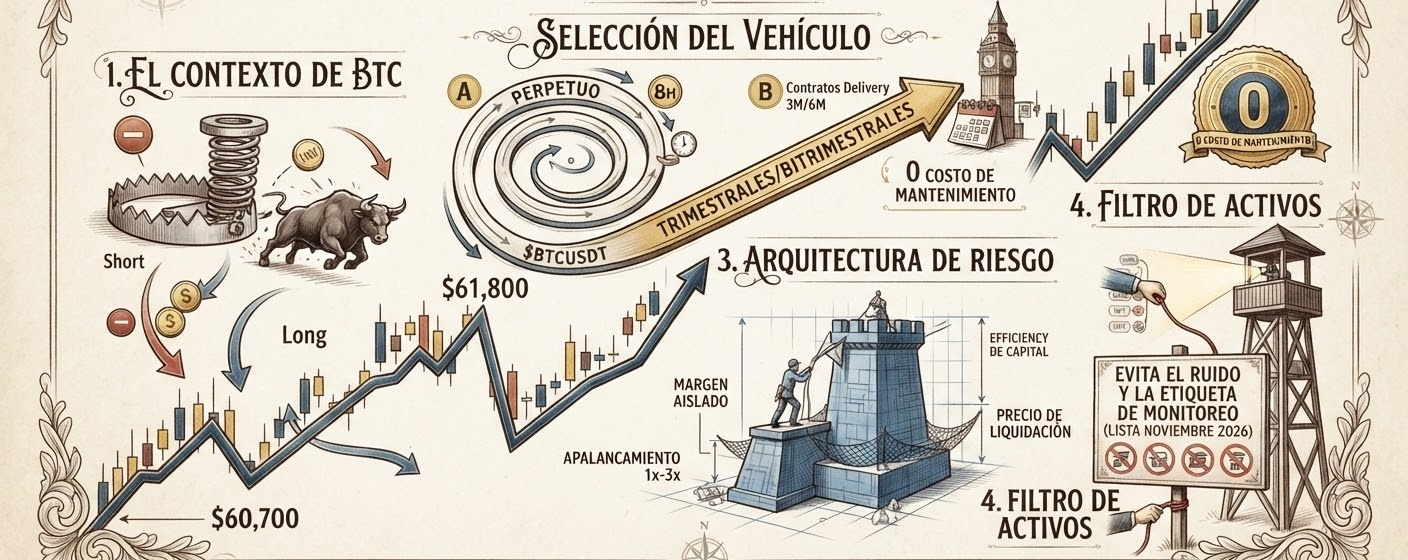


Trading derivatives in a market as technical and demanding as today’s requires you to stop watching the five-minute chart and start understanding the rules of the institutional game. With #Bitcoin trading in the $60,700–$61,800 range after a monthly correction of nearly 17.4% in November 2026, many traders are wondering whether it’s viable to hold structural positions on Binance Futures without fees or volatility liquidating their accounts.
The short answer is yes, but it requires surgical precision in contract selection, margin management, and reading market sentiment. Below, I break down the strategic roadmap for structuring long-term trades in $BTC under Binance’s current regulations.
1. BTC Context and the Hidden Advantage of the Funding Rate
Before opening any position, you need to read the order flow. Following the cascade of liquidations that shook the market in mid-November and macroeconomic pressure from expectations about Federal Reserve rates, funding rates for BTC perpetual contracts on Binance turned negative (ranging from -0.0002% to -0.0073%).
For a long-term trader, this data is worth its weight in gold for two reasons:
Shorts pay longs: When the rate is negative, traders holding long positions collect fees from short sellers every 8 hours. Instead of suffering the usual drag of holding a long position open for months, the market is paying you to hold it.
Fuel for a short squeeze: An excess of leveraged bearish positions sets the stage for sharp rebounds if the price recovers key liquidity levels.
2. Choosing the Vehicle: Perpetuals vs. Quarterly Contracts (Delivery)
Binance Futures rules clearly define how long you can stay in the market, depending on the instrument you choose:
Perpetual Contracts (BTCUSDT / BTCUSD): These have no expiration date. You can keep a position open indefinitely as long as your margin can withstand the volatility. However, you are subject to funding rate settlements every 8 hours. If sentiment turns euphoric again and funding rises to 0.03% or higher, holding that long for an entire quarter will become costly.
Quarterly and Bi-Quarterly Contracts (Delivery): These have a fixed duration of 3 months (expiring on the last Friday of March, June, September, and December) or up to 6 months for bi-quarterly contracts. Their major strategic advantage for long-term swing trading is that they have no funding rate. You pay the opening and closing fees, and you can hold the position unchanged until its expiration date with no daily holding costs. If you want to extend it beyond the quarter, simply roll it over to the next expiration date.
New ETF-Linked Derivatives (IBITUSDT): Binance recently added 24/7 perpetual contracts on BlackRock's spot Bitcoin ETF, with leverage of up to 20x. Although they offer direct exposure to institutional flows, their mark price can deviate from the index by ±3% over the weekend, so extra caution is needed around traditional market opening gaps.
3. Risk Architecture and Margin Rules on Binance
In positional trading, leverage isn't for multiplying profits, but for optimizing capital efficiency. To survive 15% or 20% pullbacks like the one BTC saw this month, follow these operating rules:
Low effective leverage (1x to 3x): Although Binance allows up to 125x on BTC (with initial limits restricted during the first 30 days for new accounts), long-term trading requires your liquidation price to be well below macroeconomic support levels. With effective leverage of 2x or 3x, your maintenance margin is protected against liquidity wicks.
Isolated Margin vs. Cross Margin: If you plan to hold a BTC position for weeks or months while scalping or trading intraday on other pairs, use Isolated Margin for your core position or manage your positions from a dedicated sub-account. This way, you avoid having a mistake in a short-term trade consume the collateral for your main position or trigger Reduce-Only restrictions across your entire account.
Notional Level Control (Tiers): Remember that on Binance, as the notional size of your BTC position increases, the maximum allowed leverage decreases and the maintenance margin rate rises. If you plan to scale into positions (DCA or pyramiding), calculate the margin required for the next tier in advance so you don't bring your liquidation price dangerously close.
4. Asset Filter: Why Focus on BTC and Avoid the Noise
While BTC absorbs market liquidity, low-cap altcoins face the greatest regulatory and operational risks on the exchange. In its latest update in November 2026, Binance expanded its Monitoring Tag list to 36 cryptocurrencies (adding assets such as BANK, INIT, MITO, ONE, THE, and ZIL).
As a trader, the rule is non-negotiable: never structure long-term positions in assets under a monitoring tag or with low liquidity. When Binance decides to delist a Spot pair after its review period, the Futures division typically closes and automatically liquidates its perpetual contracts days beforehand, destroying any long-term thesis regardless of whether your technical analysis was correct.
Operational Conclusion
To capture Bitcoin's next directional cycle on Binance Futures, prioritize survival over speed. Take advantage of negative funding windows on perpetuals when pessimism dominates the market, switch to quarterly contracts when bullish funding costs become expensive, keep your exposure isolated with actual leverage below 3x, and concentrate your capital in assets with the highest institutional liquidity, such as BTC. In derivatives, time only works in your favor when margin is under control.