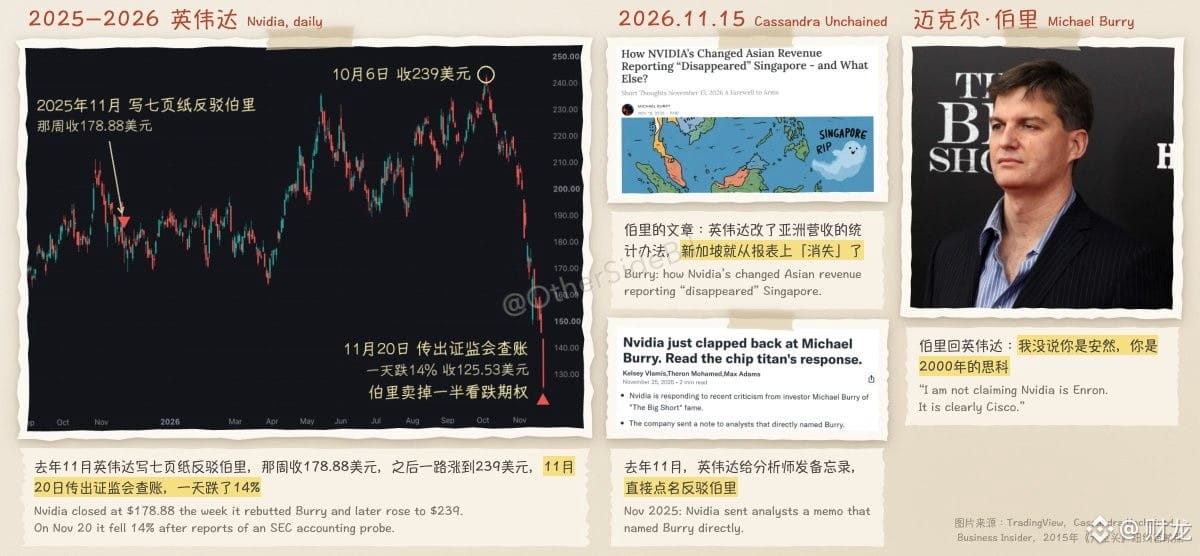

Nvidia fell 14% in a single day, reviving Burry’s questions from a year ago
Nvidia fell 14% in a single day on Friday. The trigger was a rumor: that the U.S. Securities and Exchange Commission was investigating its books.
This goes back a year.
The person questioning Nvidia’s accounts at the time was Michael Burry—the man who shorted subprime mortgages in 2008 and was later portrayed in the movie The Big Short. Last November, he shut down his fund and switched to a paid newsletter. The first company he took aim at was Nvidia, and he was holding Nvidia put options.
His point was straightforward: Nvidia’s performance wasn’t as good as its financial statements made it look. He gave two reasons.
First, it issued too much stock to employees. Since 2018, Nvidia has spent more than $100 billion buying back its shares. You’d expect the number of shares to keep shrinking, but instead the total share count grew by 47 million. A large chunk of that money was really spent buying back shares issued to employees. After including this cost, Burry calculated that the actual profit reaching shareholders was only 50% of the figure reported in the financial statements.
Second, where did the customers’ money come from? Nvidia invested in AI companies such as OpenAI, which then used the money to buy Nvidia chips. The money goes out as an investment, circles back as revenue, and makes demand look very strong—some of which Nvidia itself helped prop up.
Nvidia responded quickly. Its investor relations team wrote a seven-page memo and privately sent it to Wall Street analysts, addressing the claims point by point: the buyback total was $91 billion; Burry’s figure of $112.5 billion also included taxes on employee stock; the proportion of stock held by employees was similar to that at peer companies; and there was no circular financing. The memo also took pains to emphasize that Nvidia was not a fraudulent company like Enron.
Burry replied: “I didn’t say you were Enron. You’re Cisco in 2000.”
Cisco was a leading maker of networking equipment during the dot-com bubble. Back then, it also lent money to customers so they could buy its equipment. When the bubble burst, orders evaporated overnight, and its share price fell 89% from its peak.
But the market paid no attention to him at the time. Over the following year, Nvidia kept climbing, reaching $239 in early October this year—up another 34% from when the memo was sent.
The turning point came last Sunday. Burry raised a third issue: how revenue was reported by region.
Last year, Nvidia changed its accounting method, switching from using billing addresses to using customers’ headquarters. After the change, Singapore—which had accounted for 22% of revenue, or more than $10 billion, in a single quarter—disappeared from the reports. Nvidia said many customers simply used Singapore for consolidated billing, while the goods were actually shipped elsewhere.
Burry believes a substantial portion of this business came from Chinese companies. The change in methodology makes it harder for outsiders to judge how dependent Nvidia really is on China. He also acknowledged that there is currently no evidence that Nvidia’s accounts are wrong.
Five days later, news of the SEC investigation emerged. It’s still unclear whether the investigation concerns any of these issues.
By this week, Nvidia’s share price was already 30% lower than when it first rebutted Burry.
Burry’s own moves are interesting, too. On the day Nvidia plunged, he sold half of his Nvidia put options and half of his semiconductor ETF put options, while holding on to the other half of each. He didn’t touch a single one of his put options betting on a decline in the Nasdaq 100.
From beginning to end, Burry never argued about whether Nvidia’s chips were selling well. He focused on where the money was coming from and how it was being accounted for. A year ago, the market wasn’t very interested in these questions. Now people are starting to ask them too.
Nvidia fell 14% in a single day on Friday. The trigger was a rumor: that the U.S. Securities and Exchange Commission was investigating its books.
This goes back a year.
The person questioning Nvidia’s accounts at the time was Michael Burry—the man who shorted subprime mortgages in 2008 and was later portrayed in the movie The Big Short. Last November, he shut down his fund and switched to a paid newsletter. The first company he took aim at was Nvidia, and he was holding Nvidia put options.
His point was straightforward: Nvidia’s performance wasn’t as good as its financial statements made it look. He gave two reasons.
First, it issued too much stock to employees. Since 2018, Nvidia has spent more than $100 billion buying back its shares. You’d expect the number of shares to keep shrinking, but instead the total share count grew by 47 million. A large chunk of that money was really spent buying back shares issued to employees. After including this cost, Burry calculated that the actual profit reaching shareholders was only 50% of the figure reported in the financial statements.
Second, where did the customers’ money come from? Nvidia invested in AI companies such as OpenAI, which then used the money to buy Nvidia chips. The money goes out as an investment, circles back as revenue, and makes demand look very strong—some of which Nvidia itself helped prop up.
Nvidia responded quickly. Its investor relations team wrote a seven-page memo and privately sent it to Wall Street analysts, addressing the claims point by point: the buyback total was $91 billion; Burry’s figure of $112.5 billion also included taxes on employee stock; the proportion of stock held by employees was similar to that at peer companies; and there was no circular financing. The memo also took pains to emphasize that Nvidia was not a fraudulent company like Enron.
Burry replied: “I didn’t say you were Enron. You’re Cisco in 2000.”
Cisco was a leading maker of networking equipment during the dot-com bubble. Back then, it also lent money to customers so they could buy its equipment. When the bubble burst, orders evaporated overnight, and its share price fell 89% from its peak.
But the market paid no attention to him at the time. Over the following year, Nvidia kept climbing, reaching $239 in early October this year—up another 34% from when the memo was sent.
The turning point came last Sunday. Burry raised a third issue: how revenue was reported by region.
Last year, Nvidia changed its accounting method, switching from using billing addresses to using customers’ headquarters. After the change, Singapore—which had accounted for 22% of revenue, or more than $10 billion, in a single quarter—disappeared from the reports. Nvidia said many customers simply used Singapore for consolidated billing, while the goods were actually shipped elsewhere.
Burry believes a substantial portion of this business came from Chinese companies. The change in methodology makes it harder for outsiders to judge how dependent Nvidia really is on China. He also acknowledged that there is currently no evidence that Nvidia’s accounts are wrong.
Five days later, news of the SEC investigation emerged. It’s still unclear whether the investigation concerns any of these issues.
By this week, Nvidia’s share price was already 30% lower than when it first rebutted Burry.
Burry’s own moves are interesting, too. On the day Nvidia plunged, he sold half of his Nvidia put options and half of his semiconductor ETF put options, while holding on to the other half of each. He didn’t touch a single one of his put options betting on a decline in the Nasdaq 100.
From beginning to end, Burry never argued about whether Nvidia’s chips were selling well. He focused on where the money was coming from and how it was being accounted for. A year ago, the market wasn’t very interested in these questions. Now people are starting to ask them too.