Someone is pushing PENDLE today, saying “market cap/TVL is only 0.24x, 80% of revenue goes to buybacks, a top pick for the next bull market.” I checked the numbers, and they’re basically right. I don’t buy the conclusion.
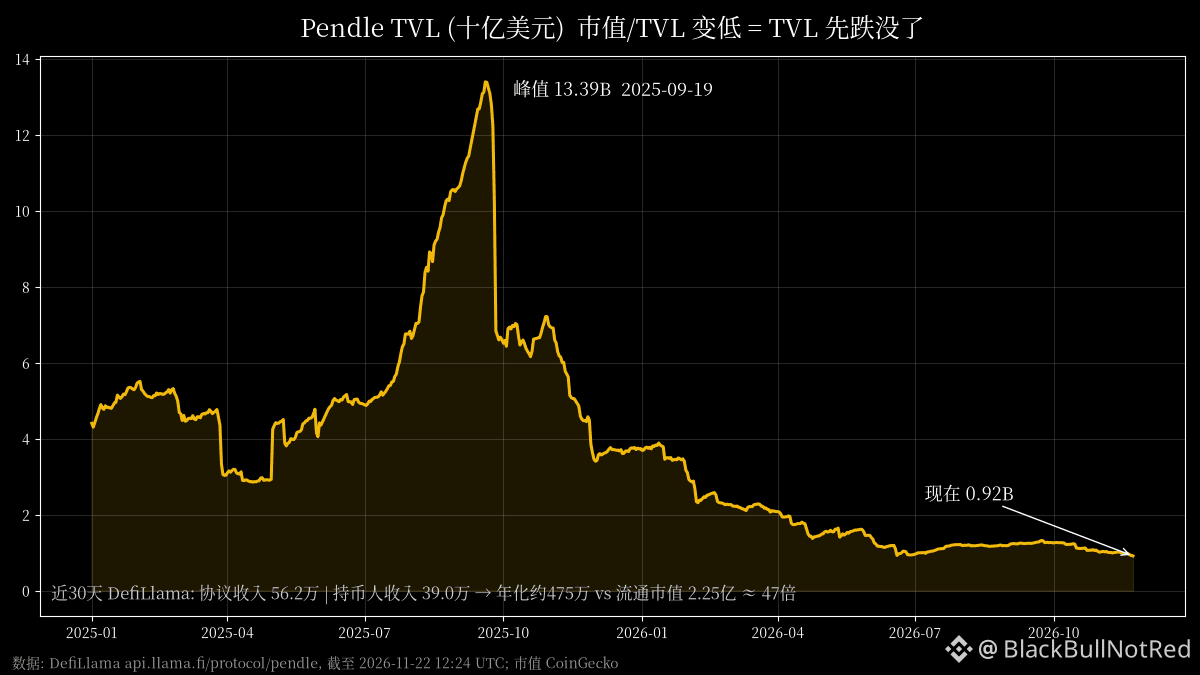
First, where does the 0.24x come from? According to DefiLlama, Pendle’s TVL peaked at $13.39 billion on September 19, 2025, and is now $916 million, down 93%. The ratio is low not because the token is cheap, but because the denominator has collapsed. Besides, Pendle’s TVL is the principal users deposit to create PTs/YTs, not the protocol’s own money, so comparing it with market cap doesn’t mean much in the first place. What really matters is how much fee revenue that principal can generate in a year.
By DefiLlama’s figures, protocol revenue over the past 30 days was $562,000, or roughly $6.83 million annualized. Revenue over the past year was $11.84 million. In other words, the current revenue run rate is more than 40% below the average for the past year.
Now, about the “80% buyback.” The official documentation is quite clear: 80% of Yield and Swap fees go toward buying back PENDLE, which is then distributed—up to 100%—to active sPENDLE holders in the form of sPENDLE. Note: it’s distributed to stakers, not burned. The circulating supply doesn’t shrink because of the buyback; tokens just move from sellers to stakers. Holders who don’t stake don’t benefit.
Let’s calculate what holders actually get: DefiLlama shows $390,000 in holder revenue over the past 30 days, or about $4.75 million annualized. Against a circulating market cap of $225 million, that’s roughly 47x, or a buyback yield of just over 2%. Using the $8.94 million figure for the past year, it’s still 25x. Is this an undervalued DeFi blue chip? This is normal pricing for a bear market, where revenue contracts along with TVL.
Also, 174 million tokens are circulating out of a total supply of 282 million, leaving 38% out of circulation.
There’s nothing wrong with Pendle’s product itself, and the interest-rate trading sector is real. But its revenue depends almost entirely on TVL and on-chain interest-rate fluctuations. For it to turn around, we first need to see TVL and fee rates recover—not call it cheap based on a denominator that’s been cut in half, then cut in half again.
#PENDLE
First, where does the 0.24x come from? According to DefiLlama, Pendle’s TVL peaked at $13.39 billion on September 19, 2025, and is now $916 million, down 93%. The ratio is low not because the token is cheap, but because the denominator has collapsed. Besides, Pendle’s TVL is the principal users deposit to create PTs/YTs, not the protocol’s own money, so comparing it with market cap doesn’t mean much in the first place. What really matters is how much fee revenue that principal can generate in a year.
By DefiLlama’s figures, protocol revenue over the past 30 days was $562,000, or roughly $6.83 million annualized. Revenue over the past year was $11.84 million. In other words, the current revenue run rate is more than 40% below the average for the past year.
Now, about the “80% buyback.” The official documentation is quite clear: 80% of Yield and Swap fees go toward buying back PENDLE, which is then distributed—up to 100%—to active sPENDLE holders in the form of sPENDLE. Note: it’s distributed to stakers, not burned. The circulating supply doesn’t shrink because of the buyback; tokens just move from sellers to stakers. Holders who don’t stake don’t benefit.
Let’s calculate what holders actually get: DefiLlama shows $390,000 in holder revenue over the past 30 days, or about $4.75 million annualized. Against a circulating market cap of $225 million, that’s roughly 47x, or a buyback yield of just over 2%. Using the $8.94 million figure for the past year, it’s still 25x. Is this an undervalued DeFi blue chip? This is normal pricing for a bear market, where revenue contracts along with TVL.
Also, 174 million tokens are circulating out of a total supply of 282 million, leaving 38% out of circulation.
There’s nothing wrong with Pendle’s product itself, and the interest-rate trading sector is real. But its revenue depends almost entirely on TVL and on-chain interest-rate fluctuations. For it to turn around, we first need to see TVL and fee rates recover—not call it cheap based on a denominator that’s been cut in half, then cut in half again.
#PENDLE