


Author: washed
Translated by: Deep Tide TechFlow
Original link: https://www.techflowpost.com/article/35280
Disclaimer: This article is reproduced from another source. Readers can find more information via the original link. If the author has any objections to the republication, please contact us and we will make changes as requested. This republication is for information-sharing purposes only and does not constitute investment advice or represent Wu Shuo’s views or position.

Across the various niche communities on Twitter (such as sneaker Twitter, crypto Twitter, and money-making Twitter), I’ve noticed a common turning point: when people’s attention shifts from the opportunities that originally brought them together to climbing the social ladder and monetizing their followers, that community is over.
Unfortunately, Crypto Twitter (CT) is at this point now.
For a little personal background, the path I took through these scenes was: Sneaker Twitter → Money Twitter → Gambling Twitter → Crypto Twitter. I was mostly a lurker on Money Twitter and Gambling Twitter, but I was deeply involved in Sneaker Twitter and Crypto Twitter for years.
These niche communities have far more in common than people are willing to admit. Without a doubt, crypto is the most ambitious sector of the bunch, and that’s why I’ve decided to stay on as a member of the community—but I won’t get into that for now.
The underlying dynamics are just so similar. Watching everything Crypto Twitter has gone through over the past year or so has given me a strong sense of déjà vu. I’ll do my best to put into words what I’ve learned from years of watching these communities rise and fall.
Early Arbitrage Opportunities and the Race to the Bottom
At first, a small group of anonymous players discovered something cool and decided to share their thoughts about it on Twitter. Pure curiosity drove the early growth, while recommendations from the algorithm and word of mouth brought in a steady stream of lucky newcomers.
The core value proposition of this small community was that early entrants could exchange ideas and capitalize on market inefficiencies. Nobody cared about marketing, and nobody was trying to bring in the next batch of suckers to hold the bag.
On the contrary, the early days often came with a kind of “gatekeeping” mindset, deliberately protecting the treasure everyone had just discovered: the less competition there was, the more money the lucky few who’d found the gold mine could make.
Over time, the game evolved and the arbitrage mechanics became well understood. Tools and businesses catering to participants began to appear, newcomers started flooding in faster, and the market became more efficient. Naturally, there was less gold left for ordinary people to find.
To some extent, this turned into a “race to the bottom.” Driven by greed, people did increasingly extreme things that accelerated the decline, like breaking unwritten rules of the game (buying more than 3% of a token’s supply, leaking early alpha, and so on).
The competitive edge shifted from “being smarter than everyone else” to “being faster than everyone else.” Everyone had the same ideas and knew what to do; the only question was who could act first.
Toward the end of Sneaker Twitter’s heyday, we even paid people with shady connections to scan shipping labels early, so we could list sneakers for presale before they were released.
Back then, official releases were usually on Saturdays, and the shoes wouldn’t arrive until the following weekend. By the time you actually had them in hand, prices had often dropped far below their release-day peak, so everyone was caught in a race to see who could dump their pairs first.
People mainly used two methods: one was to sell directly into the highest buy order on platforms like StockX, then buy up the market to source the sizes they’d just sold; the other was to place an online order, secure a pair, and immediately resell it, even though they didn’t have the shoes yet and didn’t even know when they’d ship.
The problem was that StockX required sellers to ship within two to three business days. So what was the workaround? Pay someone with access to a UPS scanner to scan your prepaid shipping label, making the system mark the package as “shipped.”
That way, your order wouldn’t be canceled by the platform. A few days later, when you actually received the shoes, you could send them out. When demand for many sneakers was extremely low, you practically had to rely on some kind of elaborate presale to squeeze out any profit at all.
(Looking back, this kind of early scanning was legally pretty dubious, but nobody cared during that race to dump inventory. I vaguely remember someone getting into trouble and facing legal consequences over it later, though I can’t recall the details.)
Crypto’s shitcoins and token-launch games are basically at this same stage now. It’s a perpetual race to be “the earliest seller dumping on everyone else”: sniping new coins, trading pre-launch pairs, distributing tokens across multiple wallets—it’s all an endless race to the bottom.
Participants will only get more aggressive, and things won’t get better on their own unless something truly disruptive comes along. Market opportunities may not have disappeared completely, but for ordinary people this game is far less appealing than it used to be.
The Shift to Socializing and “Selling Dreams”
As participants turned on one another and completely wrecked the original ecosystem, another group shifted to a very different game: the social game. Now that the original opportunity that drew everyone in is no longer so appealing, selling people the “dream of getting rich” has become a more profitable path.
Social influence used to be a byproduct of making money in the market. Now it’s the opportunity itself. People no longer “make money to build a following”; they’ve become entirely focused on “building a following to make money.”
With paid shills and referral commissions, along with various other incentives, more and more KOLs have started leading lambs to the slaughter.
The course sellers on Money Twitter make a useful comparison. Money Twitter was a little different from Sneaker Twitter: there really were people running genuine businesses and creating social value there, whereas Sneaker Twitter was almost purely a game of buying low and selling high.
From this perspective, Money Twitter has far more in common with Crypto Twitter than Sneaker Twitter does. There are genuinely cool things happening in crypto too—for example, ICE, the parent company of the NYSE, partnering with TradeXYZ to bring Hyperliquid-based perpetuals to the U.S. market.
But as easy opportunities become scarcer, people doing real work have to share the spotlight with an ever-growing number of speculative scammers. These speculators are ruining everyone’s fun and giving the entire industry a bad name.
Money Twitter was full of people like this back then: obsessed with climbing the social ladder and building a personal brand so they could aggressively sell their audience low-quality information products, predatory courses, or ads.
As competition in online business intensified and easy money dried up, some people had a sudden realization: rather than struggling to build a successful company themselves, it’s much easier—and often far more lucrative—to sell other people the “pipe dream of getting rich.”
I don’t think it’s fair to label everyone who sells courses or puts up a paywall a scammer. There is genuine insight out there that’s worth paying for. My point isn’t knowledge monetization itself, but how the social fabric of an entire community gets warped when “selling the opportunity” becomes more profitable than “getting in there and seizing it yourself.”
Earlier, I talked about how Sneaker Twitter devolved into a race to front-run everyone else and dump inventory. Crypto Twitter is now facing both of these problems at once: a race to the bottom as everyone fights over the same tokens, and the “course-selling dilemma” of Money Twitter. The influencers selling dreams of getting rich on memecoins are the new course gurus.
People are probably overstating the whole “memecoins are dead” thing. There’s already been plenty of commentary on this, so I won’t dwell on it, but objectively speaking, the dream of ordinary people getting rich by trading memecoins is pretty much dead.
This is no longer a rough-and-tumble frontier where newcomers can make a name for themselves. It’s an extremely “K-shaped,” socially driven game, where those at the top of the pyramid keep compounding their advantages.
Sneaker reselling never completely disappeared, and people still make money from it today. But that doesn’t mean it’s still the enticing business it was at its peak. Memecoins are heading down the same path: the fact that a market still exists doesn’t mean it’s still a good game worth going all in on.
Of course, one day we’ll see another legendary coin worth hundreds of millions or even a billion dollars. But for ordinary people, finding a way to catch it will be next to impossible—like mining for gold in a minefield. The rewards might be huge, but the risk-reward ratio and odds of success are abysmal.
Things have deteriorated to the point where plenty of people refuse to move on or admit that the golden age of asymmetric wealth creation is over. Instead, they keep forcing this broken dream on their audience, if only to create new exit liquidity for themselves.
The whole Kimchi saga perfectly illustrates this. Kimchi made a name for himself after the widely circulated story that he’d made $40 million on TRUMP. But the story was just a joke made up by his friend—and it spiraled completely out of control as it spread from person to person.
Even more ironically, he later partnered with Pump, which was practically shamelessly marketing the idea that “you too can be the next Kimchi by trading shitcoins.” Put simply: “Larp til you make it.” The story they used to sell the dream of getting rich was fake from start to finish.
And the current incentive structure only encourages this behavior even more. It’s perfectly rational for a new generation of entrants to prioritize “becoming an influencer” over “becoming a trader”—assuming you can even call what they’re doing trading.
After all, trading platforms need volume, and influencers need to monetize their audiences. Neither side actually cares whether their followers make money.
What’s especially striking is how much more tolerant the community has become of this. In the early days, bad actors were usually ostracized and driven out by the community, because people wanted to protect the valuable opportunity they’d worked so hard to find. Now, that same kind of person gets huge sponsorship deals and an even bigger platform.
I don’t think there’s any point in trying to fight this culture head-on. You can’t expect people to voluntarily walk away from a path that’s clearly extremely profitable just because they don’t want to “ruin the community.” Better to let them play their game and pull the plug on the places where they congregate—we can just leave.
The collective retreat and privatization of smart people
And that’s exactly what’s happening. Many of the people who once gave Crypto Twitter real value have quietly withdrawn from the public timeline. Some have moved on to U.S. stocks; some have made enough to retire and logged off; others still trade crypto but have moved entirely into private spaces, with no interest in engaging with the public scene that remains.
I think these people are generally making the right call, and I often find myself wavering over whether to disappear completely. Honestly, I’m still part of this community because I believe in the long-term inevitability of Bitcoin and blockchain. But Crypto Twitter has gone in exactly the opposite direction, and I’m finding fewer and fewer reasons to keep putting effort into sharing my thoughts publicly.
The original value of Crypto Twitter was that people at the cutting edge of trends could share ideas and discover opportunities together. Now, most worthwhile conversations and information have moved to Telegram, private group chats, and other closed spaces.
Once you’re in the right circles, you can do just fine without ever looking at Twitter’s public timeline. There’s very little genuine alpha left to find there.
Lately, the only thing I’ve felt motivated to do on Twitter is post some harmless market chatter. Still, there are people on the public timeline far better than me who continue to share real value sincerely, without dumping on their followers or pushing scams. I think they’re seriously undervalued.
I’ve put together a quick list of 100 quality accounts. I might update it later, or I might not get around to it—I can’t say for now. But there are definitely plenty of other great accounts that deserve to be on it.
One small bright spot is that as I’ve been writing this article, I’ve started seeing some of the speculators who were just here for the hype—the “tourists”—throw in the towel and leave. That’s encouraging.
I won’t name names, but one person who used to livestream buying new trading pairs and claimed he was bringing his followers into crypto (for the record, nobody asked him to do that) announced he was distancing himself from Crypto Twitter. His reason was that “people always ruin the next great opportunity handed to them.” Sounds like he thought he was that great opportunity.
The Great Decoupling: Crypto and Crypto Twitter Go Their Separate Ways
To borrow Crypto Twitter’s favorite buzzword, I’m going to call a “decoupling” too—but this time it’s crypto itself decoupling from Crypto Twitter. I’m not trying to call the exact top or get out at the peak, of course. I think Crypto Twitter actually peaked well before the 10/10 crash. The decoupling had already been happening quietly.
The clearest contrast is right in front of us: over the past year, ordinary Crypto Twitter users have spent all day complaining about launchpads, while the genuinely sharp players have already been trading perpetuals in the high seven- to eight-figure range, or finding quality on-chain assets like VVV and CARDS early on.
Strangely enough, the 10/10 crash seems to have permanently changed the psychological climate among Crypto Twitter participants. It left behind a lingering shadow: anything you achieve could vanish in the blink of an eye.
This fear, mostly buried in the subconscious, has further fueled the short-sighted, predatory mindset of “grab what you can and get out.” The current U.S. president and his family have a similar attitude toward the crypto industry, which doesn’t help either.
People have become so accustomed to this kind of extraction that they no longer collectively drive bad actors out, as they did a few years ago.
I’m not writing this article to mindlessly shill the crypto market. I think the adoption of crypto technology is irreversible, but it’s evolving in a way that’s completely different from what Crypto Twitter imagined.
In my view, Crypto Twitter has become disconnected from the real direction of the crypto industry over the longer term. Blockchains are evolving into the underlying plumbing that will patch up the old financial system. It sounds boring—and there can be speculative fun in picking the right projects that solve real pain points—but on the whole, it’s nowhere near as exciting as making millions from vaporware.
When Bitcoin rallies and rekindles the market’s appetite for risk, those feverish moments will surely return. People will lose their minds again and pour real money into high-risk casinos. But these windows are fragile and short-lived, and the exits for taking profits will only get narrower.
Crypto Twitter’s mood swings wildly with the price of Bitcoin, but a rally mostly just hides the rot underneath; it doesn’t cure it. Even if BTC starts a one-way bull run and everyone forgets their troubles for a while, the underlying mindsets and tactics of the participants won’t change.
The price ceiling may rise, but the number of rugs, scams, and malicious cash grabs will often surge disproportionately alongside it. Add it all up, and the bad may even outweigh the good.
The on-chain mini bull run from late August through September last year is a case in point: a few coins did indeed double or shoot up even more, but the scale of the siphoning and cash grabs happening at the same time was just as shocking.
Closing thoughts
I’m not just now calling the top on Crypto Twitter. It actually peaked 12 to 18 months ago. This article is more of a collection of observations that support my view that the peak is behind us, and a chance to talk about where this scene might go next: it may look bleak to some, but not necessarily to everyone.
In the long run, I don’t think this matters all that much. The idea that a few launchpad and on-chain gambling antics could undermine the long-term thesis for Bitcoin is ridiculous in the first place.
Crypto Twitter has a strange addictive quality, and I don’t think it’s going to become a ghost town anytime soon. Instead, people will cluster into tighter, more insular circles, move into private spaces, and become increasingly selective about who they talk to. Muting keywords and accounts and carefully curating your following list have already become the norm, and this trend will only intensify.
Going back to Money Twitter and Sneaker Twitter, which I mentioned at the start of the article, two charts may help illustrate what I’m getting at. In a way, Nike’s stock chart captures the full life cycle of Sneaker Twitter:
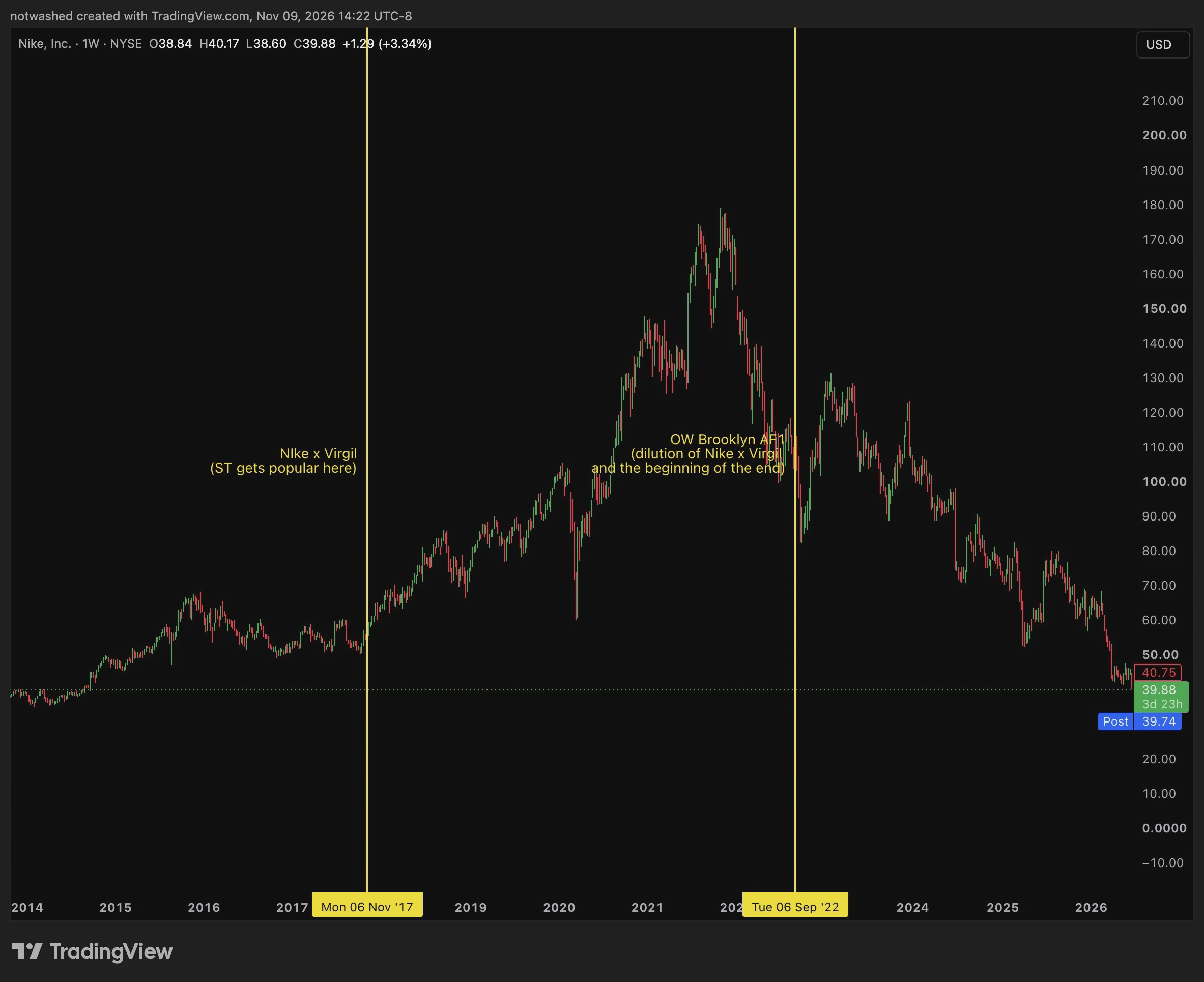
Chart: Nike weekly share price, annotated with key moments in the rise and fall of Sneaker Twitter (ST): from the rise of collaborations in 2017 to peak saturation in 2022 (Source: TradingView)
By 2023, most people in the sneaker scene had moved on, reselling trading cards (TCGs), flipping concert tickets, or starting their own brick-and-mortar businesses.
The chart below is definitely a less fitting example than Nike’s. It’s just my rough personal take on the relationship between Crypto Twitter and the crypto industry, so don’t read too much into it:
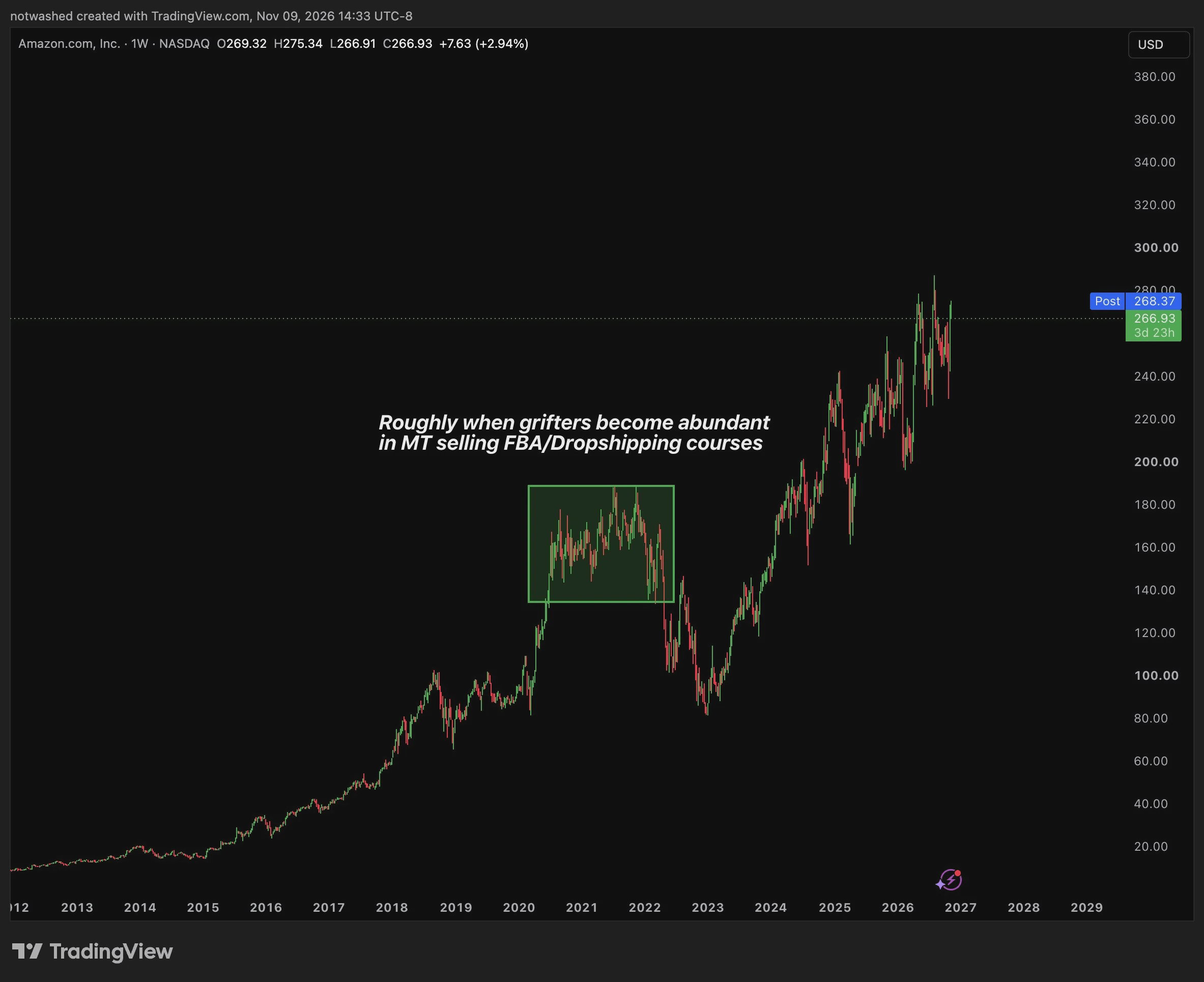
Chart: Amazon (AMZN) weekly price action compared with the heyday of course-selling on Money Twitter (MT): speculative course sales peaked in the highlighted 2021–2022 period, while the industry itself continued to grow (Source: TradingView)
E-commerce as a whole has been on a near-constant upward trajectory, but the niche Twitter community built around e-commerce, its popular narratives, and its arbitrage opportunities peaked back in 2021–2022.
Of course, Amazon is now much more than an e-commerce company; it’s a commercial behemoth. The point here is that an entire industry’s continued success doesn’t necessarily mean the social circles that spotted and capitalized on its early emergence will continue to enjoy the same advantages.
I should also add that Money Twitter covered a very broad range of topics—almost every kind of online business. When I was lurking, the main themes were building private-label brands (sometimes using dropshipping), paid information products, agencies providing outsourced operations, and affiliate marketing.
The story of Sneaker Twitter shows how participants cannibalized one another through increasingly aggressive competition, ultimately destroying the very opportunity that had drawn them in to begin with.
The story of Money Twitter, meanwhile, shows how, when the original opportunity becomes less appealing, participants shift from “making money by running a real business or trading” to “making money by monetizing their social influence.”
In that sense, Crypto Twitter today is more like Money Twitter than Sneaker Twitter. The crypto industry itself hasn’t peaked and collapsed the way sneaker resale culture did, and Crypto Twitter won’t become a completely empty ghost town either.
But Crypto Twitter can become increasingly irrelevant to the future of the crypto industry without having any effect on the crypto world’s continued growth and success.
The alpha that once lived on Crypto Twitter is increasingly moving into hands-on on-chain trading or disappearing into private circles on Discord and Telegram.
Of course, not all public social media is bad. There are still quality accounts doing their best to make this place better as they grow their influence. The most sensible thing to do is mute the noise and focus on following those people.
That niche corner of Crypto Twitter where you could discover new opportunities, exchange new ideas, and meet smart people has basically come to an end—and that’s no big deal.