SOL Roadmap Sparks Debate Over Doubling Compute Capacity | Officials Confirm Rotor and Constellation Still on Track for 2027 | I’m Waiting for 71.2 to Hold
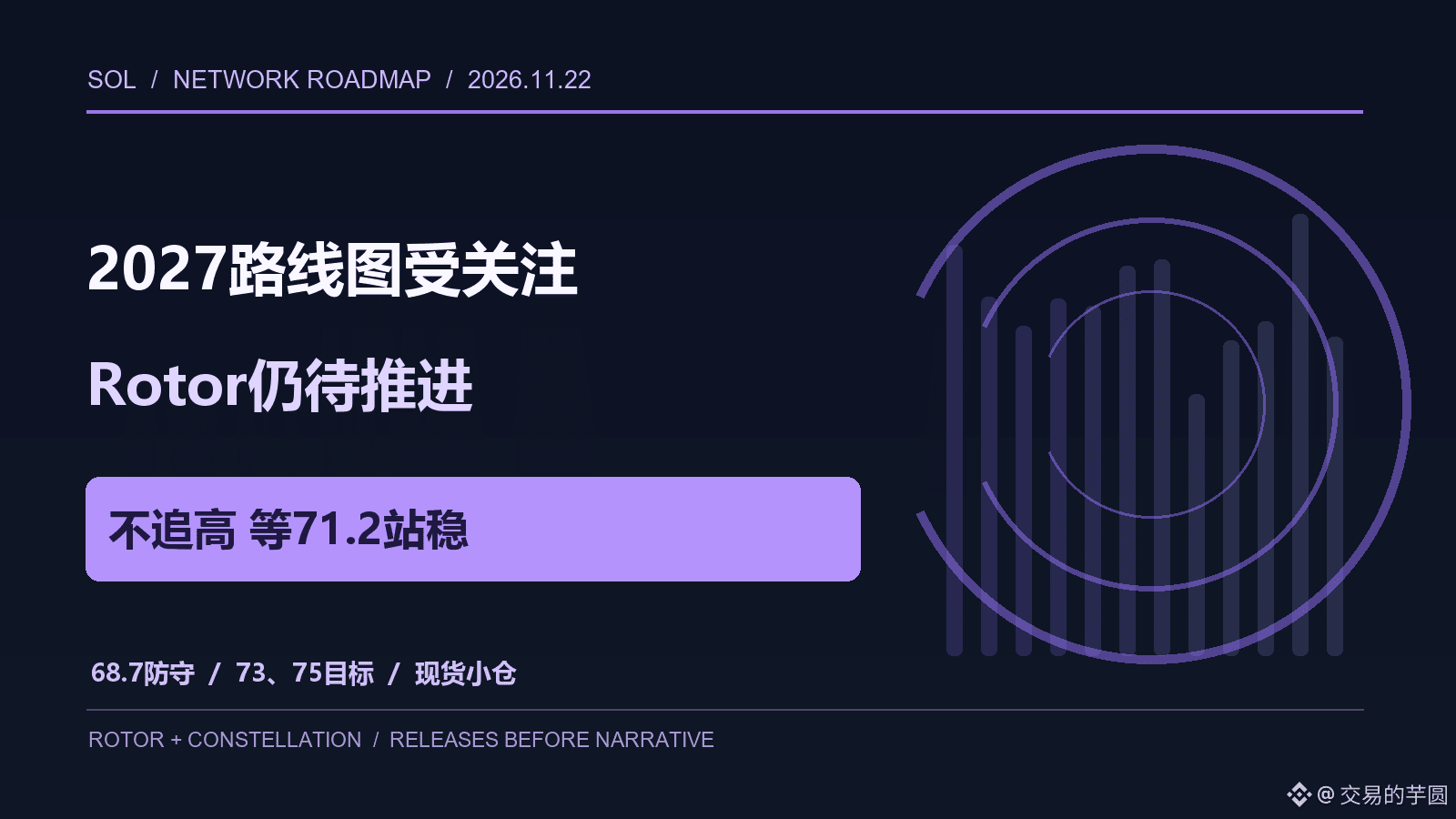
I’m optimistic about the direction of network engineering, but I won’t treat a roadmap as a delivery today, let alone chase SOL based on a headline. Discussion of #SolanaSets2027RoadmapToDoubleComputeCapacity on Binance Square is gaining traction, with figures such as “doubling compute capacity” and “cutting compute consumed by a single token account transaction by 80%” circulating. The primary source I can verify directly is the Solana Foundation’s November 19 recap of day two of Breakpoint: Anza CEO Brennan Watt said that Alpenglow Next is planned for 2027, with Rotor replacing Turbine and Constellation redesigning block building to make transaction ordering more predictable and fairer. The Foundation’s recap does not conclude that “doubling has already been achieved,” so these figures are part of a roadmap discussion and must not be presented as current mainnet performance.
The connection between this development and SOL’s price is conditional. Faster block propagation and more stable transaction ordering could theoretically improve the experience of getting transactions through during congestion, making payments, trading, and on-chain applications more likely to stay on Solana. But there is still a gap between a roadmap and value actually being delivered: code, testing, validator upgrades, app usage, and fee revenue all matter. A chain’s ability to handle more transactions does not mean SOL will rise by the same proportion; supply, risk appetite, and capital flows matter too. My previous article discussed the ecosystem product Supermassive; this one focuses on the infrastructure rollout timeline. The two plans are not yet live, so they cannot be combined and treated as demand that has already materialized.
For the market reaction, I’d look at live trading rather than the narrative. SOLUSDT on Binance was around $70.79 when checked, up about 2.65% over 24 hours, with a range of $68.70 to $71.12; the current price was already close to the day’s high. Farside showed net outflows of about $5.9 million from SOL funds on November 20. Their occurrence alongside the price rebound suggests short-term buying should not be directly attributed to sustained institutional accumulation. I view 71.2 as the breakout confirmation level and 68.7 as the defense level for this move, with 73 and 75 as potential targets to monitor in stages. These are trading conditions, not official forecasts. I would abandon my bullish view if the price falls back below 68.7, or if an official upgrade is delayed and activity and fees fail to pick up.
If I were trading this myself, I wouldn’t chase the price. I’d only consider a small spot position to test a long trade, with no leverage. I’d enter with 2% of my total capital only if SOL closes and holds above 71.2 for two consecutive one-hour candles, and buyers step in if it retests 71.2. If it breaks below 68.7 first, I’d stay out and wouldn’t try to catch the bottom. After entry, I’d take half off at 73, then half of the remainder at 75, and close the rest if a one-hour candle closes back below 71.2. I’d set the initial stop-loss at 69.8 and exit the entire position if any one-hour candle closes below it. I might also exit early if there is no volume follow-through after a breakout or fund outflows continue. I’d limit the maximum planned loss on a single trade to no more than 0.05% of total capital. If I miss the move, I’ll wait for the next one rather than abandon my discipline to chase a hot topic.
Sources: Solana Foundation’s day-two Breakpoint recap; Binance SOLUSDT 24-hour market data; Farside SOL fund flows. #SolanaSets2027RoadmapToDoubleComputeCapacity #SOL
The above is solely my personal market observation and does not constitute investment advice.