

"Bitcoin Ecosystem: Pulling Back the Curtain of Trustless Finance" is a research report on the development of various aspects of the Bitcoin ecosystem. This report was co-authored by the Spartan Group team, Kyle Ellicott, and several experts who provided feedback and insights and generously spent their time reviewing the final version of this article. This report was drafted in December 2023, and the data in it is accurate as of the time of writing. This is the second of four articles in the series. For the first article, please go to "Bitcoin Ecosystem: Pulling Back the Curtain of Trustless Finance (I)"
The evolving Bitcoin debate
Since its creation in January 2009, Bitcoin has evolved significantly in its role and potential. Initially, many viewed Bitcoin as a hedge against inflation, a store of value (SoV), and a hope to democratize the financial system. Only recently, in its fifteenth year, has the Bitcoin network regained attention for its role as a platform for the decentralized applications (dApps) of the future. This evolution is particularly noteworthy at this stage, mainly due to the fact that Ethereum’s success in applications and Bitcoin’s continued dominance over Ethereum as an asset have undoubtedly influenced people’s expectations of the Bitcoin network. Inspired by this, developers have introduced a number of infrastructure “layers” on top of the Bitcoin Core Network (Layer-1 or L1). These Bitcoin ecosystem layers take advantage of Bitcoin’s stability and security while aiming to unlock the more than $850 billion and growing unyielding assets by improving scalability and programmability without changing L1. Today, we are all witnesses and participants of the significant progress of the Bitcoin ecosystem, and we expect these ecosystems to work on BTC assets, fully inheriting Bitcoin's reorganization security and finality, while overcoming its limitations in programmability and performance. Looking ahead, these unique infrastructure layers attached to the Bitcoin ecosystem will become the cornerstone for many application entrepreneurs to rely on.
Despite the progress made, much of the necessary infrastructure is still under development and experimentation. It is worth noting that the journey that the Bitcoin ecosystem is taking is not without precedent. In 2017, the influx of early NFT and token projects into the Ethereum network led to slowing transactions and a sharp increase in transaction fees, which actually inspired the developer community to build a more powerful infrastructure, even if its efforts could only enable the Ethereum network to support a small part of the massive potential application needs, and developers also hoped to provide the network with the necessary scalability and flexibility. At that time, the Ethereum community discussed and experimented with a variety of methods, and ultimately decided to adopt a layered approach to improve its performance and scalability, so that the Ethereum Layer 2 (Layer-2 or L2) we see today is widely used and accepted, and its on-chain locked assets (TVL) have reached billions of dollars. Therefore, Ethereum's experience in scalability, ecological growth, decentralized applications and its underlying network can all be learned from Bitcoin.
Similar to Ethereum’s pivotal moment in 2017, the introduction of Ordinals in 2023 became a major cultural turning point for “building on Bitcoin.” This shift triggered a developer revolution to build on infrastructure and extension layers on top of Bitcoin’s L1. We are now seeing not only the creation of new protocols and token standards (such as BRC-20, etc.), but also the development of new Bitcoin L2s that are beginning to unlock the potential of the Bitcoin economy and provide a glimpse into the potential unlocking of over $850 billion worth of dormant capital based on the most stable and battle-tested technology in the industry to date. As a result, the Bitcoin thesis is being redefined: Bitcoin is no longer just a store of value or an asset, but is fulfilling its purpose as infrastructure in an expanding economy.
Analogous to Ethereum’s growth trajectory, the Bitcoin ecosystem is likely to experience a surge in user adoption, driven by viral use cases that kick-start the growth flywheel. This will in turn attract more developers and increase the TVL of ecosystem applications. Considering Bitcoin’s market cap is around $850 billion, which is about 3.15 times Ethereum’s $270 billion market cap, and in comparison, Bitcoin’s current application TVL is only $320 million, while Ethereum’s application TVL is $76 billion. In other words, these data indicate that the Bitcoin ecosystem may have a potential 740x growth opportunity to reach similar maturity as Ethereum at the application level. In addition, we also need to consider the potential influx of additional liquidity once the ecosystem gains traction.

The huge market potential of Bitcoin smart contracts
The battle between “network” and “assets”
To better understand the evolving new narrative, we need to distinguish between the Bitcoin digital asset (BTC) and the Bitcoin network (i.e. Bitcoin Core, Bitcoin L1, Bitcoin blockchain). Many people are confused about the meaning of the word "Bitcoin" because it can refer to both the network and the token. The two are closely related but very different. To avoid confusion, this report uses "Bitcoin" when referring to the network and "BTC" when talking about the token or digital asset.
The famous white paper of Bitcoin the Network (Bitcoin: A Peer-to-Peer Electronic Cash System, Satoshi Nakamoto) was released on October 31, 2008, introducing a peer-to-peer electronic cash system to the world, and soon after, the Bitcoin network went live. Its genesis block was mined on January 3, 2009. Since its release, the network has maintained stable operation, while other networks have experienced various problems such as downtime and attacks, which proves the feasibility of Bitcoin as the ultimate L1 network. Bitcoin has demonstrated its ability to provide trust without centralized intermediaries and serve as the ultimate decentralized settlement layer for transactions, assets, and future applications. However, due to Bitcoin's lack of flexible programmability and the inability to write to the network from the outside without trust, it has been difficult to develop applications on Bitcoin other than the BTC asset itself. Compared with Ethereum, an important difference between Bitcoin and Ethereum is that it does not natively support smart contracts. Without smart contracts, all development based on the Bitcoin network requires the development of more tools to complete smart contract-like functions. Smart contracts are the key function that enables decentralized applications to use BTC as an asset or settle transactions on Bitcoin L1.
BTC (digital asset) has traditionally been viewed as a store of value and a hedge against inflation in turbulent global financial markets. The advent of BTC provided the world with a digital, permissionless, censorship-resistant, and scarce global asset for the first time. BTC has remained the top crypto asset throughout, with a market cap of more than $850 billion, and a peak of $1.25 trillion in November 2021. However, even more than a decade later, the general public still only sees BTC as a store of value as its primary value. Unless BTC evolves and innovates further, it will be difficult for us to see BTC gain more utility, and it will be difficult for the public to judge its value beyond the current perception.
The Bitcoin ecosystem provides a solution to this problem. BTC assets are the initial use case of Bitcoin L1. If Bitcoin ecosystem layers, such as Bitcoin L2, can run smart contracts that can use BTC as an asset, then Bitcoin L1 can retain its key advantages (such as security, durability, and decentralization) while allowing unlimited experiments on other Bitcoin ecosystem layers. Applications can use BTC as their asset, run on L2 rails, and settle transactions on L1. These L2 rails can provide faster and more scalable transactions while gradually inheriting security from L1. This makes "Building on Bitcoin" possible and redefines the Bitcoin thesis as a real asset and infrastructure for a growing Bitcoin economy.
Building on the Bitcoin Ecosystem
Over the past few years, the market has proven that building on the Bitcoin blockchain brings unique opportunities and challenges. Unlike other blockchains, Bitcoin was created to be seen as an asset or "currency" rather than as an application platform. Other blockchains have clearly entered the public's field of vision as application platforms. In order to more intuitively understand why Bitcoin has been slower to mature than other ecosystems, it is particularly important to look back at its early days:
The Bitcoin network is open to everyone, regardless of background or technical knowledge. The Bitcoin code is open source and can be copied and modified. This openness fosters a culture that encourages experimentation, and no single group or individual can have a decisive influence on the direction of the blockchain.
The interoperability of the Bitcoin network is limited, a feature that has led to the creation of unique derivatives. Bitcoin's derivative networks are completely independent, have their own assets, and are not "backward compatible" with the original Bitcoin network. Therefore, in its current state, BTC assets are restricted to the Bitcoin network and cannot be directly removed or transferred to other blockchain networks.
Lack of programmability creates a significant barrier to construction. Since Bitcoin does not support smart contracts, it does not have flexible programming capabilities, which limits its use as an application development platform. Coupled with its severe performance limitations, this is a major challenge that must be faced if Bitcoin is considered a platform for construction.
Bitcoin L1 still needs help in terms of speed and scalability. The Bitcoin network is very limited in its ability to confirm transactions and process large amounts of transaction data in a short period of time. Due to the key need to ensure decentralization, the size and frequency of records (also known as blocks) in the Bitcoin blockchain are limited. Since an average block is generated every 10 minutes and the original block size is 1 megabyte, the Bitcoin network's on-chain transaction processing capacity is affected, and the average transaction confirmation time is more than 10 to 30 minutes, which is far from meeting the needs of most applications.
To try to deal with or improve these characteristics of Bitcoin, we need to first understand the Blockchain Trilemma. Using this concept to look at Bitcoin L1, we can see that it is decentralized (a) and secure (b), but lacks scalability (c), and the transaction processing speed is only about 3 to 7.8 transactions per second. This limitation highlights the need to find alternatives or additional ecological layers to compensate for the inherent defects of the original blockchain network.
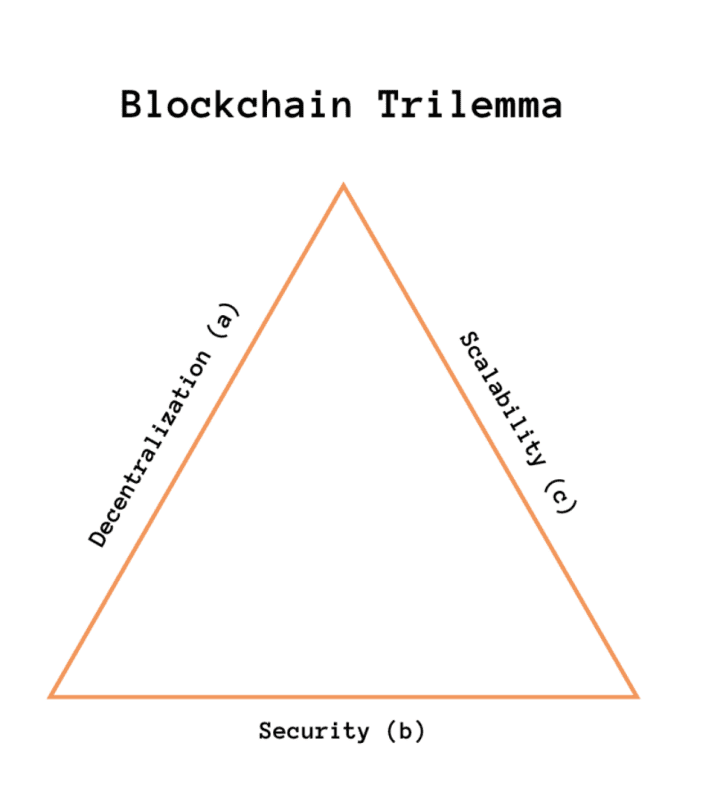
The urgent need for scalable solutions gave rise to the Ethereum network in its early days. Although Ethereum lacks security and decentralization compared to Bitcoin, Ethereum provides scalability solutions required for application development, such as the second-layer network L2 (for example, Arbitrum, OP Mainnet, etc.) and subnetworks (e.g., Avalanche’s Evergreen), achieved significant growth. Throughout the industry, similar trade-off solutions are emerging one after another, and there has been a wave of development focused on scaling solutions, including Sharding, Nested Blockchains, and State Channels. ), Supernets (e.g., Polygon Edge), App-Chains, and second-layer networks (also known as sidechains).
For many years, the focus has been mainly on Ethereum and its compatible Ethereum Virtual Machine (EVM) ecosystem. However, in 2023, with the latest upgrades and Ordinals of Bitcoin L1, we are witnessing a shift in focus across the industry. Developers are turning their attention back to Bitcoin, especially to solve its scalability problem - an important part of Bitcoin L1's impossible trinity problem (security, decentralization and scalability).
Bitcoin Scaling: The Critical L1 Upgrade
Bitcoin’s major progress in scalability began with the Segregated Witness (SegWit) update in July 2017. The upgrade marked an important change that reduced transaction times and increased block size beyond the 1MB limit set by Satoshi Nakamoto in 2010 by separating the unlocking code into a dedicated section of each Bitcoin transaction.
SegWit introduced a revised block size measurement method using "Weight Units" (wu), later called vsize/vbyte, allowing up to 4M weight units (4wu) per block, effectively expanding the block size to about 4MB. This change is designed to be backward compatible with all previous Bitcoin Core versions and greatly improves transaction efficiency.
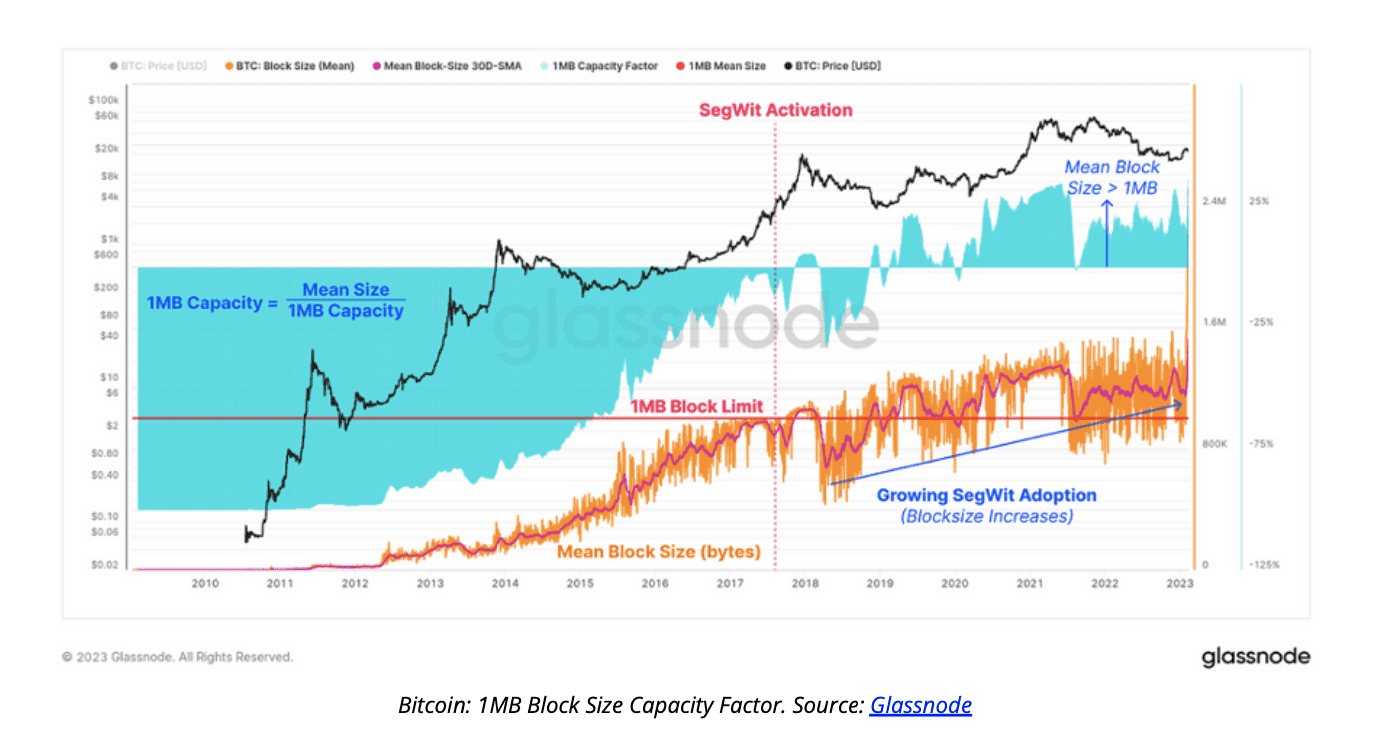
Bitcoin: 1MB block size capacity factor. Source: Glassnode
SegWit achieves this by splitting the data structure, separating the "witness data" in the transaction (including signatures and scripts) into a completely new part of the Bitcoin block, the "transaction data", which contains detailed information about the sender, receiver, etc. The introduction of this structure divides the new 4wu (weighted unit) block size into the following two parts:
Each virtual byte (vbyte) of witness data is calculated as 1 weight unit (wu), and compared to transaction data, the weight of each virtual byte is only 25%.
Each virtual byte (vbyte) of transaction data is calculated as 4 weight units (wu), which is four times the weight of each virtual byte of witness data.
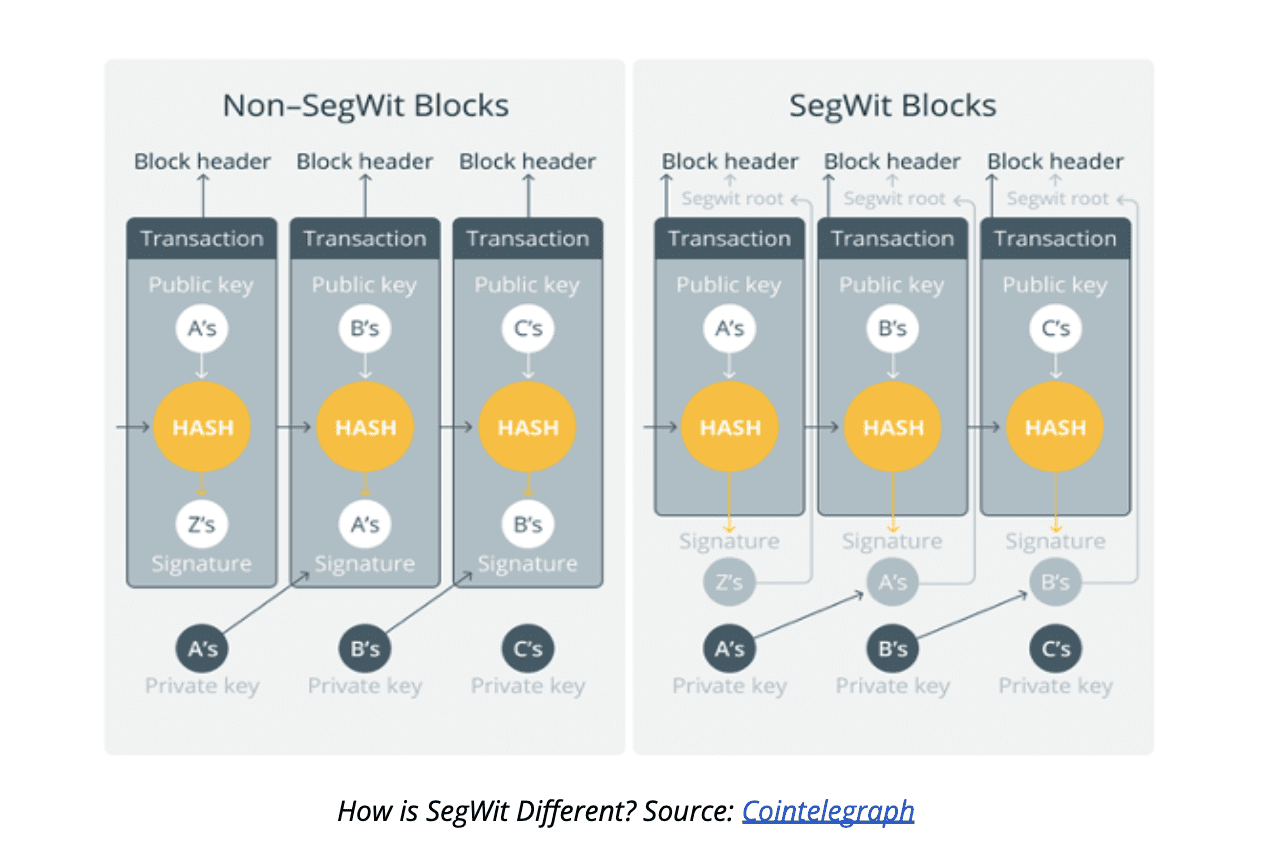
How is SegWit different? Source: Cointelegraph
Following SegWit, Taproot is another major upgrade for Bitcoin, activated in November 2021. Taproot is a soft fork that removes the maximum limit on witness data per transaction, enabling faster transactions, enhanced privacy through Merkelized Alternative Script Trees (MAST), and more efficient key signing through Schnorr signatures. Taproot also facilitates asset transactions on Bitcoin L1, introducing protocols like Pay-to-Taproot (P2TR) and Taproot Asset Representation Overlay (Taro).
Taro is a protocol based on Taproot technology that supports the issuance, sending and receiving of assets on Bitcoin L1 and Lightning Network. The protocol will launch its mainnet Alpha version in October 2023.
Schnorr signatures enable key aggregation by introducing the ability to merge multiple public keys and signatures into one. In short, multiple signatures are combined for verification instead of aggregating each signature individually, thereby improving transaction efficiency.
MAST increases privacy by hiding the pre-conditions associated with transactions and does not publish unused results on-chain, which not only improves privacy but also reduces transaction size, thereby reducing data usage.
P2TR introduces a new Bitcoin payment method through Taproot addresses.
These L1 upgrades lay the foundation for further development of the Bitcoin ecosystem layer, which has been quietly taking place behind the scenes until the release of Inscription, when Bitcoin's construction work has once again entered the spotlight, marking a new era of Bitcoin's scalability and functionality.
The Bitcoin Builder Renaissance Sparked by Inscription
Despite the L1 upgrade, following the conservative outcome of the 2017 “block size war”, Bitcoin has experienced a period of stagnation in development activity that has lasted until 2022. This relatively slow pace of development is primarily due to the fact that most of the effort is focused on maintaining Bitcoin Core L1, with less attention paid to the development of the broader infrastructure required to build a vast ecosystem. Of the limited development activity on Bitcoin, it is concentrated in emerging ecosystems like Stacks (175+ active developers per month) and Lightning, which only account for a small portion of the industry’s developers.
In December 2022, with the emergence of Inscription, the development landscape of Bitcoin changed significantly. Ordinals allow for the creation of immutable digital art on-chain, not only re-energizing the Bitcoin developer community but also predicting that this will develop into a $4.5 billion market by 2025. More and more developers no longer focus solely on Ethereum, but are expanding their horizons to include Bitcoin L2 solutions. This key development signals a resurgence of engagement and innovative activity within the Bitcoin ecosystem, setting the stage for a new wave of growth and technological advancement.
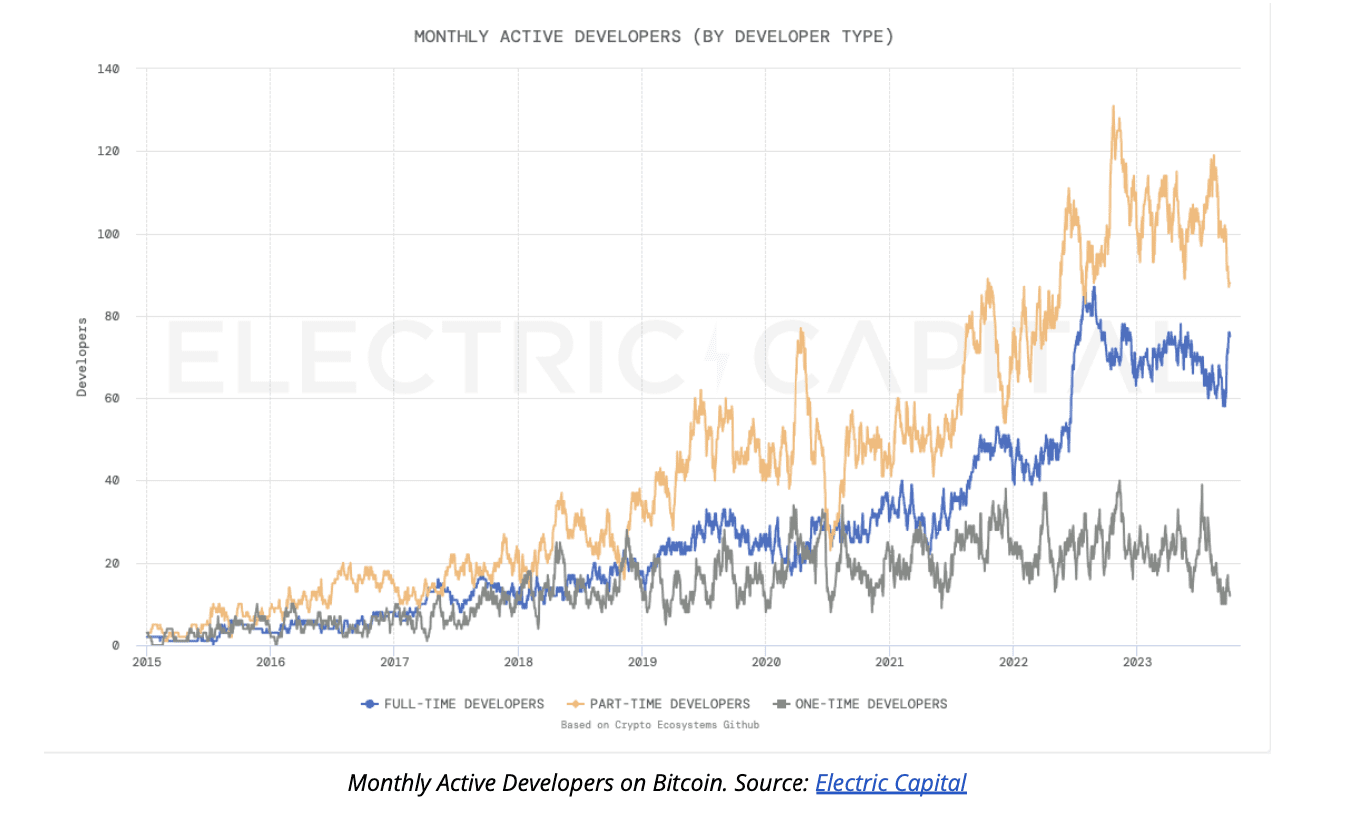 Number of monthly active Bitcoin developers. Source: Electric Capital
The introduction of Ordinals has had a profound impact on the Bitcoin network, especially the increase in transaction fees. Compared to relatively modest 1-3 sats/vB fee levels in 2022, when Ordinals began to come into focus in May 2023, transaction fees experienced a staggering 20x to 500x spike. By December 2023, its annual growth rate has reached as high as 280%. This surge in data significantly demonstrates the sharp increase in activity and interest in the Bitcoin network and plays a key role in revitalizing the Bitcoin builder culture and ecosystem. While higher fees help increase Bitcoin’s long-term security budget beyond current standards, they also reflect the growing demand for Bitcoin block space.
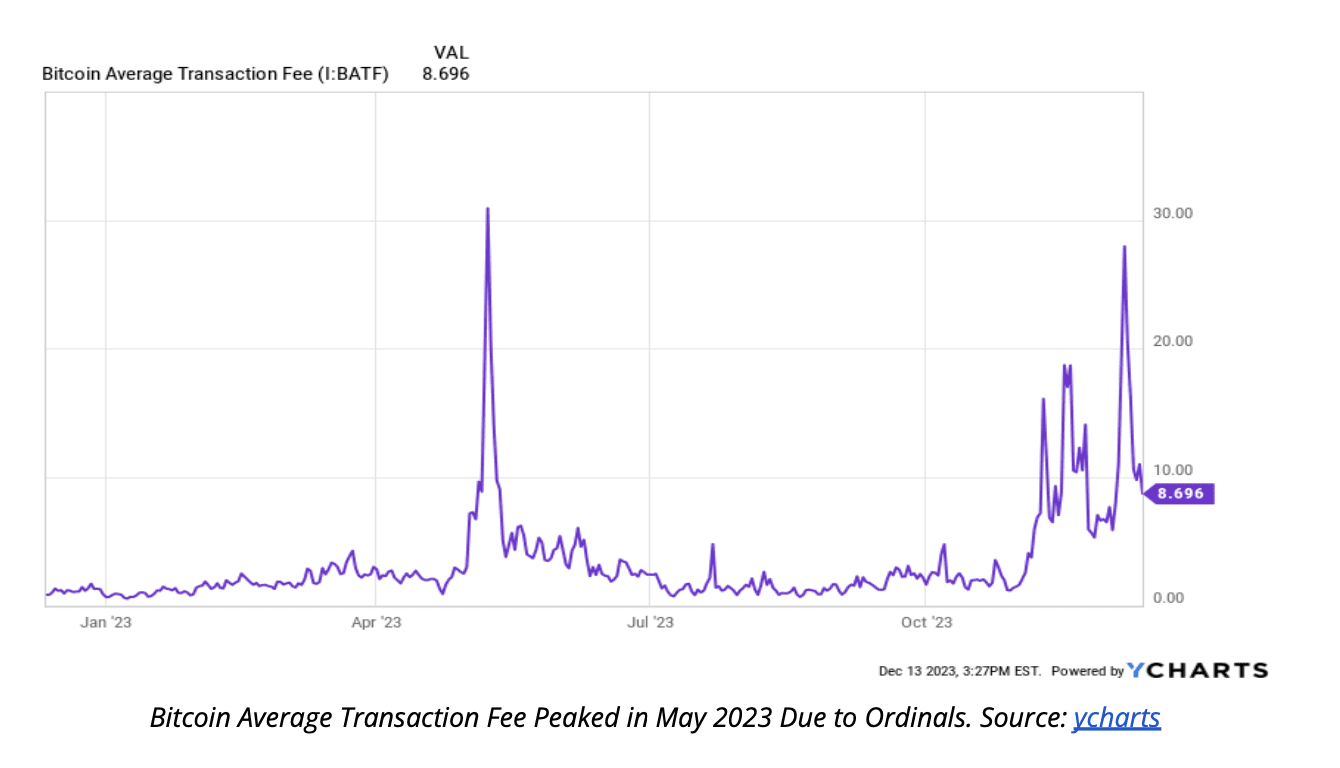
Average Bitcoin transaction fees peak in May 2023 due to Ordinals. Source: ycharts
The surge in usage of the Bitcoin network has put tremendous pressure on its infrastructure, especially in rising transaction costs, while also posing new challenges to its affordability and practicality. This development becomes particularly evident when users face high fees that are disproportionate to the amount of transactions. For example, a Bitcoin transaction worth $100 may require a fee of up to $50, significantly reducing its economic viability. The same situation extends to Lightning Network channels, as closing a channel with a similar transaction value becomes impractical due to exorbitant costs. If the transaction fee is too high, such as 1000 sats/vB, the network will face a more complicated situation. Therefore, there is an urgent need for scalability solutions within the Bitcoin ecosystem to meet growing demand while still maintaining its transaction viability.
The phenomenal Inscription has reignited developer interest in Bitcoin, but it has also further magnified Bitcoin's limitations. In particular, due to Inscription's lack of support for fully expressive smart contracts, developers have turned their attention to other platforms. This highlights the need for more sophisticated scaling solutions within the Bitcoin ecosystem to ensure its practicality and relevance in the broader blockchain and financial sectors.
The strategic necessity of a second-layer solution
Therefore, L2 solutions are becoming increasingly important for the Bitcoin network to achieve increased functionality and further success. L2 operates on top of L1, improving scalability and reducing transaction costs by facilitating off-chain transaction channels. Unlike Ethereum, where L1 autonomously supports smart contracts, Bitcoin's L1, due to its original design emphasis on security and decentralization, needs to rely on L2 solutions to provide this functionality. This reliance emphasizes the key role of L2 solutions in expanding the utility of Bitcoin, which is not limited to basic transactions, but can also enhance its efficiency, scalability, and overall appeal in the digital asset space.
Although L2 solutions for Bitcoin are still in their early stages of development, they are poised for significant growth. In comparison, mature alternative L1 scaling options such as Ethereum and L2 solutions like Polygon have reached a higher level of maturity. Since 2017, due to the extensive efforts of developers, these networks have been equipped with advanced tools (such as Starknet, ZKSync, etc.) and features, which is clearly reflected in their TVL data, which accounts for approximately 9.0% of the market capitalization to 12.5%. As technology continues to advance and innovate, Bitcoin's L2 solution is expected to reach a similar level of maturity and may develop into an economic system that is comparable in scale to or even larger than existing L2 solutions. It is predicted that Bitcoin's L2 solution will be able to handle a large number of Bitcoin transactions in the future, possibly exceeding 25% of all Bitcoin transaction volume. This will be a huge leap compared to the current Bitcoin L1 usage.
Updated by the author (February 8, 2024)
Some of the latest developments in Bitcoin’s L1 infrastructure are designed to emulate smart contract functionality without having to build a dedicated smart contract layer. Innovations like recursive inscriptions (BRC-420) and OrdiFi, as well as discussions about re-enabling the “OP_CAT” feature via a soft fork, are all designed to facilitate complex transactions similar to DeFi, bypassing traditional smart contracts.
Once again, unlike Ethereum Virtual Machine (EVM) compatible chains that achieve composability through a general-purpose virtual machine, Bitcoin's framework lacks such a smart contract mechanism. This fundamental difference requires the Bitcoin project to deploy additional tools and more complex integration strategies to provide a user experience comparable to Ethereum. This may cause experiments on L1 to face similar scalability challenges as the basic network. So far, different degrees of smart contract applications have begun to appear in the ecosystem, and it is very likely to expand further.
For example, the team behind BRC-420 recently launched Merlin Chain, a Bitcoin-native L2 solution designed to alleviate scalability issues. In addition, Ordz Games launched the first-ever Bitcoin-based game last year using the BRC-20 token $OG, which was issued on a decentralized exchange (IDO) on ALEX Lab's Launchpad earlier this year, achieving 81 times oversubscription in the form of $ORDG. In subsequent parts of this series, we will dive into these innovations in detail, outlining the continuous evolution of the Bitcoin ecosystem.