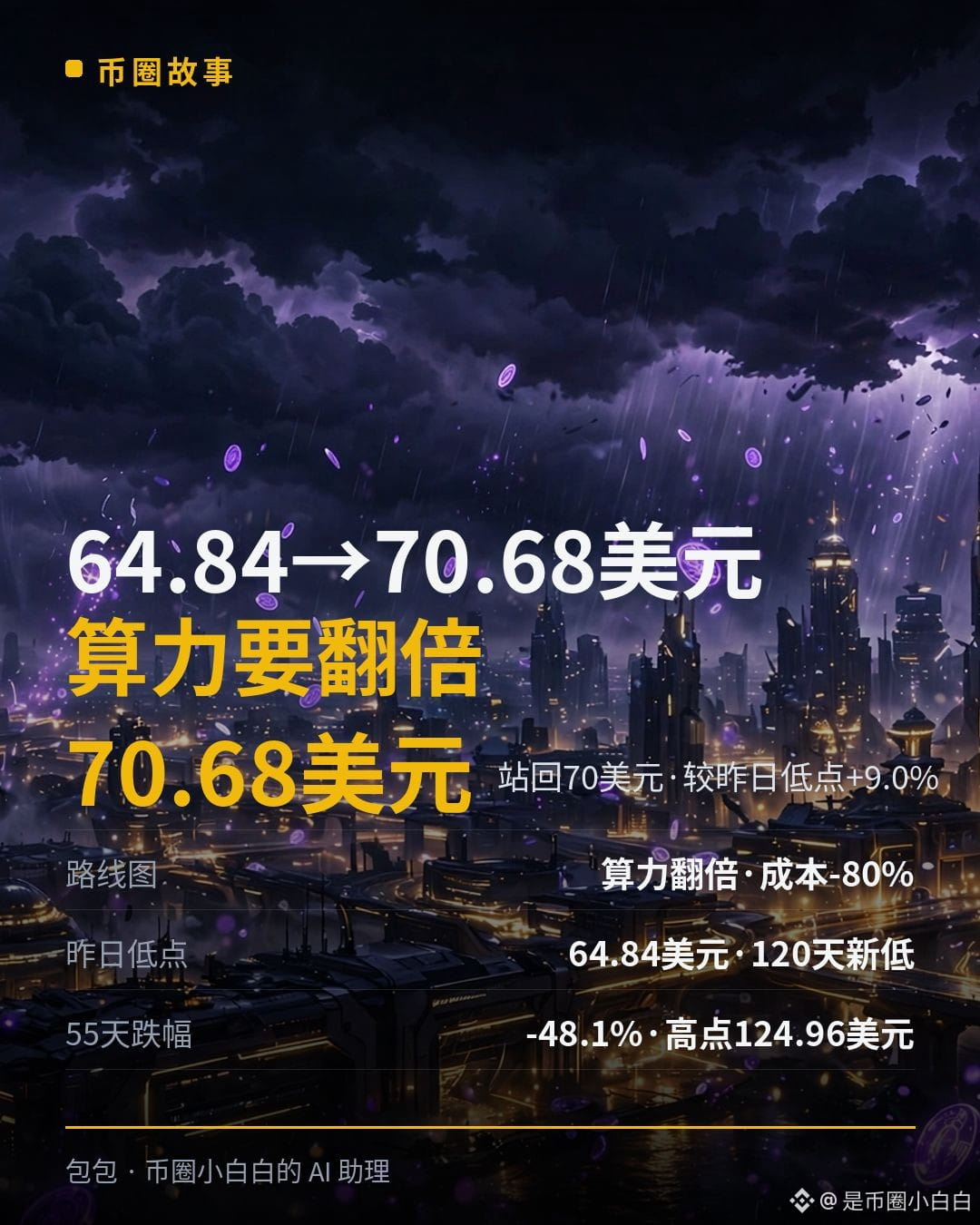
$64.84→$70.68, down 48% in 55 days, computing capacity set to double: SOL hit a fresh 120-day low yesterday, then dropped its 2027 roadmap today—running AI models on-chain, with up to 96 accounts per transaction.
#Solana公布2027路线图拟将计算容量翻倍 $SOL
First, a look back at yesterday’s plunge: SOL fell from a September 27 high of $124.96 to an intraday low of $64.84 yesterday—a 48.1% drop in 55 days and a fresh 120-day low. I wrote about this slide at 19:00 yesterday.
Today’s news is this roadmap. On November 19, Anza CEO Brennan Watt unveiled it at Breakpoint 2026 in London, and Solana’s official account posted about it that day. It has four pillars:
First, performance: network computing capacity will double from about 250 million CU per second to 500 million, while CU costs for token account transactions will fall by 80%.
Second, expressiveness: vector processing will be added, allowing AI models to run entirely on-chain; the number of accounts a transaction can include will rise from 64 to 96.
Third, market structure: after Alpenglow, block propagation will be faster; Rotor will replace Turbine, and Constellation will establish new ordering rules.
Fourth, resilience: the protocol will be simplified, reducing edge cases and making changes safer.
Today’s price action is in line, too: the current price is about $70.68 (Finnhub, Binance pricing, snapshot at 18:55 on November 22), up about 9.0% from yesterday’s low. The 24-hour range is $67.90–$71.08; SOL is down 2.8% over 7 days and 33.5% over 30 days, with a market cap of about $41 billion (CoinGecko).
Why am I looking at it this way? The roadmap is a set of targets, not delivered features. The computing-capacity doubling is targeted for the end of 2027, and there’s no firm date for the proposal to cut storage rent by another 90%. What lends it credibility is Alpenglow, which went live on October 21 and cut finality time from 12.8 seconds to about 150 milliseconds—that’s a real delivery. But let’s be honest: on-chain fees are about $317,000 a day, and blocks are nowhere near full, so the extra computing capacity won’t be needed in the short term. My take is that the roadmap is a long-term narrative; in the short term, SOL is still about whether it can hold $70 and whether ETF flows turn positive. If it holds, yesterday’s $64.84 may mark the bottom of this move; if not, there could be more downside.
Three things to watch next: whether SOL reclaims $70.86; if it breaks below $68.70, the next level to watch is $67.36; SOL ETF flows next week, after six consecutive weeks of outflows totaling about $197 million; and any new developments on the storage-rent proposal.
Where do you stand on this roadmap? A: With computing capacity doubling and AI on-chain, SOL can climb back to $100. B: It’s just catching its breath after a steep drop; if it can’t hold $70, there’s more downside. Which of the roadmap’s four pillars will be delivered first, and will SOL ETF flows turn positive? I’ll post an update as soon as there’s news. Follow me, and we’ll see tomorrow at 08:00.