$BTC $ETH $ZEC
Oil is above 90, the Middle East is at war, and Bitcoin has surged to 61,365—this isn’t what a safe haven looks like.
Let’s put tonight’s three hard facts on the table and check them one by one.
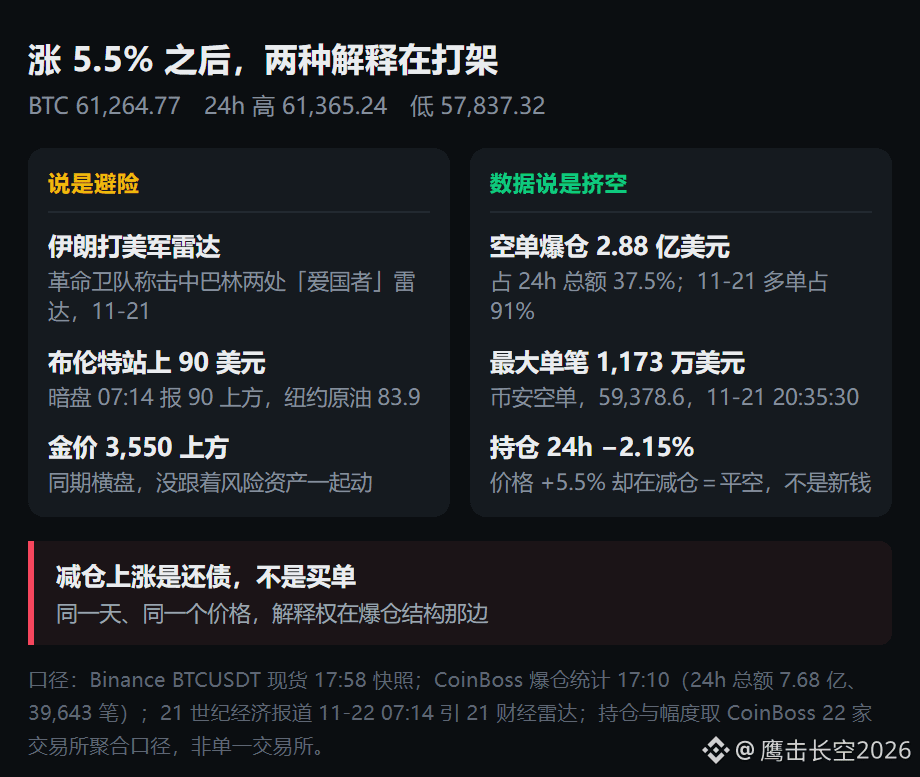
First, the Middle East. On 11-21, Iran’s Revolutionary Guard issued a statement saying it had used missiles and drones to strike the Patriot air-defense radars at two U.S. bases in Bahrain, in Riffa and Awali, in response to U.S. violations of Iranian airspace (Xinhua, citing the Islamic Republic News Agency). That same day, Trump told Fox News he wanted to negotiate a “permanent agreement” with Iran.
Second, oil and gold. At 7:14 a.m. on 11-22, Brent in the off-market session was up nearly 0.2%, above $90 a barrel, while New York crude was at 83.9. Gold was holding above 3,550 in the off-market session (21st Century Business Herald, citing 21 Finance Radar). Oil is moving; gold isn’t.
Third, liquidations. Across the market, $768 million was liquidated over 24 hours, across 39,643 trades. The largest single liquidation was $11.73 million—a Binance short, filled at 59,378.6 and wiped out at 20:35:30 last night. Shorts made up 37.5% of the total, while on 11-21, longs still accounted for 91% (CoinBoss, 17:10).
Now that we’ve laid out the three facts, here’s how the transmission chain works.
Step one: the Middle East catches fire, and oil climbs above 90. Oil is the father of inflation; no one disputes that link.
Step two: with oil at 90, inflation expectations return, and CME FedWatch put the odds of a 25-basis-point rate hike in December at 96.4% (11-21). Discount rates rise, so risk assets should fall.
Step three: Bitcoin, which should have fallen, instead climbed from 57,837.32 to 61,365.24, up 5.54%, setting a new high for the day. This is where the chain breaks.
Where did it break? There are only two explanations: either Bitcoin really has become a safe-haven asset, or this 5.5% move wasn’t driven by macro factors.
I’m going with the second explanation. The reason isn’t in the price; it’s in the liquidation list: that 5.5% rise liquidated $288 million in shorts, 37.5% of the day’s total liquidations. The largest single liquidation was a short worth $11.73 million, forced out at 59,378.6—it was wiped out during the rebound. Genuine safe-haven buying doesn’t liquidate anyone; only a short squeeze does.
And to be honest, an hour ago I wrote, “Don’t chase above 59,700.” It’s now at 61,264. I was wrong because I mistook the shorts covering their debts for the end of the move. I didn’t account for a second wave of short covering.
Here’s how I’d trade tonight: two levels, no directional call.
Upper level: 61,365.24. That’s today’s high and the shorts’ last stop-loss zone. Only a one-hour candle closing above it would confirm a breakout. That’s when I’d turn bullish, with a stop at 60,410.
Lower level: 60,410. That’s the high of the 16:00 one-hour candle, and the step where this rally began. A drop back below it would mean the 1,951.8 contracts of volume in the 17:00 candle were the final push—a false breakout. I wouldn’t take it.
Stay out of the middle. There’s no U.S. stock market or ETF creation and redemption on Sunday night, so liquidity is thinnest and wicks are more common than trends.
Keep two times in mind: 00:00 Beijing time, when funding rates settle; and Monday at 08:00, when the weekly candle closes. Whether this weekly candle closes above or below 60,000 matters much more than tonight’s 900-point move.
Takeaway: Leverage can explain what macro can’t.
Li Yi wrote, “I wonder where the reed flute is being played; all the soldiers look homeward through the night.” A flute sounds in the night, and everyone turns to look back toward home. Tonight, that flute is 61,365.
Are you in the group whose short got wiped out, or the group that just chased in at 61,000? Give me three numbers—position size, leverage, and whether your stop is at 60,410 or 61,000—and I’ll go through them one by one.
If you want to come argue in person, tap the group-chat link on my profile: Eagle Strikes the Sky · Crypto Study Club. It’s a small group, so people can hear you.