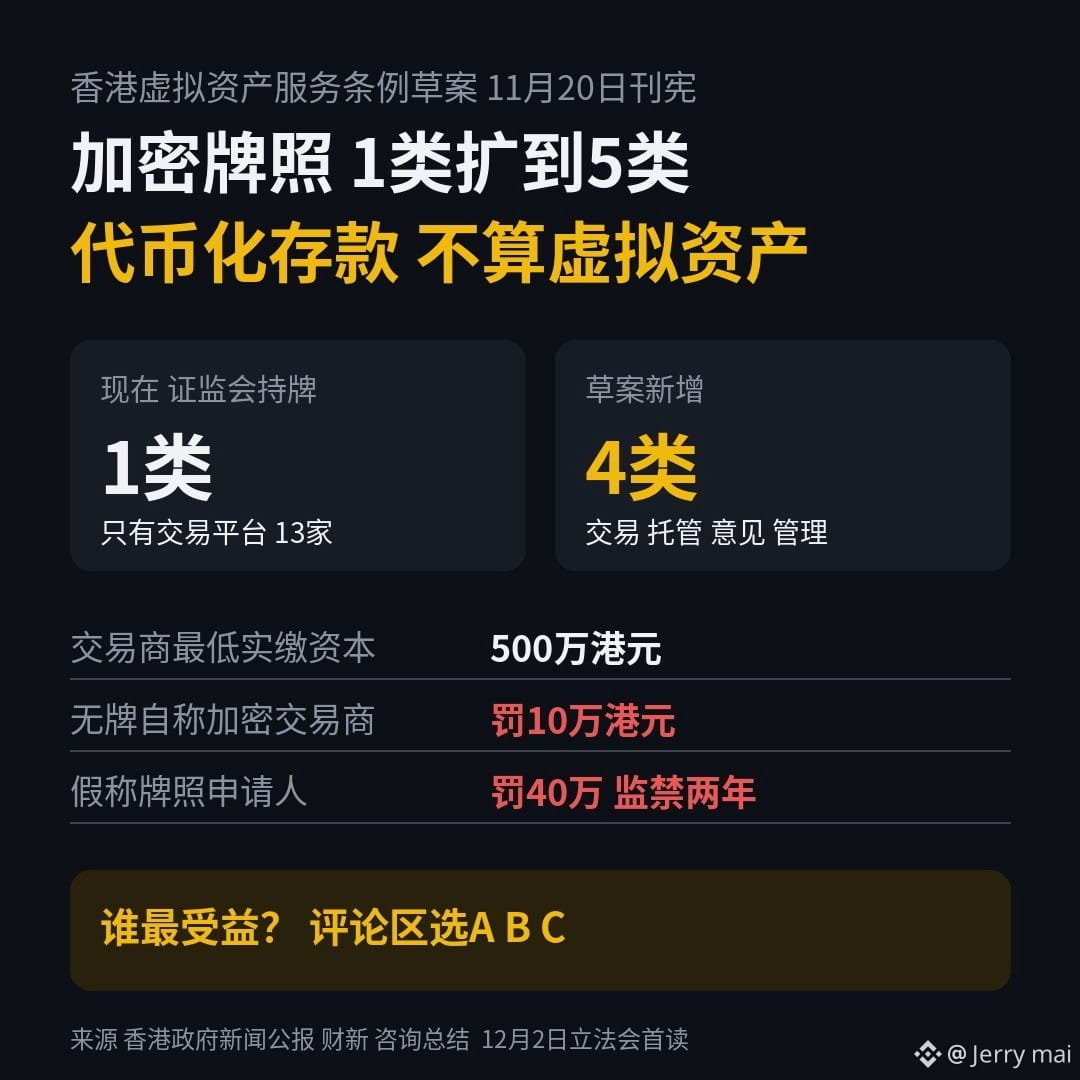
A Hong Kong draft bill expands crypto licensing from 1 category to 5, while on-chain deposits issued by banks are carved out separately.
On November 20, the Hong Kong government gazetted the Virtual Asset Service Providers (Amendment) Bill 2026. It will have its first reading in the Legislative Council on December 2.
The phrase used by Christopher Hui, Secretary for Financial Services and the Treasury, was “same business, same risks, same rules.”
1 category becomes 5.
So far, crypto businesses in Hong Kong that need an SFC licence have basically been limited to trading platforms. The list updated on October 16 had 13 firms.
The draft bill adds trading and custody, as well as providing advice and asset management. Over-the-counter dealers and firms that hold private keys for clients will also need licences.
HK$5 million.
According to the consultation conclusions published by the Financial Services and the Treasury Bureau and the SFC last December, dealers will need minimum paid-up capital of HK$5 million. Existing firms will not be deemed licensed during a transitional period. Those that have not contacted the SFC by the time the law takes effect may have to suspend operations. The effective date has not been set.
HK$100,000.
According to Caixin, anyone without a licence who claims to be a “crypto dealer” or “virtual asset custodian” could be fined HK$100,000 upon conviction, plus HK$2,000 for each day the offence continues. Anyone who has not submitted an application but claims to be in the process of applying could, upon conviction on indictment, be fined HK$400,000 and imprisoned for two years.
Tokenized deposits issued by banks are not considered virtual assets, but banks are still subject to extensive regulation.
Under the HKMA’s framework, they are classified as private money on the monetary side and continue to be regulated as deposits. The same draft bill also requires banks and licensed stored-value facility operators to register with the SFC if they provide any virtual asset services in Hong Kong.
The gazettal and first-reading dates are stated in the government press release. The penalty figures currently come from Caixin’s reporting. Whether staking, lending and margin trading will be permitted is still under separate review, and the provisions may also be revised during the Legislative Council’s deliberations.
My take is that Hong Kong is splitting up on-chain money according to its issuer: the bank-issued kind falls under the HKMA, while the crypto-industry kind falls under the SFC. Intermediaries without licences who attract customers by relying on a title will have much less room to operate going forward...
Who do you think will benefit most once this draft bill takes effect?
A. The 13 trading platforms that are already licensed
B. Banks offering tokenized deposits
C. Ordinary investors
#香港代币化存款拟不列虚拟资产 #香港拟罚冒用加密头衔者10万港元 #香港
On November 20, the Hong Kong government gazetted the Virtual Asset Service Providers (Amendment) Bill 2026. It will have its first reading in the Legislative Council on December 2.
The phrase used by Christopher Hui, Secretary for Financial Services and the Treasury, was “same business, same risks, same rules.”
1 category becomes 5.
So far, crypto businesses in Hong Kong that need an SFC licence have basically been limited to trading platforms. The list updated on October 16 had 13 firms.
The draft bill adds trading and custody, as well as providing advice and asset management. Over-the-counter dealers and firms that hold private keys for clients will also need licences.
HK$5 million.
According to the consultation conclusions published by the Financial Services and the Treasury Bureau and the SFC last December, dealers will need minimum paid-up capital of HK$5 million. Existing firms will not be deemed licensed during a transitional period. Those that have not contacted the SFC by the time the law takes effect may have to suspend operations. The effective date has not been set.
HK$100,000.
According to Caixin, anyone without a licence who claims to be a “crypto dealer” or “virtual asset custodian” could be fined HK$100,000 upon conviction, plus HK$2,000 for each day the offence continues. Anyone who has not submitted an application but claims to be in the process of applying could, upon conviction on indictment, be fined HK$400,000 and imprisoned for two years.
Tokenized deposits issued by banks are not considered virtual assets, but banks are still subject to extensive regulation.
Under the HKMA’s framework, they are classified as private money on the monetary side and continue to be regulated as deposits. The same draft bill also requires banks and licensed stored-value facility operators to register with the SFC if they provide any virtual asset services in Hong Kong.
The gazettal and first-reading dates are stated in the government press release. The penalty figures currently come from Caixin’s reporting. Whether staking, lending and margin trading will be permitted is still under separate review, and the provisions may also be revised during the Legislative Council’s deliberations.
My take is that Hong Kong is splitting up on-chain money according to its issuer: the bank-issued kind falls under the HKMA, while the crypto-industry kind falls under the SFC. Intermediaries without licences who attract customers by relying on a title will have much less room to operate going forward...
Who do you think will benefit most once this draft bill takes effect?
A. The 13 trading platforms that are already licensed
B. Banks offering tokenized deposits
C. Ordinary investors
#香港代币化存款拟不列虚拟资产 #香港拟罚冒用加密头衔者10万港元 #香港