Russia’s crypto exchanges have nominally opened their doors, but there’s still a sign hanging at the entrance: no one can come in to trade yet.
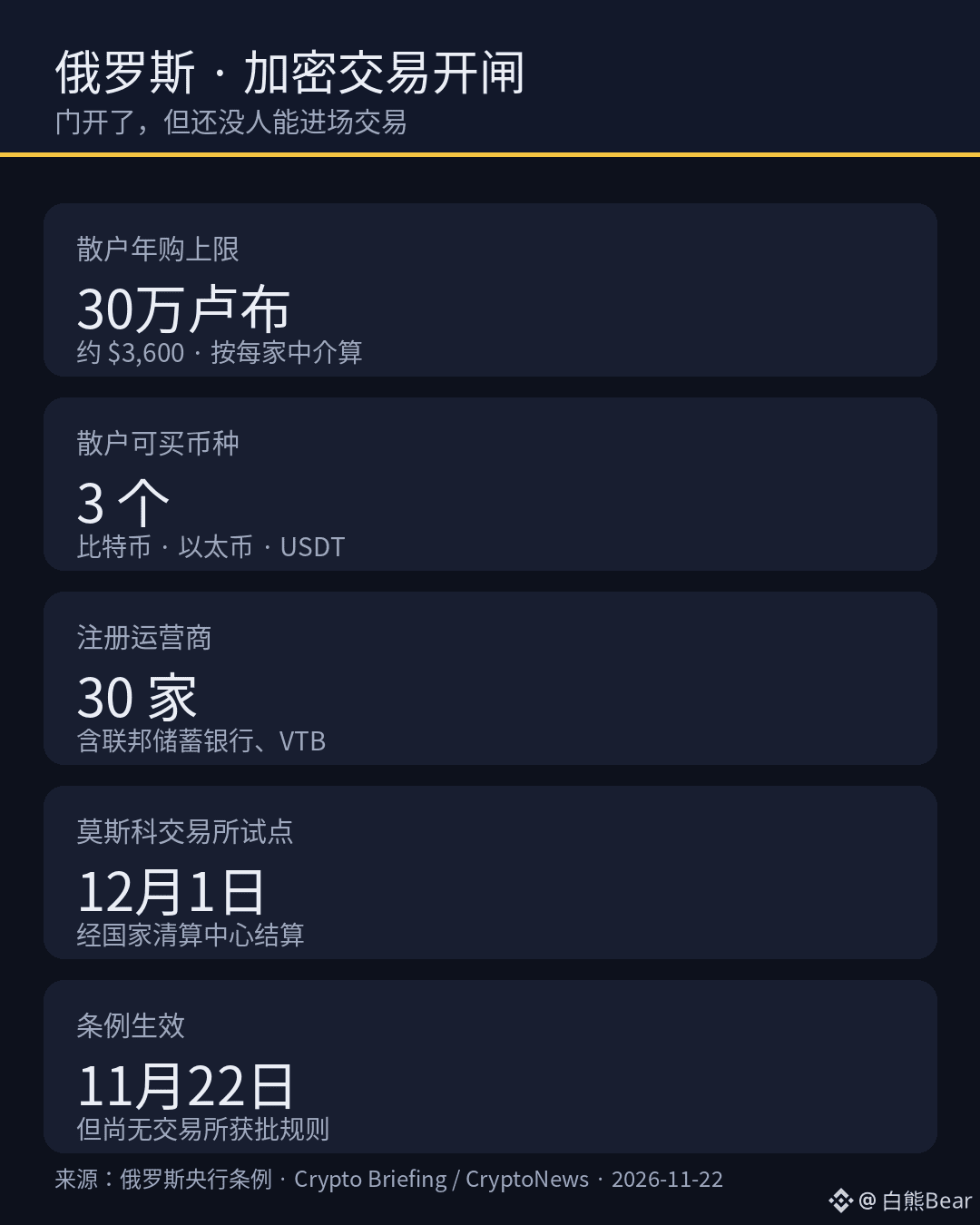
The central bank regulations that took effect on November 22 stipulate that exchanges must first get the central bank’s approval of their trading rules before they can launch. But the central bank hasn’t published a single list of approved rules, so the Moscow Exchange has had to push its pilot back to December 1. In other words, what’s opening is a legal framework, not a market.
The rules for retail investors are spelled out in detail: they can only buy Bitcoin, Ether, and USDT, and can purchase no more than 300,000 rubles’ worth a year—about $3,600—through a single intermediary. They also have to pass a knowledge test before buying. Qualified investors face no limits and can buy any coin. The foundation is the Digital Currency and Digital Rights Law, which took effect on September 1. By November 18, there were already 30 registered operators, including Sberbank and VTB.
What do I think? This isn’t Russia embracing crypto; it’s locking crypto inside a fenced yard. The gate is open, but the central bank holds the key, and the limit is so low it’s only enough to test the waters. Don’t expect this to bring fresh buying pressure to crypto prices in the short term. An annual cap of $3,600 isn’t even enough to build a decent position. There are two things really worth watching: First, the Moscow Exchange pilot will be settled through the National Clearing Center, which was sanctioned by the U.S. Treasury in June 2024. Whether this settlement system can actually work is far more important than whether the door opens. Second, the cap applies per intermediary, so in theory, people could get around it by opening accounts with several firms. Sooner or later, that loophole will either be closed or exploited.
It’s no surprise that a major country is bringing crypto into the mainstream financial system. What is surprising is how specifically it has drawn the boundaries. Next, we’ll see whether the pilot can launch on schedule on December 1, and whose rulebook makes the central bank’s first cut.
Do you think this kind of “open door, limited access” regulation is paving the way for crypto, or putting it on a leash?
$BTC $ETH #俄罗斯 #CryptoRegulation