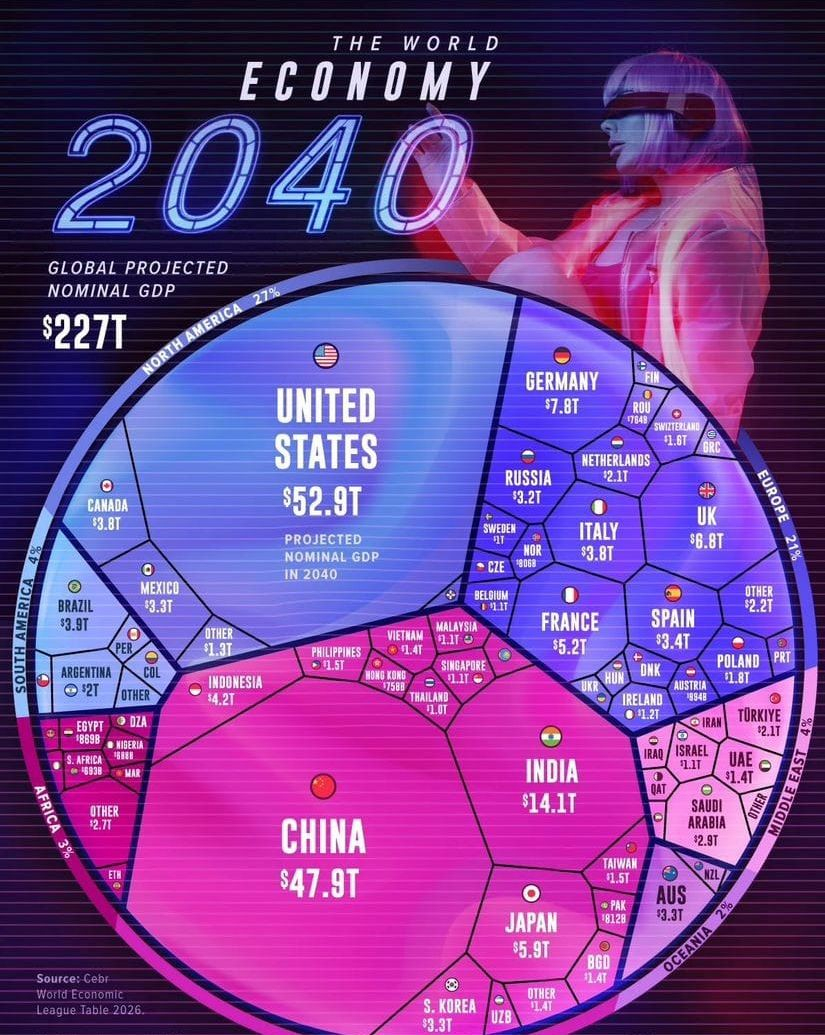
📊 Who will lead the global economy in 2040?
Cebr has updated its long-term forecast for 190 countries.
Although Cebr itself promised back in 2020 that China would overtake the US as early as 2028. Since then, the date has been pushed back every year, and now even in 2040 America remains in first place, while China will pull ahead only sometime around 2045🤷♂️.
This time, they even brought the date forward, but not because China is accelerating—rather, it’s due to worse long-term projections for the US. China, meanwhile, is held back by an ageing population, debt and property market problems, so Cebr no longer sees it as the engine of global growth as it once did.
India and Indonesia are being boosted by their young populations, who are just entering working age, while Europe is ageing and gradually losing its share.
It’s worth remembering that all figures are calculated in current dollars, without adjusting for inflation. So a country’s ranking is affected not only by factories and services, but also by exchange rates. A weaker dollar or a stronger yuan could shift the “overtaking date” by several years… And in purchasing power parity terms, the IMF has long ranked China first.