
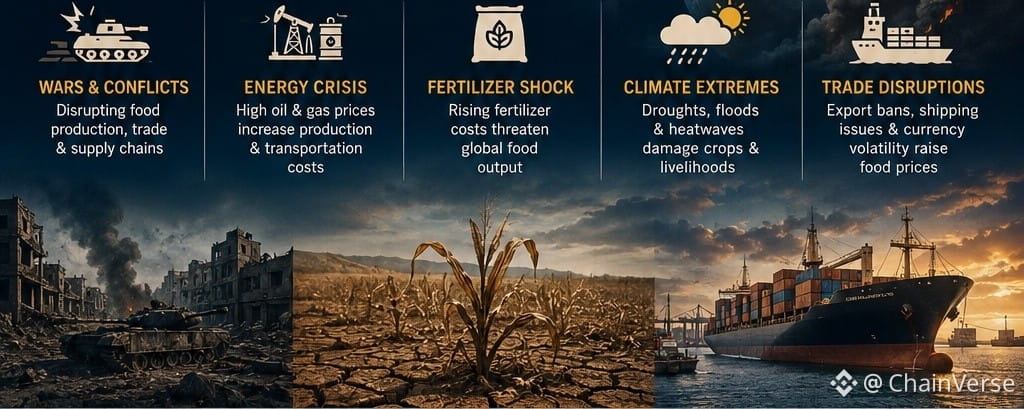

A dangerous combination of war, energy, climate, and inflation!
Will 2027 be a difficult year for ordinary people around the world? Ongoing wars, instability in oil markets, natural gas shortages, rising fertilizer prices, climate change, and uncertainty in international trade have raised a pressing question: Will the world face a food and economic crisis next year?
This is not just a general concern. Research and forecasts from various international organizations, including the United Nations, the World Food Programme (WFP), the Food and Agriculture Organization (FAO), and the World Bank, raise serious concerns about food security and the cost of living.
Let's analyze the issue in detail.
1. War: One of the biggest risks to the global food supply
Several ongoing conflicts around the world have put international food and energy supply systems at risk.
In particular:
• The Russia-Ukraine war may affect international markets for wheat, corn, sunflower oil, and fertilizer.
• Conflict in the Middle East: May disrupt oil and natural gas supplies and international shipping.
• Sudan's civil war: Destroying agricultural production, food transportation, and ordinary people's livelihoods.
• Yemen: Prolonged war and an import-dependent economy have made food security a severe challenge.
War does not only take human lives; it also destroys farmland, ports, transportation, electricity, factories, and food supply systems.
2. Oil and gas crisis: The hidden reason food prices rise
Many people think that when oil prices rise, only the cost of cars or transportation goes up. In reality, the effects ripple through the entire food production system.
How?
1. Farmers need diesel to run tractors and irrigation equipment.
2. Fuel is needed for trucks, ships, and other vehicles to transport food.
3. Natural gas is one of the main raw materials used to produce urea fertilizer.
4. When fertilizer production costs rise, farmers' production costs go up.
5. When production and transportation costs rise, consumers ultimately have to pay more.
In other words, if the oil and gas crisis persists, it may affect the prices of rice, wheat, pulses, fish, meat, eggs, and vegetables.
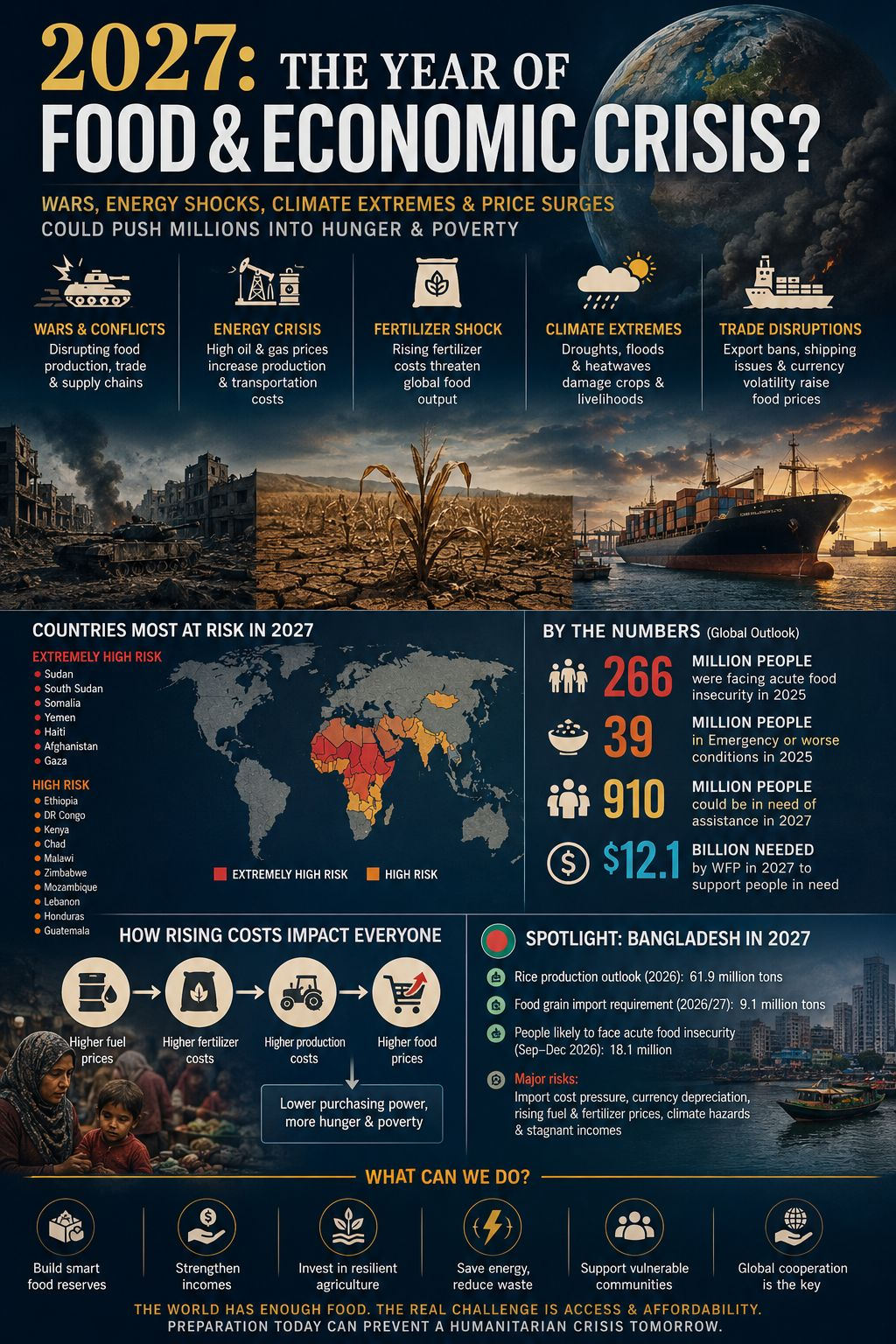
3. Countries at risk of food crises in 2027
Considering war, poverty, climate change, dependence on food imports, and political instability, several countries are of particular concern.
Extremely high-risk countries:
• Sudan
• South Sudan
• Somalia
• Yemen
• Haiti
• Afghanistan
• Gaza
High-risk countries and regions:
• Ethiopia
• Democratic Republic of the Congo
• Kenya
• Chad
• Malawi
• Zimbabwe
• Mozambique
• Zambia
• Lebanon
• Honduras
• Guatemala
These countries will not all face the same kind of crisis. In some, the main problem is war; in others, drought; and in still others, high food prices and people's lack of purchasing power.
One point needs to be made clear: there is no definitive forecast that famine will occur in every one of these countries in 2027. These are countries to watch based on current risks and the possibility of conditions worsening.
4. El Niño: A major test for agricultural production in 2027
Alongside climate change, El Niño conditions could pose a major challenge to global agriculture.
El Niño is a climate phenomenon associated with changes in sea surface temperatures in the Pacific Ocean. It can alter normal rainfall and temperature patterns in different parts of the world.
As a result:
• Severe drought may occur in some places.
• Heavy rainfall and flooding may occur in other places.
• Agricultural yields may decline.
• Livestock farming and water supplies may be affected.
• Dependence on food imports may increase.
The WFP's 2026 El Niño risk analysis warns that food security could worsen for around 49 million additional people in 45 at-risk countries.
It is especially important to monitor parts of Southern and Eastern Africa and Latin America.
5. What happens if food-exporting countries halt exports?
One major vulnerability in global food markets is that supplies of some key food commodities depend on a handful of countries.
For example:
• Russia and Ukraine: wheat and other grains.
• India: a major supplier in the international rice market.
• Brazil: soybeans, corn, and other agricultural products.
• Canada: wheat and pulses.
• United States: corn, soybeans, and wheat.
• Indonesia and Malaysia: palm oil.
If a major exporting country imposes export restrictions to control its domestic market, import-dependent countries may face difficulties.
This could reduce supplies on international markets and drive prices up.
6. Ordinary people's purchasing power could decline in the global economy
The most alarming thing is that even if food is available in the market, people may not be able to afford it.
Suppose a person's monthly income is 30,000 taka.
Their current expenses for food, rent, transportation, electricity, and other needs total 28,000 taka.
But if rising food, fuel, and transportation costs push monthly expenses to 33,500 taka, they will not be able to make ends meet on their income.
This is a real example of declining purchasing power.
As a result:
• Middle-class families may reduce their savings.
• People on low incomes may buy less nutritious food.
• Debt and installment-payment burdens may increase.
• Small businesses may face higher costs.
• Unemployment and poverty may rise.
• Living standards may decline.
7. How risky will 2027 be for Bangladesh?
Bangladesh's situation is somewhat different.
Domestic rice production is a major strength for our country. However, Bangladesh depends on international markets for wheat, edible oil, pulses, fuel, fertilizer, and various agricultural inputs.
In its 2026 forecast for Bangladesh, the FAO stated that:
• Rice production in 2026 is expected to reach around 61.9 million tonnes.
• The need for grain imports in 2026/27 is around 9.1 million tonnes.
• Around 18.1 million people are forecast to face acute food insecurity between September and December 2026.
The main potential risks for Bangladesh are:
1. The taka losing value against the US dollar.
2. Rising international oil and gas prices.
3. Higher import costs for wheat and edible oil.
4. Higher production costs for farmers due to rising fertilizer prices.
5. Higher transportation and electricity costs.
6. Floods, heavy rainfall, cyclones, and heatwaves.
7. Food prices rising while people's incomes remain unchanged.
For Bangladesh, the bigger problem may be rising food prices and a crisis in people's purchasing power, rather than food production coming to a complete halt.
8. Which commodity prices are at risk of rising in 2027?
Considering global energy, fertilizer, transportation, and agricultural production conditions, these commodities are worth keeping an eye on:
• Wheat and flour
• Edible oil
• Pulses
• Corn
• Soybeans
• Sugar
• Urea fertilizer
• Diesel and petrol
• Natural gas
• Animal feed
• Fish and poultry feed
However, this does not mean that the price of every one of these commodities will rise. Prices will depend on production, stocks, weather, and conditions in international trade.
9. Could the world face another major economic crisis in 2027?
In my view, the situation could become serious if several risks materialize at once.
Suppose:
• The war in the Middle East drags on.
• Shipping through the Strait of Hormuz is disrupted.
• Oil and gas prices rise.
• Fertilizer production costs increase.
• Production falls in several major agricultural regions because of El Niño.
• Food-exporting countries restrict exports.
• The currencies of import-dependent countries lose value against the US dollar.
Then food, energy, transportation, and production costs could all rise at the same time.
This would not simply be a food crisis; it could create a multidimensional economic crisis.
10. What should ordinary people do to prepare now?
There is no need to panic. However, it is important to be prepared for the future.
• Plan to keep a 1–2 month supply of essential nonperishable food for your family.
• Try to reduce unnecessary debt and installment payments.
• Build an emergency fund.
• Look for alternative sources of income.
• Reduce food waste.
• Ensure your family has nutritious and essential food.
• Keep track of international markets and the country's economic situation.
11. Important sources for international research
Research and reports from several organizations are especially important for understanding these issues:
1. WFP — World Food Programme
2. FAO — Food and Agriculture Organization
3. World Bank — Commodity Markets Outlook
4. IPC — Integrated Food Security Phase Classification
5. FEWS NET — Famine Early Warning Systems Network
6. IMF — International Monetary Fund
7. WMO — World Meteorological Organization
In particular, it is important to monitor the WFP Global Outlook 2027, the Global Report on Food Crises 2026, and the World Bank's Commodity Markets Outlook.
Final thoughts: The world needs to prepare now for 2027
We live in a time when a war does not affect only the economy of one country; its impact is felt in markets thousands of kilometers away.
A gas crisis in one country can raise fertilizer prices in another. An export ban in one country can destabilize food markets elsewhere. A drought in one region can increase food costs for people on the other side of the world.
There is no scientific basis for saying that famine will occur in every country in 2027. But there is a real risk that the combined effects of war, climate change, energy challenges, and economic instability will make life even harder for millions of people.
The biggest question is not just whether there will be food in the world, but whether ordinary people will be able to afford it.
From now on, it is important to focus on food security, agricultural production, energy management, and economic preparedness.
What do you think? Is the world heading toward a major food and economic crisis in 2027?
#GlobalFoodCrisis #FoodSecurity #2027Forecast #WorldEconomy #ClimateChange #ElNino #EnergyCrisis #Inflation #Bangladesh #WFP #FAO #WorldBank