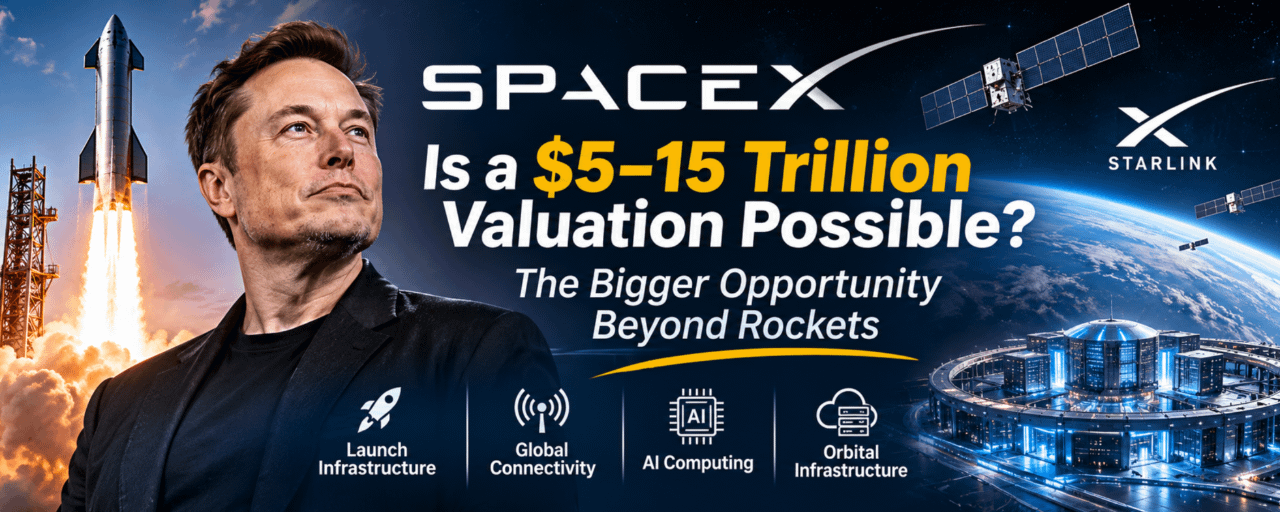
SpaceX: Is a $5–15 Trillion Valuation Possible? The Bigger Opportunity Beyond Rockets
SpaceX is increasingly becoming something much bigger than a rocket-launch company. Its ambitions now extend across global telecommunications, artificial intelligence, cloud computing and potentially even orbital data centres.
The investment question is no longer simply how many rockets SpaceX can launch. It is how much of the future digital infrastructure economy the company can capture.
At approximately $1.74 trillion in market capitalisation, SpaceX is already one of the world's most valuable companies. However, its long-term ambitions raise an even bigger question: could it eventually become a $5 trillion, $10 trillion or even $15 trillion company?
There is a credible growth thesis behind these possibilities, but getting there will require extraordinary execution.
1. The current market correction
SpaceX went public in June 2026 at $135 per share under the Nasdaq ticker SPCX.
By November 20, shares had fallen to $127.79, below their IPO price and approximately 43% below their reported 52-week high of $225.64. Its market capitalisation stood at approximately $1.74 trillion.
The decline comes amid a wider reassessment of technology and AI valuations, particularly concerns about the enormous capital expenditure required to build AI infrastructure and how quickly that investment will generate returns.
However, the company's latest financial results tell an interesting story.
For Q3 2026, SpaceX reported:
Revenue of $14.6 billion, up 161% year-on-year.Net income of $4.4 billion.Adjusted EBITDA of $8.8 billion.Starlink consumer subscribers reaching 13.6 million.AI computing capacity reaching 1.7 GW.
Its connectivity business generated $5.25 billion in quarterly revenue, while its Super Intelligence business has emerged as another significant growth engine.
These numbers suggest that SpaceX is building multiple substantial businesses under one corporate structure.
2. Starlink could become one of the world's largest connectivity businesses
Starlink is arguably one of SpaceX's most important assets.
Traditional telecommunications infrastructure depends heavily on terrestrial networks, fibre-optic cables, cellular towers and undersea cables.
Starlink offers a different approach by using a constellation of low-Earth-orbit satellites to provide broadband connectivity across geographical boundaries.
Its addressable market extends beyond residential internet.
There are opportunities in aviation, maritime transport, enterprise connectivity, government services, military communications and direct-to-cell mobile services.
The direct-to-cell opportunity is particularly interesting because it could allow ordinary mobile devices to connect through satellite infrastructure, reducing dependence on traditional cellular coverage in underserved areas.
SpaceX is also pursuing additional spectrum capacity to expand its mobile ambitions.
The more Starlink expands, the more valuable its satellite infrastructure, customer relationships and global distribution network could become.
At the November 2026 Baron Investment Conference, investor Ron Baron discussed a scenario in which Starlink could eventually generate $1 trillion in annual revenue and be worth $14–15 trillion within approximately ten years.
That is an exceptionally bullish projection, not an established financial forecast. Nevertheless, it illustrates the scale of the opportunity investors are considering.
3. Starship could fundamentally change the economics of space
Starship is arguably the most important technological component of SpaceX's long-term strategy.
The economics of space infrastructure are heavily influenced by the cost of transporting payloads into orbit.
If SpaceX achieves reliable, rapid and fully reusable Starship operations, the cost of deploying satellites and other infrastructure could fall substantially.
This would have implications beyond the launch business.
It could enable:
Much larger Starlink satellite constellations.More frequent satellite replacements and upgrades.Greater global broadband capacity.New commercial and government space infrastructure.Potential deployment of orbital computing infrastructure.
SpaceX reported its first revenue-generating Starship mission in Q3 2026, delivering 26 Starlink V3 satellites into its constellation.
That is an important milestone, although sustained high-frequency operations and full reusability still need to be demonstrated.
Starship is therefore not just another rocket development programme. It is potentially the infrastructure that makes several of SpaceX's other businesses economically viable at much greater scale.
4. Artificial intelligence could become an equally important growth engine
The AI opportunity introduces another dimension to SpaceX's valuation.
The company is expanding its computing infrastructure, AI models and software businesses. Its acquisition of Cursor, completed in August 2026 at an implied equity value of $60 billion, further demonstrates its ambitions in the AI ecosystem.
The opportunity is enormous.
Demand for computing power is growing as businesses adopt AI agents, automated workflows, advanced models and increasingly sophisticated applications.
However, building AI infrastructure requires enormous amounts of capital.
On November 20, Reuters reported a roughly $44 billion financing package arranged by Apollo and Goldman Sachs to support SpaceX's acquisition of Nvidia GPUs and associated equipment.
This illustrates both sides of the AI opportunity: enormous potential demand, but also substantial financing requirements.
There is another particularly ambitious idea being explored: orbital data centres.
The proposition is to eventually deploy computing infrastructure in space, taking advantage of solar energy and the thermal environment while potentially reducing some of the constraints associated with terrestrial data centres.
The concept is interesting, but its commercial economics remain unproven.
Power management, radiation, maintenance, communications latency, launch costs and equipment replacement are substantial engineering challenges.
For now, terrestrial AI infrastructure is the more established opportunity, while orbital computing should be treated as a longer-term possibility rather than an existing competitive advantage.
5. What could SpaceX be worth in the future?
The valuation question requires separating realistic growth scenarios from exceptional outcomes.
At approximately $1.74 trillion today, SpaceX already commands a substantial valuation. A future multi-trillion-dollar valuation would require significant growth in revenue, profitability and cash generation.
Consider three illustrative scenarios:
Scenario A: $3–5 trillion
SpaceX continues expanding Starlink, scales its AI infrastructure, improves Starship economics and converts its growing revenue into sustainable profits.
This would represent a major increase in enterprise value, but would not require orbital data centres to become commercially dominant.
Scenario B: $5–10 trillion
Starlink becomes a global connectivity powerhouse, AI infrastructure develops into a major commercial business, and Starship dramatically reduces the cost of accessing space.
In this scenario, SpaceX would be competing across several enormous infrastructure markets rather than relying on a single business.
Scenario C: $10–15 trillion and beyond
This would require exceptional execution across almost every major component of the strategy.
Starlink would need to capture a much larger share of global connectivity and enterprise markets. AI computing would need to generate substantial returns on invested capital, while Starship and orbital infrastructure would need to unlock entirely new commercial opportunities.
Ron Baron's $14–15 trillion Starlink projection provides an example of this highly optimistic long-term outlook.
These scenarios are illustrative, not price targets or probability-weighted forecasts. A $20–50 trillion SpaceX valuation would be an even more extreme outcome and should not be treated as a reasonable base case.
6. The risks investors should not ignore
Despite the opportunity, SpaceX faces considerable challenges.
Capital expenditure and financing: AI infrastructure, satellites, launch vehicles and orbital systems require enormous investment. Financing costs and returns on invested capital will matter.
Execution risk: Starship must demonstrate reliable, repeatable operations at scale. Delays could affect several connected business opportunities.
Competition: Starlink faces competition from terrestrial telecommunications providers and other satellite operators. Its AI business competes with established hyperscalers and emerging AI infrastructure companies.
Valuation risk: Even if SpaceX executes successfully, its stock could underperform if investors have already priced in too much future growth.
Regulation and governance: Spectrum allocation, international market access, space regulation and the concentration of strategic decision-making also present risks.
My overall outlook
I think the most interesting aspect of SpaceX is the way its businesses reinforce one another.
Starship can reduce the cost of deploying satellites. Starlink can generate recurring connectivity revenue. AI infrastructure can create another major revenue stream. Eventually, orbital computing could introduce an entirely new dimension to the business.
This creates a potentially powerful infrastructure ecosystem.
The market may currently be reassessing the cost of building that ecosystem, but the underlying long-term opportunity has not disappeared.
I would distinguish between the near-term investment case and the long-term technological opportunity.
A recovery towards the $3 trillion valuation region is one possible outcome if growth continues and market sentiment improves. Reaching $5–10 trillion would require much more substantial execution, while $14–15 trillion and beyond belongs to a highly optimistic long-term scenario.
The bigger question is whether SpaceX can become the infrastructure backbone of an increasingly connected, AI-driven global economy, both on Earth and eventually beyond it.
If it succeeds, today's valuation debate could look very different a decade from now. If it fails to translate its enormous investments into sustainable returns, even its existing valuation could prove difficult to justify.
#SpaceX #SPCX #Starlink #Starship #ArtificialIntelligence #AIInfrastructure #Investing #Technology