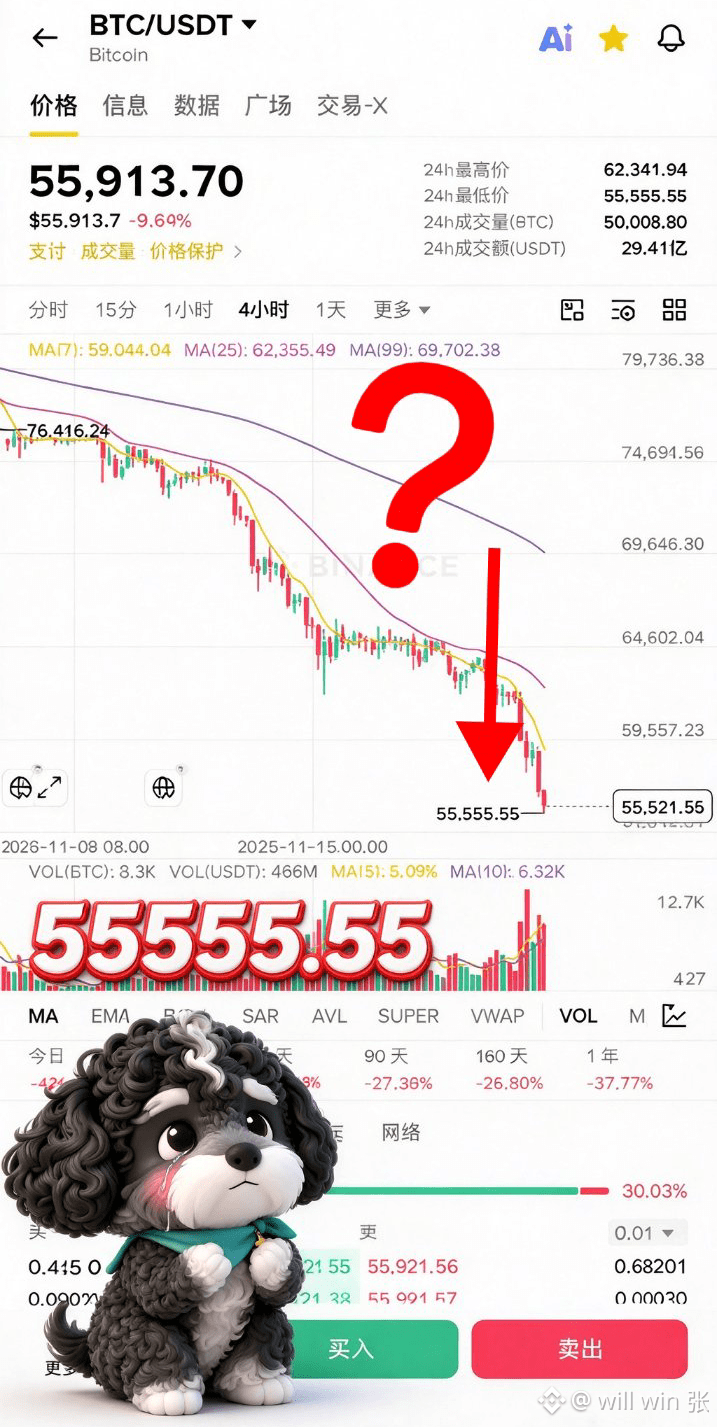

$BTC Overnight wick: 55127, then a 9.8% rebound to reclaim 60,000—is this real dip-buying or short covering?
Last night, BTC bounced from $55,127 to $60,523 in one go, a gain of about 9.8%.
Half the fuel for the rebound came from the shorts themselves 🔥
During that one-hour rebound, $68.82 million in short positions were liquidated, compared with just $1.64 million in longs. Shorts accounted for 97.7%. Liquidated short positions create buying pressure, so this rally was forced. 24-hour trading volume was still down 38% year over year—a low-volume rebound.
There was some genuine dip-buying too, but it’s moving slowly 🐋
Whales increased their holdings by 2.5% over 30 days, bringing their balance to 3.02 million coins—the fastest pace since February 2026. This is long-term money accumulating, which is not the same as an overnight pump.
Institutions are still pulling out 📉
On November 19, spot BTC ETFs saw net outflows of $582 million in a single day. IBIT alone saw $541 million withdrawn, its largest single-day outflow since launch. On the 20th, outflows totaled $124 million, marking the fourth consecutive day, with November’s total at about $3.59 billion. The biggest buyers haven’t returned yet.
Conclusion
Dip-buying: yes, but it’s mostly long-term and spread out. The rebound’s main driver: short covering. That wick to $55,000 looks more like a liquidity event than the sound of a bottom being formed.
Watch these 4 signals next 👇
1. Can 60,000 hold? A drop back below would mean a false breakout.
2. Can BTC reclaim 62,000 (the starting point of the previous decline)?
3. When will ETF outflows turn positive?
4. At Monday’s U.S. market open, can AI stocks avoid a second sell-off? $ETH , $ZEC , #多名巨鲸逢低买入,比特币回升突破6万美元