Today's crypto topic:
If AI finds vulnerabilities that no human has ever seen, who wins: the attacker or the defender?
In crypto, the asymmetry is brutal.
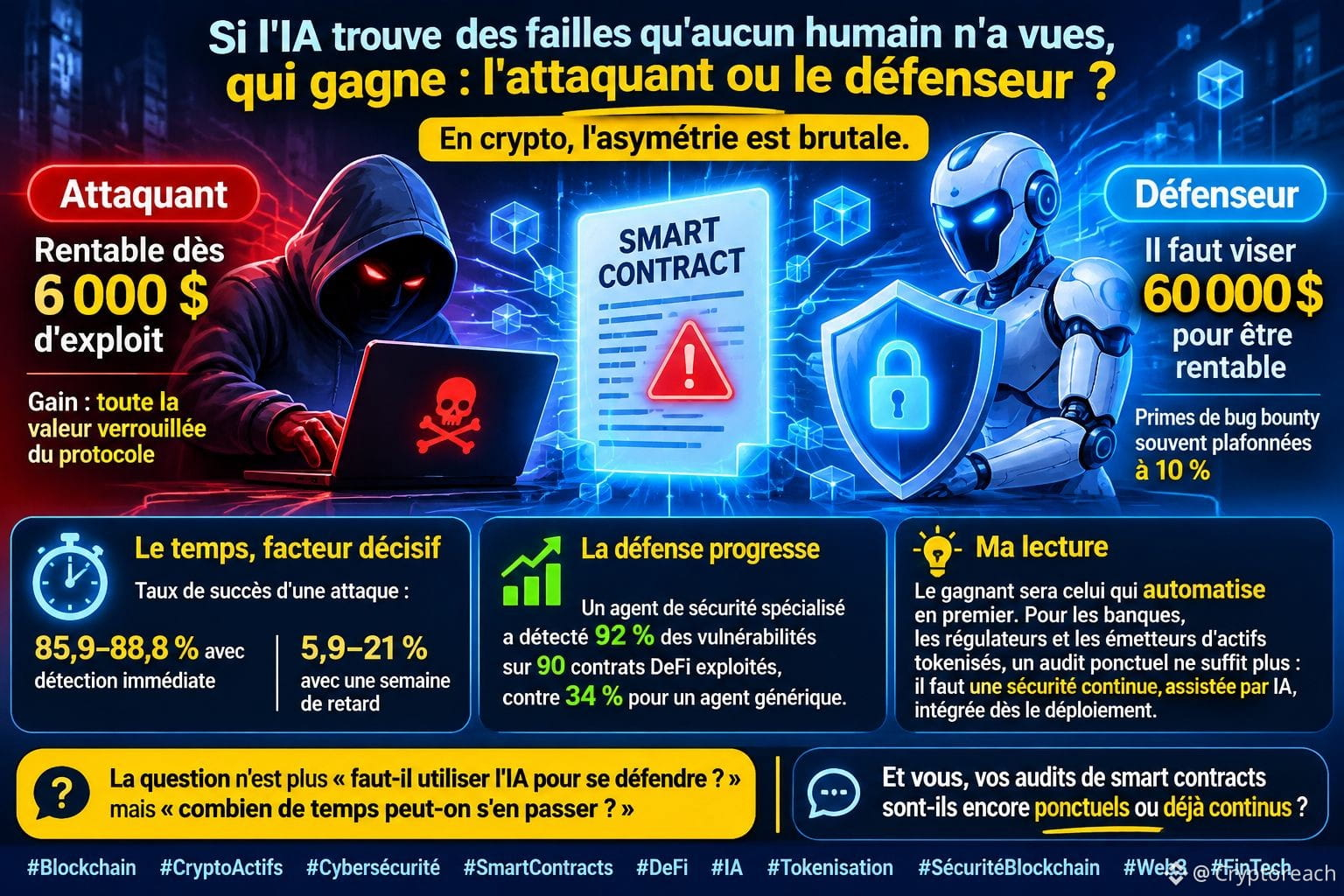
A study by researchers at UCL and Sydney on AI agents exploiting smart contracts shows that an attacker becomes profitable with an exploit worth as little as 6,000 $ , compared with 60,000 $ for the defender. For the attacker, the reward is the entire value locked in the protocol. For the defender, bug bounty payouts are often capped at 10%.
The decisive factor is time. The success rate of an attack drops from 85.9–88.8% with immediate detection to 5.9–21% with a week's delay.
But defenses are improving too. A specialized security agent detected 92% of vulnerabilities across 90 exploited DeFi contracts, compared with 34% for a generic agent based on the same model.
My take: the winner will be whoever automates first. For banks, regulators, and tokenized asset issuers, one-off audits are no longer enough. Security needs to be continuous, AI-assisted, and built in from deployment.
The question is no longer “Should we use AI to defend ourselves?” but “How long can we afford to go without it?”
What about you: are your smart contract audits still one-off, or are they already continuous?
#Blockchain #CryptoAssets #Cybersecurity #SmartContracts #DeFi #AI #Tokenization #BlockchainSecurity #Web3 #FinTech
If AI finds vulnerabilities that no human has ever seen, who wins: the attacker or the defender?
In crypto, the asymmetry is brutal.
A study by researchers at UCL and Sydney on AI agents exploiting smart contracts shows that an attacker becomes profitable with an exploit worth as little as 6,000 $ , compared with 60,000 $ for the defender. For the attacker, the reward is the entire value locked in the protocol. For the defender, bug bounty payouts are often capped at 10%.
The decisive factor is time. The success rate of an attack drops from 85.9–88.8% with immediate detection to 5.9–21% with a week's delay.
But defenses are improving too. A specialized security agent detected 92% of vulnerabilities across 90 exploited DeFi contracts, compared with 34% for a generic agent based on the same model.
My take: the winner will be whoever automates first. For banks, regulators, and tokenized asset issuers, one-off audits are no longer enough. Security needs to be continuous, AI-assisted, and built in from deployment.
The question is no longer “Should we use AI to defend ourselves?” but “How long can we afford to go without it?”
What about you: are your smart contract audits still one-off, or are they already continuous?
#Blockchain #CryptoAssets #Cybersecurity #SmartContracts #DeFi #AI #Tokenization #BlockchainSecurity #Web3 #FinTech