Solana just promised to double its speed — while $SOL trades 75% below its peak.
Solana has laid out its 2027 roadmap, unveiled by Anza CEO Brennan Watt at Breakpoint 2026 in London. The plan doubles network compute capacity from about 250 million to 500 million units per second, cuts token-account transaction costs by 80%, raises the accounts-per-transaction limit from 64 to 96, and adds native vector processing so AI models can run fully on-chain. Turbine gets replaced by a faster system called Rotor, and Constellation brings clearer rules for transaction ordering.
This builds on Alpenglow, which went live on October 21 and cut transaction finality from about 12.8 seconds to roughly 150 milliseconds — and Solana finally dropped its "mainnet beta" label.
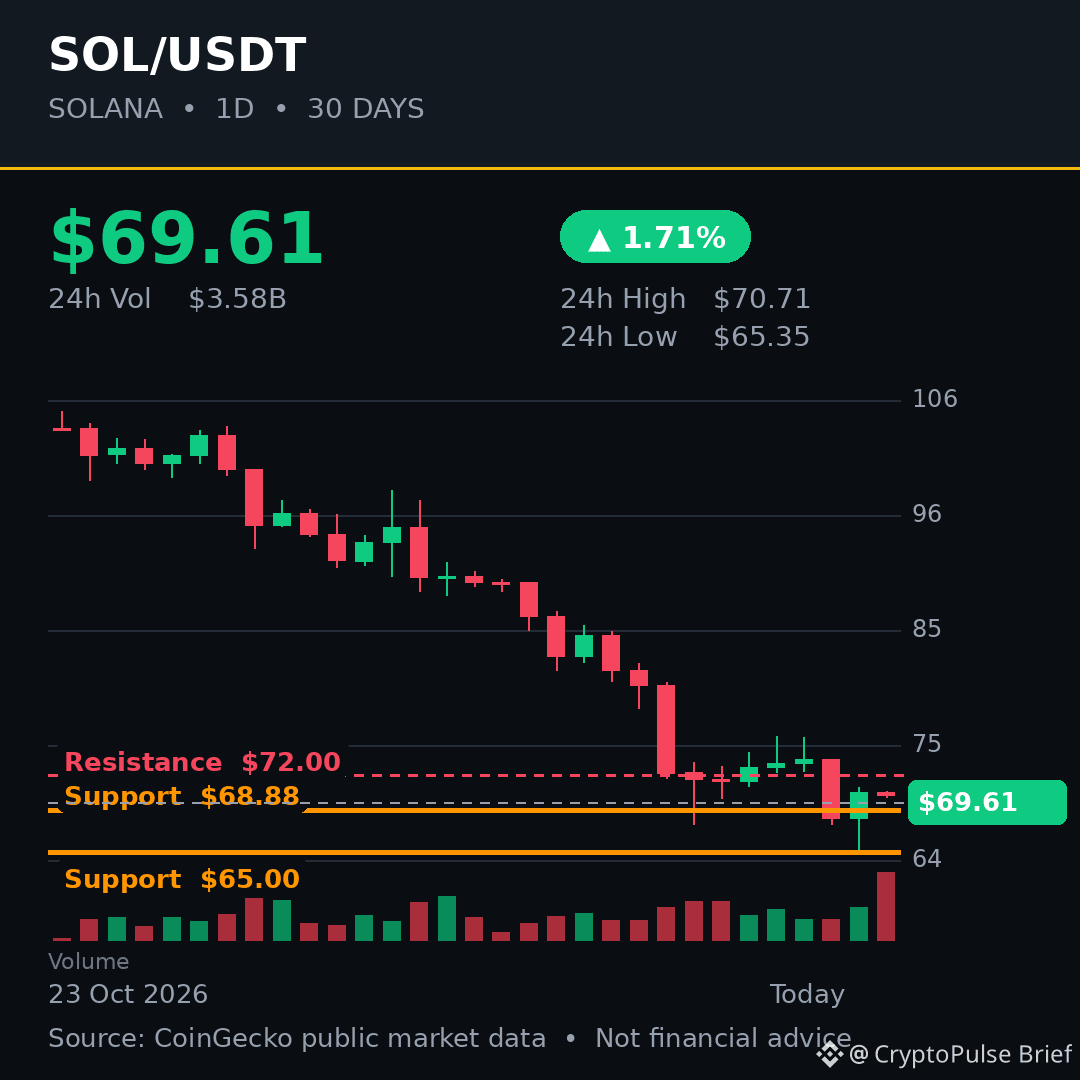
The price, though, tells a colder story. $SOL trades near $69.61, up 1.7% in 24 hours but roughly 75% below its January 2025 peak, with a market value near $42.8 billion. $BTC, meanwhile, holds above $60,000 at about $60,200, up 2.1% in a day, with the Fear & Greed Index still stuck at 11 — extreme fear.
My take: the engineering is real, but speed is not the bottleneck — demand is. Solana's user fees are running at $205 million for the first eleven months of 2026, down from $645 million in all of 2025. A roadmap is a set of targets, not deliveries, and doubling capacity only pays if someone buys the extra output. Still, in a market obsessed with the Fed and fear, a chain that keeps shipping is exactly the kind of story that separates builders from bag-holders.
Levels to watch: support at $68.88, then $65; resistance at $72, then $75.
Is Solana's roadmap enough to close that 75% gap — or does the market need demand, not just speed? Drop your view below.
Source: BeInCrypto via TradingView, CoinRanking, AInvest — 19–21 Nov 2026
Follow for daily crypto updates.
#Solana #Crypto #BTC
Not financial advice.