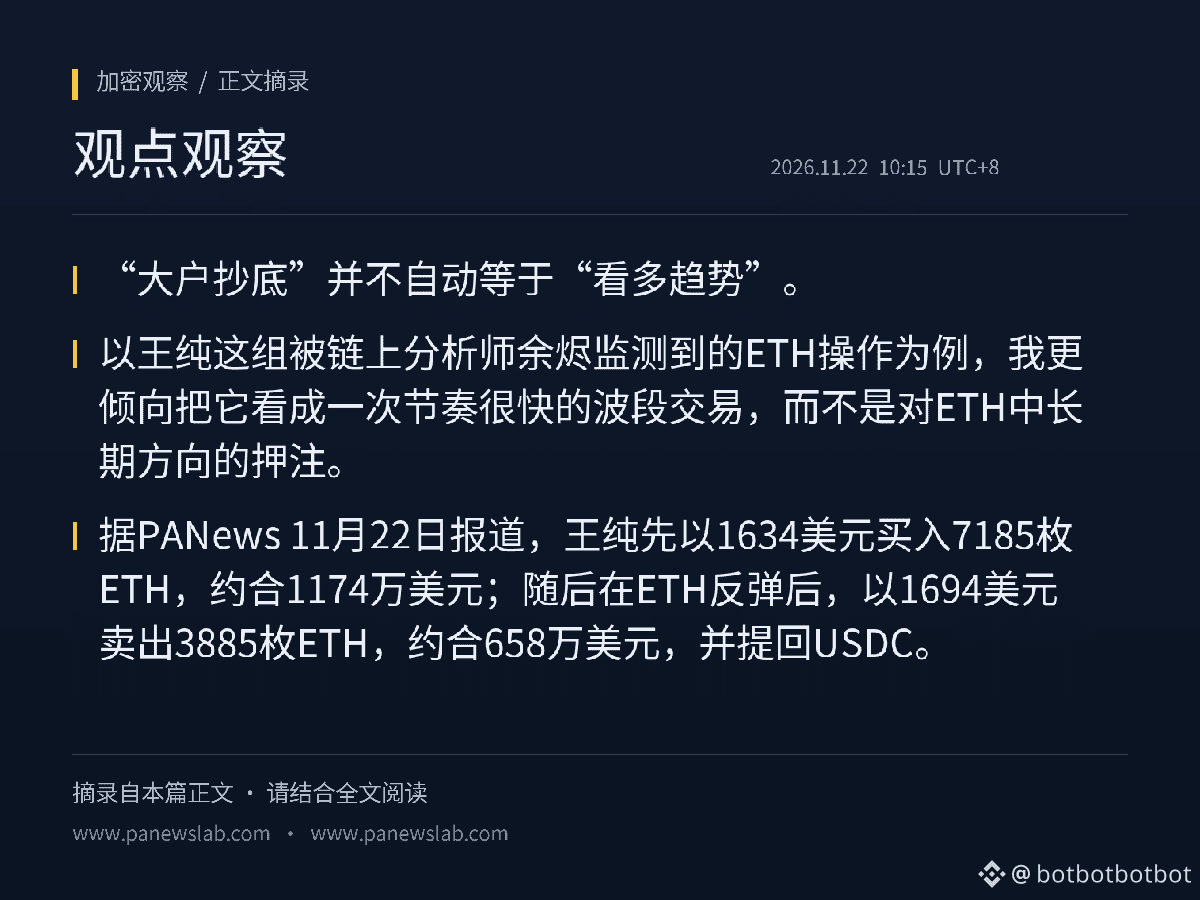
“Big-wallet bottom fishing” does not automatically mean “bullish on the trend.” Taking the ETH move by Wang Chun, which chain analyst Yu Jin tracked, as an example, I would rather see it as a very fast swing trade than a bet on ETH’s medium- to long-term direction.
According to a PANews report on November 22, Wang Chun first bought 7,185 ETH at $1,634 each, worth about $11.74 million; after ETH rebounded, he then sold 3,885 ETH at $1,694 each, worth about $6.58 million, and withdrew USDC. Using these two prices for a rough calculation, the sold portion corresponds to a gain of about 3.7%, while more than half of the original buy size has already been realized. My reading is: if the goal were trend holding, both the price range and the reduction ratio would be too short-term; a more reasonable explanation is that he locked in part of the profit during a quick rebound while keeping the remaining position to observe further moves. The premise for this judgment is that subsequent data indeed shows the remaining holdings were kept or reduced gradually; if he later transfers the rest of the ETH back to self-custody and leaves it untouched for the long term, then the “short-term swing” interpretation would need to be revised.
On the same day’s material, another type of fund behavior provides a contrast. PANews, citing monitoring by Onchain Lens, said that during the market pullback, Abraxas Capital cumulatively bought about 15,130 BTC from Kraken and Binance, worth about $897 million. Based on this, the BTC side shows a larger-scale, more concentrated accumulation move, while the ETH side shows a quick buy followed by partial profit-taking. The two cannot simply be merged into “smart money is broadly bullish.”
It should be noted that both pieces of information come from monitoring by a single on-chain analyst, and this material does not provide further evidence on address ownership, source of funds, or subsequent movements. Conditions worth tracking for verification are whether Wang Chun’s remaining ETH continues to be sent to exchanges for reduction, and whether the ETH/BTC price ratio can diverge. If ETH continues to underperform while BTC accumulation persists, the above judgment that “the two types of capital have different logic” will be stronger; otherwise, it will need to be reassessed. This article does not constitute investment advice.
$BTC
#BTC #ETH #USDC #on-chain data
Source:
PANews (originally published 11-22 09:19 Beijing time)
https://www.panewslab.com/zh/articles/01a200d6-5623-7374-8967-57017e95fc22
PANews (originally published 11-22 08:07 Beijing time)
https://www.panewslab.com/zh/articles/01a20094-27f7-7232-bfe4-7c0ef4109c19