
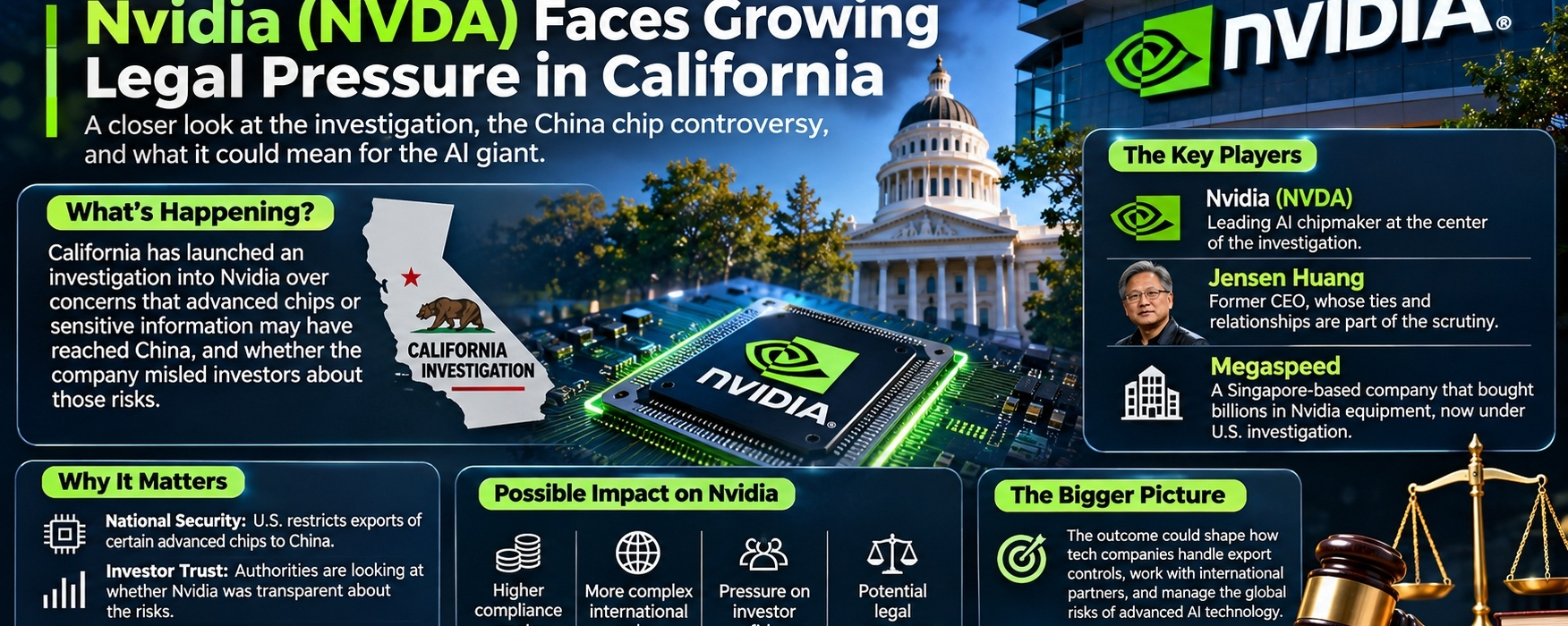


A closer look at the investigation, the China chip controversy, and the challenges facing one of the world's most important technology companies.
Nvidia has become a household name in the technology world, largely because of the artificial intelligence boom. Its chips power some of the world's most advanced AI systems, and its business has grown rapidly as companies invest billions in new computing infrastructure.
For a long time, the company's story was simple: demand for AI was rising, Nvidia was leading the market, and its future looked increasingly promising.
Now, the company is dealing with a different kind of attention.
Nvidia is facing growing legal scrutiny in California over concerns involving advanced chips, China, and the information provided to investors. The investigation comes amid wider questions about the company's business relationships, export controls, and corporate leadership.
For a company operating at the center of the AI revolution, these are serious issues. The outcome could affect how Nvidia does business, how investors view its risks, and how closely regulators examine the semiconductor industry.
But there is an important distinction to keep in mind: an investigation does not mean a company has been found guilty of wrongdoing. The facts still need to be established.
California wants answers from Nvidia
On November 19, 2026, California Attorney General Rob Bonta announced that his office had issued an investigative subpoena to Nvidia.
The investigation is examining whether advanced chips or confidential information may have reached China. Officials are also looking into whether Nvidia misled investors or the public about the risks surrounding these developments.
The announcement has brought renewed attention to Nvidia's business relationships and the company's handling of sensitive technology.
A subpoena allows investigators to request information and examine what happened. It does not, by itself, prove that Nvidia broke the law.
For now, the investigation is about gathering evidence and understanding the circumstances.
That means investigators will likely be looking closely at business records, communications, and the company's knowledge of the transactions under scrutiny.
For Nvidia, the challenge is to cooperate with authorities while continuing to run a business that serves customers around the world.
Source: California Department of Justice, November 19, 2026.
Why the China chip issue is so sensitive
Nvidia's chips are not ordinary computer components. They are powerful enough to support the development of advanced AI systems, making them valuable to businesses and strategically important to governments.
That is one reason the United States has placed restrictions on exporting certain advanced chips to China.
Washington's concern is that powerful computing technology could be used for military applications or other purposes that could affect national security.
The challenge is enforcing those restrictions in a global industry where products can pass through multiple companies and countries before reaching their final destination.
This is where Nvidia's current situation becomes complicated.
The company sells products internationally, and overseas sales are a normal part of its business. The concern is whether restricted technology may have reached prohibited customers through intermediaries or other arrangements.
Investigators are examining whether Nvidia chips may have been diverted to China through business relationships involving Megaspeed, a Singapore-based data center company.
The key question is whether any restricted products reached China and, if they did, what Nvidia knew about it.
It is also important to establish whether the company or any individuals associated with it knowingly contributed to a violation.
Those questions cannot be answered simply by looking at the existence of a business relationship. They require evidence about the transactions, the people involved, and the company's internal procedures.
Megaspeed's role in the controversy
Megaspeed has become an important part of the story because of its reported purchases of Nvidia equipment and questions about where some of that technology may have ended up.
U.S. authorities have been investigating whether the company was involved in the diversion of advanced chips to China.
According to a joint statement from the U.S. Department of Commerce and Department of Justice, the Commerce Department began investigating Megaspeed in 2024 after identifying suspicious activity involving possible semiconductor diversion.
In May 2025, investigators requested records from Nvidia concerning direct or indirect sales to Megaspeed. Nvidia placed the company on its no-sell list the following month.
The statement also said that Commerce Department investigators, working with Singaporean law enforcement officials, conducted an on-site end-use check at Megaspeed in June 2025.
The Justice Department later took the lead in the criminal investigation.
These details matter because they show that U.S. authorities were examining Megaspeed's activities before California's investigation became public.
They also show that Nvidia had been asked to provide information about its dealings with the company.
However, the government statement does not establish that Nvidia knowingly participated in illegal exports. That remains a question for investigators to examine.
Megaspeed has described itself as a legitimate business and has disputed allegations about its operations.
Source: U.S. Department of Commerce and Department of Justice, November 16, 2026.
Jensen Huang's departure adds uncertainty
The controversy has also drawn attention to Nvidia's leadership.
Jensen Huang helped build Nvidia into one of the most important companies in the semiconductor industry. His leadership has been closely tied to the company's identity, growth, and long-term strategy.
Reports involving his personal relationships, including an alleged relationship with Alice Huang, have added another layer to the controversy.
U.S. intelligence officials have reportedly examined whether Alice Huang had connections to Chinese intelligence. Those allegations remain under investigation and should not be treated as established facts.
The situation has raised questions about whether personal relationships and business connections may have created risks for Nvidia.
That is particularly sensitive for a company whose technology is strategically important and whose operations involve customers, suppliers, and partners across multiple countries.
Huang's departure is also significant because Nvidia has long been closely associated with its founder.
The board has ruled out reinstating him, while Chief Financial Officer Colette Kress is serving as interim CEO.
For Nvidia, the challenge is now twofold: the company must address legal and regulatory scrutiny while also managing a leadership transition.
For investors, that creates uncertainty at a time when the company is expected to keep delivering on an ambitious technology roadmap.
Could Nvidia face consequences for misleading investors?
One of the most important parts of the California investigation concerns the information Nvidia provided to shareholders.
Investors rely on public companies to explain important risks honestly and accurately. When a company faces a significant legal or regulatory issue, the question becomes whether shareholders were given enough information to understand what was happening.
California officials are examining whether Nvidia misled investors or the public about the possibility that advanced chips or confidential information could have reached China.
That means investigators may look at what Nvidia knew, when it knew it, and what the company said about the situation.
This is a serious legal question, but it is not a simple one.
A company is not automatically liable because an investigation begins or because allegations receive public attention. Authorities must determine whether the company's statements or omissions actually violated the law.
The same principle applies to shareholder lawsuits.
Investors may argue that they were not given important information, but those claims must be supported by evidence.
If authorities establish that Nvidia violated disclosure requirements, the company could face legal expenses, additional scrutiny, or other consequences.
For now, the outcome remains uncertain.
Nvidia's board faces questions about oversight
The investigation has also brought corporate governance into the spotlight.
A company's board is responsible for overseeing senior management, monitoring important risks, and protecting shareholders' interests.
When a business is closely associated with a powerful founder, questions can arise about how effectively that oversight works.
The current controversy has raised questions about how Nvidia managed risks involving executive relationships, sensitive technology, and international business arrangements.
That does not automatically mean the board failed in its responsibilities.
The important questions are what directors knew, what risks were brought to their attention, and how they responded.
Still, investors may pay closer attention to Nvidia's internal controls and the way its board manages major risks.
The company will need to show that its governance systems remain effective during a period of uncertainty.
What the investigation could mean for Nvidia's business
Nvidia's legal challenges are unfolding at a time when demand for AI computing remains a major driver of its business.
The company's chips are used by technology companies, data center operators, and businesses building AI systems. That demand has helped Nvidia become one of the most influential companies in the global technology market.
But strong demand does not remove the risks associated with international business.
The investigation could affect Nvidia in several ways.
Higher compliance costs: The company may need to invest more in customer verification, monitoring, and export-control procedures.
More complicated international sales: Tighter restrictions or enforcement could make it harder to sell certain products in some markets.
Pressure on investor confidence: Legal uncertainty and leadership changes could influence how investors assess the company's future.
Potential legal expenses: Nvidia may need to devote additional resources to responding to investigations and defending itself against claims.
These are possible consequences, not confirmed outcomes.
The actual impact will depend on what investigators discover and whether any violations are established.
Nvidia's technology and customer relationships remain important strengths. The challenge is protecting those advantages while managing the risks surrounding its international operations.
Why the outcome matters beyond Nvidia
The investigation is also important for the wider semiconductor industry.
Advanced chips have become a major part of the global competition over artificial intelligence. Governments want to support innovation while also preventing sensitive technology from reaching prohibited users.
That creates a difficult balance for companies operating internationally.
Nvidia is not the only semiconductor company facing questions about export controls and the destination of advanced computing products.
The outcome of this investigation could influence how technology companies handle customer verification, distribution arrangements, and the monitoring of products after they are sold.
It could also shape how regulators evaluate the responsibilities of manufacturers when their products move through international supply chains.
For the industry, the bigger question is how companies can continue operating globally while complying with increasingly complex technology restrictions.
What investors should watch next
The investigation is still developing, and several important questions remain unanswered.
Investors should watch for further information about whether restricted chips or confidential information reached China, whether investigators identify wrongdoing by Nvidia or individuals associated with the company, and whether additional legal action follows.
The leadership transition will also remain important.
Nvidia must continue managing its business while addressing questions about corporate oversight and the risks surrounding its international operations.
Its future performance will depend on demand for AI computing, its ability to maintain its technological position, and how effectively it manages the legal and regulatory challenges ahead.
The investigation may become an important issue for investors, but it is only one part of the company's overall business outlook.
A careful assessment should separate confirmed developments from allegations and possible consequences.
Conclusion
Nvidia's expanding California investigation is a serious development for a company that has become central to the global AI industry.
The case raises questions about advanced chip exports, corporate disclosures, national security, and the responsibilities of company leadership.
It also highlights the challenges facing technology businesses as their products become increasingly important to governments and international competition.
Nvidia has built its position through years of technological development and strong demand for its computing products. Maintaining that position will require more than delivering powerful hardware.
The company must also demonstrate that it can manage sensitive business relationships, comply with export restrictions, provide accurate information to investors, and maintain effective corporate oversight.
The investigation has not established that Nvidia violated the law. Its eventual outcome will depend on the evidence and the decisions made by authorities.
For now, the most important question is how Nvidia responds to the scrutiny and whether it can maintain confidence among investors, customers, and regulators while continuing to compete in the AI market.
Nvidia's next chapter will be shaped not only by the technology it develops, but also by how it handles the legal and geopolitical challenges surrounding that technology.