🧵 What exactly do TapeOut netlists do?
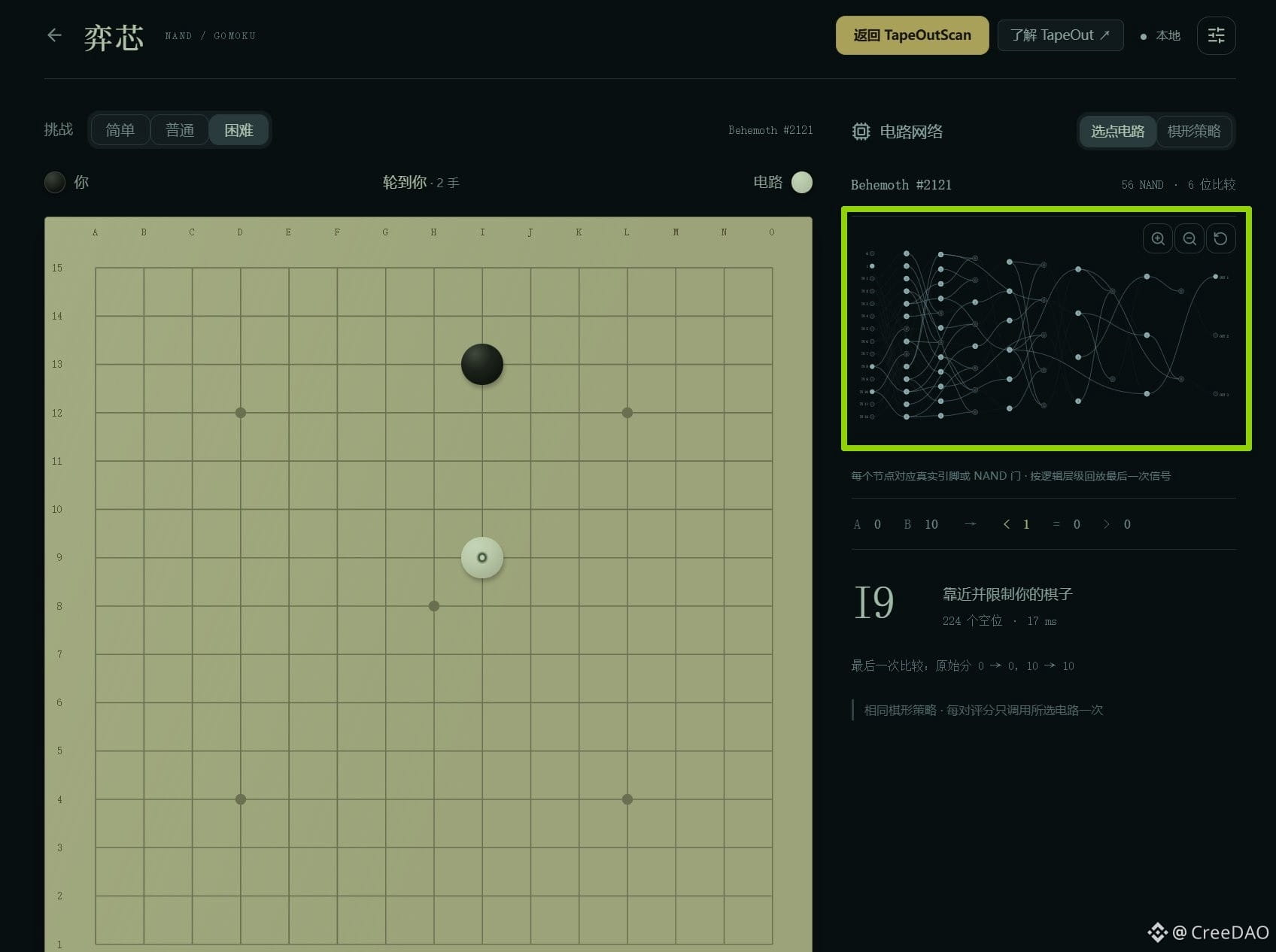
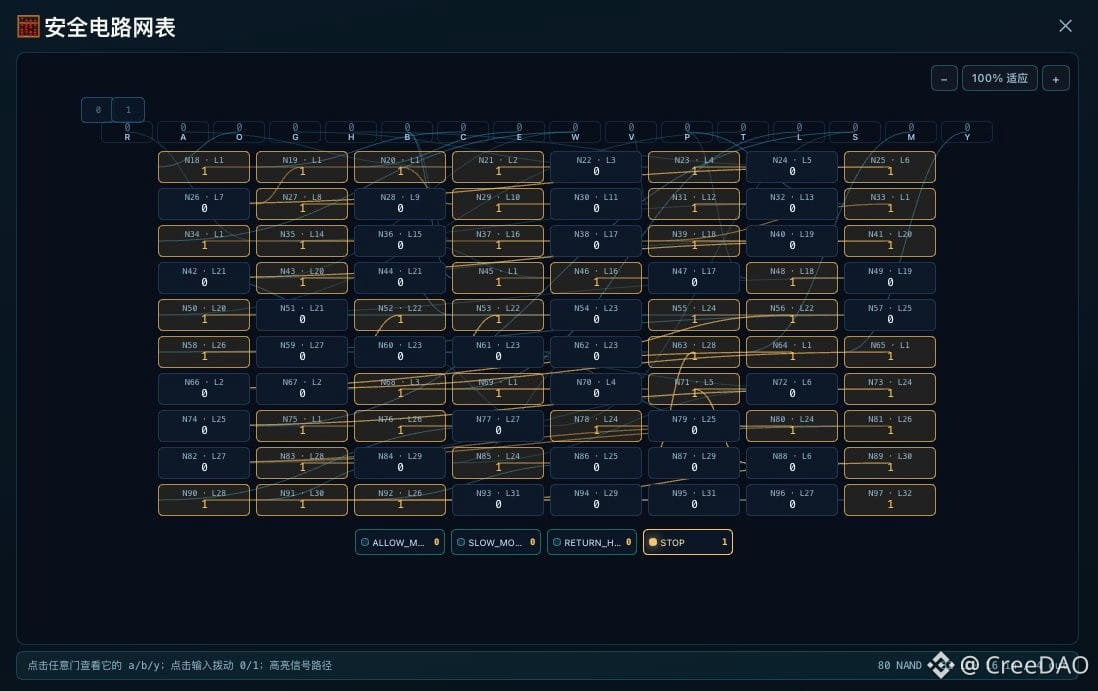
In some TapeOut ecosystem projects, you may sometimes see netlists like this. They look very complex, but also pretty cool. So what exactly are these netlists, and what are they used for?
A netlist is essentially a “list of circuit connections”: it precisely specifies which components (gates) the circuit uses, where each component’s inputs are connected, where its outputs go, and which ports are inputs and which are outputs.
⚙️ A few of its key functions
1️⃣ Describe a circuit precisely and unambiguously
- A schematic can be drawn in different ways, and it’s easy to miss something; a netlist fixes the structure in a purely data-based format, so everyone and every tool gets the same result.
- In TapeOut, it’s simply a { nIn, gates: [{a,b}...], outputs: [...] } structure, for example, 16 inputs / 80 NAND gates / 4 outputs.
2️⃣ An intermediate format connecting “design” and “manufacturing”
- The synthesizer (truth table → NAND) outputs a netlist;
- Place-and-route, chip fabrication, FPGA downloads, and 74HC00 breadboard wiring all use the same netlist;
- So it’s the bridge between “what I want to build” and “how it’s laid out on the chip.”
3️⃣ Verifiable / simulatable
- With a netlist, you can calculate the results automatically: given the inputs, calculate the output of every gate and each circuit output;
- You can exhaustively verify it (for example, check all 65536 input combinations of a safety circuit to ensure the outputs are mutually exclusive);
- You can perform equivalence checks (whether a circuit imported from Verilog is equivalent to the one you built by hand) and timing analysis.
4️⃣ Reproducible, shareable, and versionable
- A netlist can be stored as text/JSON, shared with others, compared, and fingerprinted (the 7-byte gate records, gateHex, and verification credentials in your project all depend on it);
- It can also be translated back into Verilog or used to generate a hardware BOM.
5️⃣ Security and auditing
- Once critical logic (TapeRover’s safety circuit) is fixed as a netlist, it can be audited gate by gate and proven to have no backdoors and to behave as expected.
🔍 An intuitive analogy
- A logic diagram / 3D diagram ≈ a photo or schematic of the circuit;
- A netlist ≈ the circuit’s “construction specification” and “connection database.”
Netlists are actually at work everywhere in your project: synthesizer output, the 110-gate seven-segment decoder, the underlying circuits of the counter/CPU, Verilog imports, nand-cli, and the 74HC00 pin mappings for hardware assembly are all, essentially, built around the same NAND netlist.
#TapeOut #Netlist