250,000 pages, not a single one read
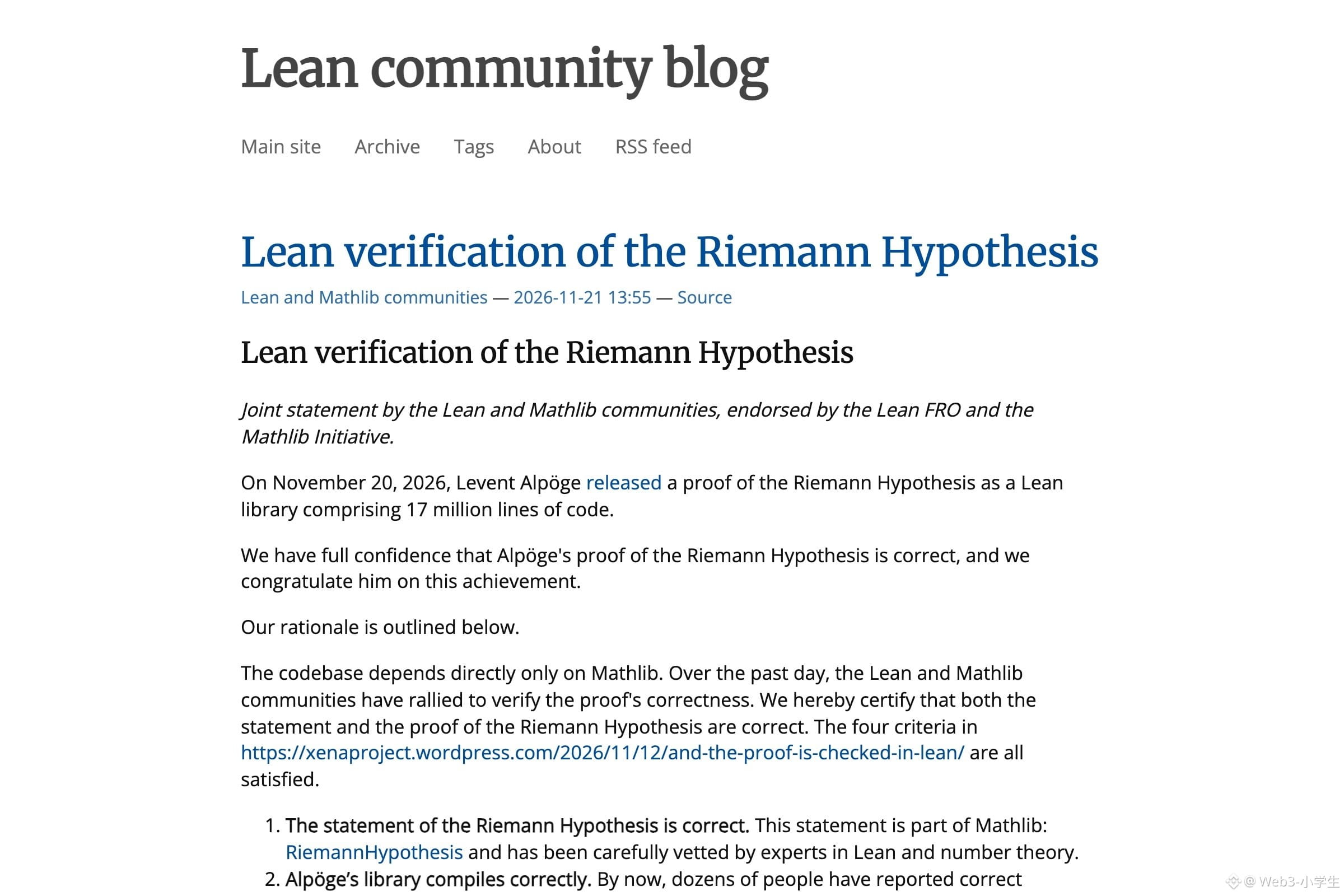
On November 20, Levent Alpöge, a mathematician at Anthropic, released a proof of the Riemann Hypothesis. No paper—just 17 million lines of code. The next afternoon, Lean and Mathlib jointly certified that it was correct.
One day.
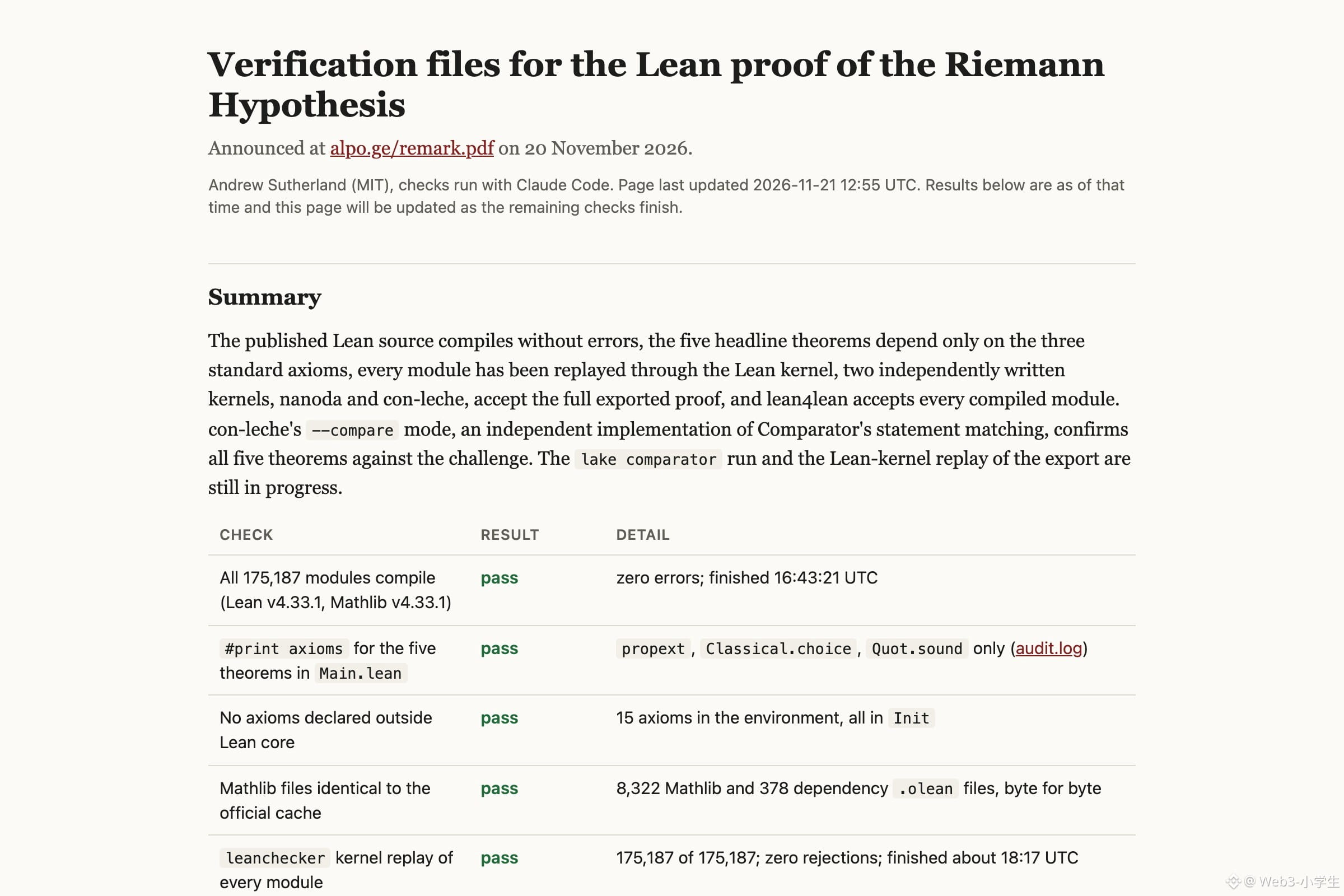
That speed isn’t really a miracle. What changed was the yardstick. People read a proof by following the chain of reasoning, page by page. Machines read a proof by compiling it: 17 million lines broken into 175,000 modules, each checked by the kernel. Zero errors.
So how can the machine guarantee it didn’t make a mistake?
The community wrote a special file that cites only the public math library. They pulled out the original statement of the Riemann Hypothesis on its own, then used two unrelated tools to check it against the theorem the author proved. The results matched on both sides. Not a word out of place.
The strange part is on the other side.
That same day, American Mathematical Society President Ravi Vakil wrote on his blog that there was also a purely human-written proof, 940 pages long, whose author had spent twelve years writing it. Eight hours later, he updated the post: several people had found flaws in it using different AI models.
Machine-written. Certified in a day. Human-written. Picked apart in eight hours.
The crypto world saw this news and immediately thought of private keys. But that reaction is wrong. The Riemann Hypothesis is about where the nontrivial zeros of the ζ function lie. RSA relies on how hard it is to factor a large number into two primes. Knowing how primes are distributed doesn’t mean you can factor any particular number. This proof didn’t provide a single algorithm.
What got hit was another frontier: formal verification.
It’s already in use on-chain. Sui uses the Move language, which came with a companion tool called Move Prover back when it was developed for Diem. It can express the rules a contract must obey as propositions that a machine can check. $SUI runs on this very system.
Money moved on the AI side, too. $TAO , which works on decentralized computing power, rose five percent today, with $109 million in trading volume—one of the few assets in this theme with real trading activity. Nvidia $NVDAB rose four percent, with $30 million in volume.
After reading that statement, though, I remembered another number. The really strange thing is that nobody can say what, exactly, is written in those 250,000 pages.
Alpöge himself has said that he also generated a version for people to read: more than 250,000 pages, 25 meters tall if printed. He simply calls it a huge, unreadable pile of garbage.
The Clay Institute’s $1 million prize is still on the table. The rules require a paper to be published in a recognized journal for two years before it can be reviewed. On the fastest possible timeline, it won’t be eligible until 2029—and as of now, this work isn’t even a paper.