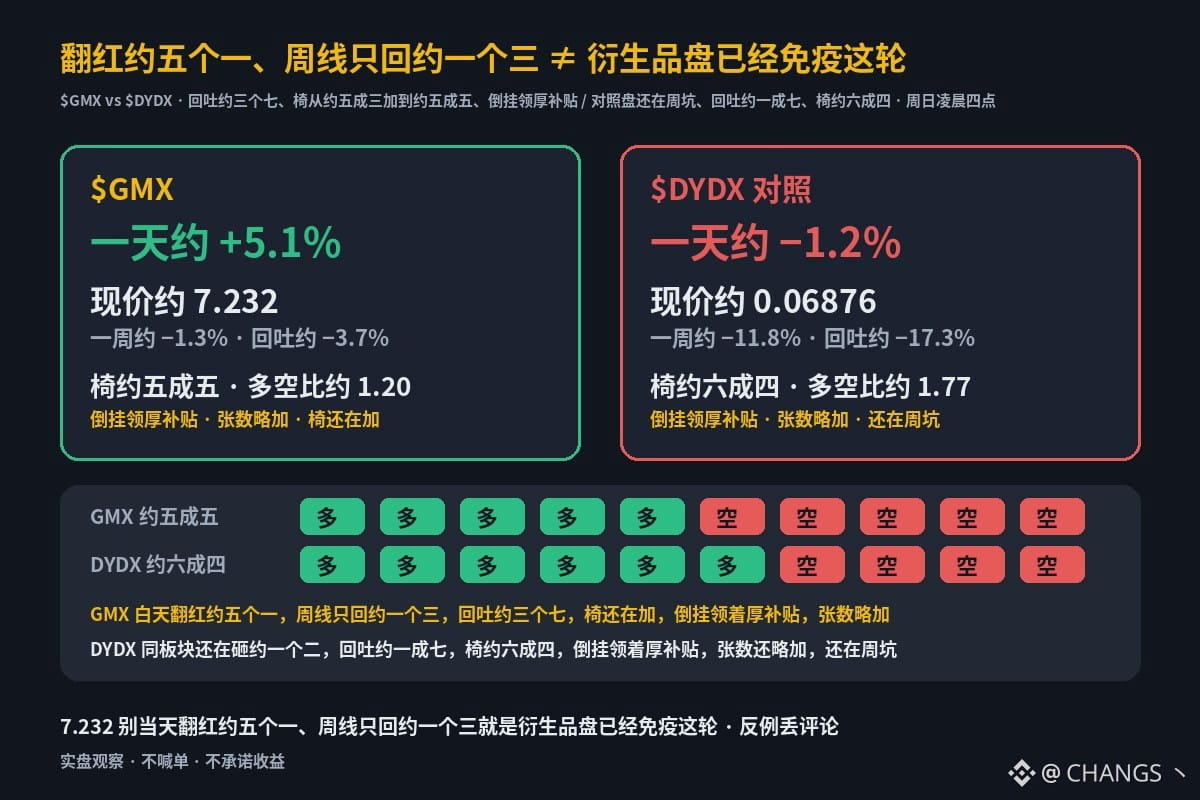
At 4 a.m. Sunday, there are about four hours until the 8 a.m. funding settlement. Some are taking the perpetual DEX’s roughly 5.1% gain on the day and just 1.3% loss for the week as proof that the derivatives market is immune to this week’s slump, that it has found shelter for the weekend, and that they can call it a night. The numbers tell a different story: one asset climbed from about 6.667 to 7.232, near its intraday high of about 7.328 and not far from its weekly high, with only about a 3.7% pullback. Its long share rose from about 53% to 55%; funding is inverted, paying a hefty subsidy, and contract open interest is up slightly. Meanwhile, another asset in the same sector is still down about 1.2%. Its long share fell from about 66% to 64%; funding is also inverted and paying a hefty subsidy, while contract open interest is still up slightly. It’s down about 17% from its weekly high and remains in the weekly hole.
$GMX: about +5.1% on the day / −1.3% on the week; current price around 7.232. Weekly high around 7.507; pullback about −3.7%. Account long/short ratio around 1.20 (about 55% long; around a day ago it was 1.14 / 53%, so longs are adding). Funding is inverted at around −0.0057%/8h, paying a hefty subsidy. Contract OI over the past day is up about 0.8% (USD-margined OI up about 5.6%, mostly due to the price rise, with contracts up slightly). Price rebounded from an intraday low of around 6.667, approached the intraday high of around 7.328, and now stands near 7.232—not far from the weekly high. Don’t take 7.232, a roughly 5.1% daily gain and just a 1.3% weekly loss as proof that the derivatives market is immune to this week’s slump. And don’t assume that longs still adding while funding is inverted and paying a hefty subsidy means shelter for the weekend has been found and you can call it a night.
On the same platform, $DYDX is down about 1.2% on the day and 11.8% on the week, currently around 0.06876. Its weekly high was about 0.0831, a pullback of around 17.3%. Longs account for about 64% (long/short ratio around 1.77; about a day ago it was 1.90 / 66%, so longs are unwinding). Funding is inverted at around −0.0059%/8h, paying a hefty subsidy. Contract OI over the past day is up about 1.7% (USD-margined OI up about 0.7%, with contracts up slightly). Price slid from an intraday high of around 0.07225, dipped to about 0.06567 during the day, then recovered to around 0.06876. It is still a long way from its weekly high; longs have retreated from about 66% to 64%, funding is inverted and paying a hefty subsidy, and contract OI is still up slightly. It remains in the weekly hole.
One asset is up about 5.1% on the day, climbing from around 6.667 to 7.232, down only about 1.3% on the week, with a pullback of around 3.7%; its long share has risen from about 53% to 55%, funding is inverted and paying a hefty subsidy, and contract OI is up slightly. Meanwhile, another asset in the same sector is still down about 1.2%; its long share has fallen from about 66% to 64%, funding is also inverted and paying a hefty subsidy, contract OI is still up slightly, and it is down about 17% from its high and remains in the weekly hole. Does a roughly 5.1% daily gain and just a 1.3% weekly loss mean the derivatives market is immune to this week’s slump and has found shelter for the weekend? Or is it simply one asset still not far from its weekly high, with longs still adding and funding inverted and paying a hefty subsidy, while the comparison asset remains in the weekly hole, still has about 64% of accounts long, and has contract OI up slightly? Post a counterexample in the comments.
$GMX: about +5.1% on the day / −1.3% on the week; current price around 7.232. Weekly high around 7.507; pullback about −3.7%. Account long/short ratio around 1.20 (about 55% long; around a day ago it was 1.14 / 53%, so longs are adding). Funding is inverted at around −0.0057%/8h, paying a hefty subsidy. Contract OI over the past day is up about 0.8% (USD-margined OI up about 5.6%, mostly due to the price rise, with contracts up slightly). Price rebounded from an intraday low of around 6.667, approached the intraday high of around 7.328, and now stands near 7.232—not far from the weekly high. Don’t take 7.232, a roughly 5.1% daily gain and just a 1.3% weekly loss as proof that the derivatives market is immune to this week’s slump. And don’t assume that longs still adding while funding is inverted and paying a hefty subsidy means shelter for the weekend has been found and you can call it a night.
On the same platform, $DYDX is down about 1.2% on the day and 11.8% on the week, currently around 0.06876. Its weekly high was about 0.0831, a pullback of around 17.3%. Longs account for about 64% (long/short ratio around 1.77; about a day ago it was 1.90 / 66%, so longs are unwinding). Funding is inverted at around −0.0059%/8h, paying a hefty subsidy. Contract OI over the past day is up about 1.7% (USD-margined OI up about 0.7%, with contracts up slightly). Price slid from an intraday high of around 0.07225, dipped to about 0.06567 during the day, then recovered to around 0.06876. It is still a long way from its weekly high; longs have retreated from about 66% to 64%, funding is inverted and paying a hefty subsidy, and contract OI is still up slightly. It remains in the weekly hole.
One asset is up about 5.1% on the day, climbing from around 6.667 to 7.232, down only about 1.3% on the week, with a pullback of around 3.7%; its long share has risen from about 53% to 55%, funding is inverted and paying a hefty subsidy, and contract OI is up slightly. Meanwhile, another asset in the same sector is still down about 1.2%; its long share has fallen from about 66% to 64%, funding is also inverted and paying a hefty subsidy, contract OI is still up slightly, and it is down about 17% from its high and remains in the weekly hole. Does a roughly 5.1% daily gain and just a 1.3% weekly loss mean the derivatives market is immune to this week’s slump and has found shelter for the weekend? Or is it simply one asset still not far from its weekly high, with longs still adding and funding inverted and paying a hefty subsidy, while the comparison asset remains in the weekly hole, still has about 64% of accounts long, and has contract OI up slightly? Post a counterexample in the comments.