


🚨 IS THE NEXT ×10 AMONG THESE 4 CRYPTOS? THE RISK THAT DOESN’T SHOW UP IN THE PRICE
INFINIT, MIRA, SAPIEN, and NAORIS: four microcaps linked to artificial intelligence, DeFi automation, data, and cybersecurity. Some boast impressive theoretical multiples. They could also lose much of their value.
Research horizon: 6–12 months. Reference data as of 11/21/2026. Approximate values in USD.
On a day when Bitcoin, Ethereum, and Solana dominate the headlines, speculative capital often looks for small projects that could multiply in value if they manage to attract real demand. But one mistake keeps recurring: confusing a small market capitalization with an investment opportunity.
We compared four tokens, their businesses, their competitors, and the supply that could still enter the market. The result reveals potential multipliers of more than ×20 in a purely arithmetic exercise. These are not predictions or likely returns.
1. The radar: four projects, four stories
TokenSectorReference priceMarket capRating$INAI agents for DeFiUS$0.0235US$8.1 M7/10$MIRAAI verificationUS$0.0293US$11.2 M6/10$SAPIENHuman data for AIUS$0.0422US$11.1 M6/10$NAORISPost-quantum securityUS$0.0338US$20.3 M4/10
INFINIT and NAORIS have a verified presence on Binance Alpha; MIRA and SAPIEN are analyzed as microcaps traded on crypto markets. Alpha is not a guarantee of quality or future inclusion on Binance Spot.
When comparing market capitalizations with approximate sector benchmarks, the picture is striking: INFINIT is equivalent to just 3.2% of VIRTUAL, while SAPIEN is equivalent to about 4.2% of GRASS.
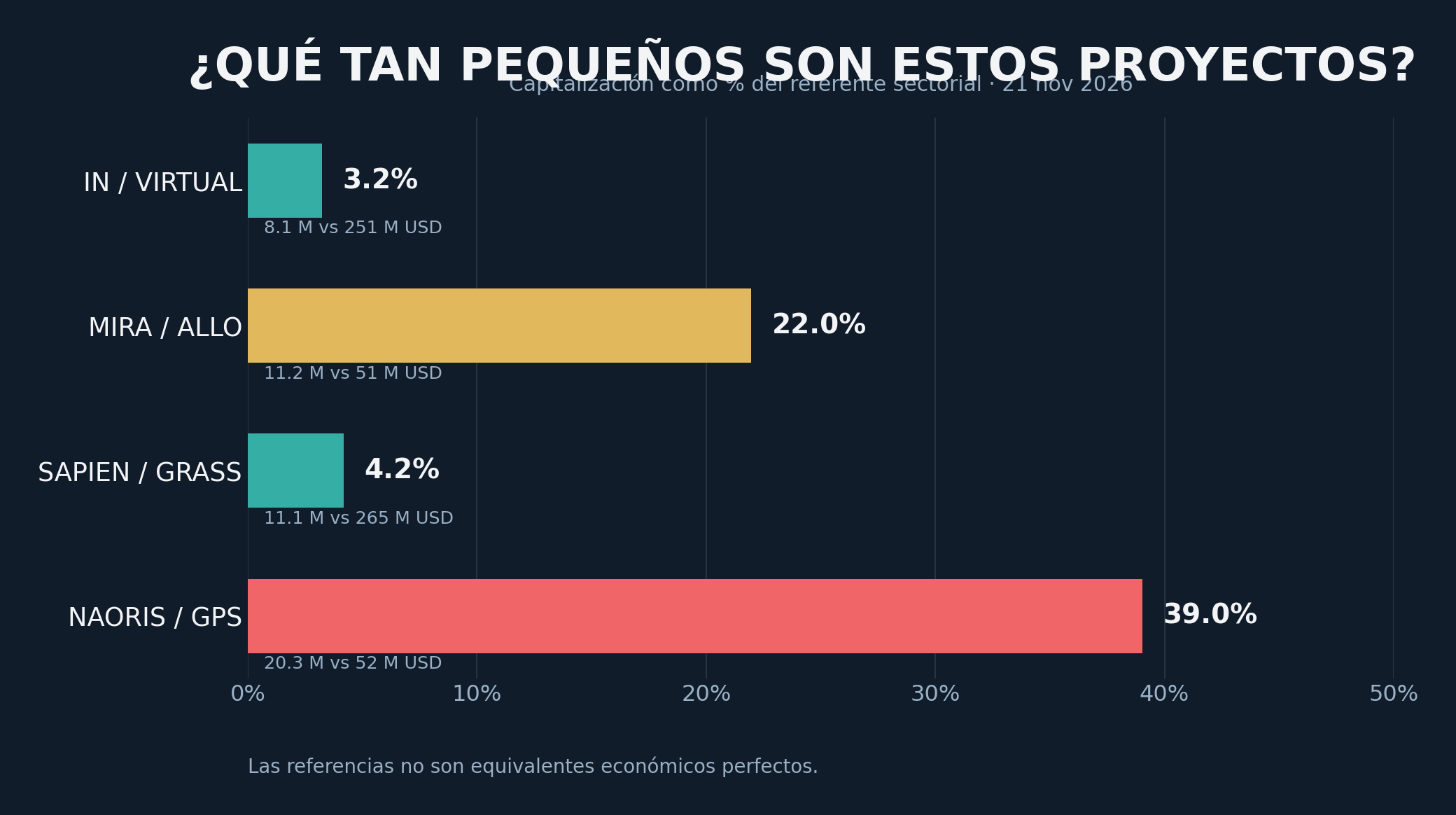
INFOGRAPHIC 1 · Relative size of each microcap compared with its sector benchmark.
The problem: VIRTUAL, ALLO, GRASS, and GPS are not economic twins of these projects. Their users, margins, value-capture models, and supply can be very different. The comparison measures the valuation gap, not proven undervaluation.
2. Where does the famous ×10 come from?
To calculate a theoretical equivalent, we take the market capitalization of a benchmark project and estimate the price each token would have if it reached 25%, 50%, or 100% of that figure, keeping the current circulating supply constant.
TokenBenchmark25%50%100%INVIRTUAL (US$251 M)$0.1817$0.3633$0.7266MIRAALLO (US$51 M)$0.0335$0.0671$0.1342SAPIENGRASS (US$265 M)$0.2519$0.5037$1.0075NAORISGPS (US$52 M)$0.0218$0.0437$0.0874
At a valuation equivalent to 100% of its benchmark, IN would represent approximately ×30.9 its initial price; SAPIEN, ×23.9; MIRA, ×4.6; and NAORIS, ×2.6. These multipliers are based on an extreme mathematical hypothesis, not a base-case scenario or a probability of success.
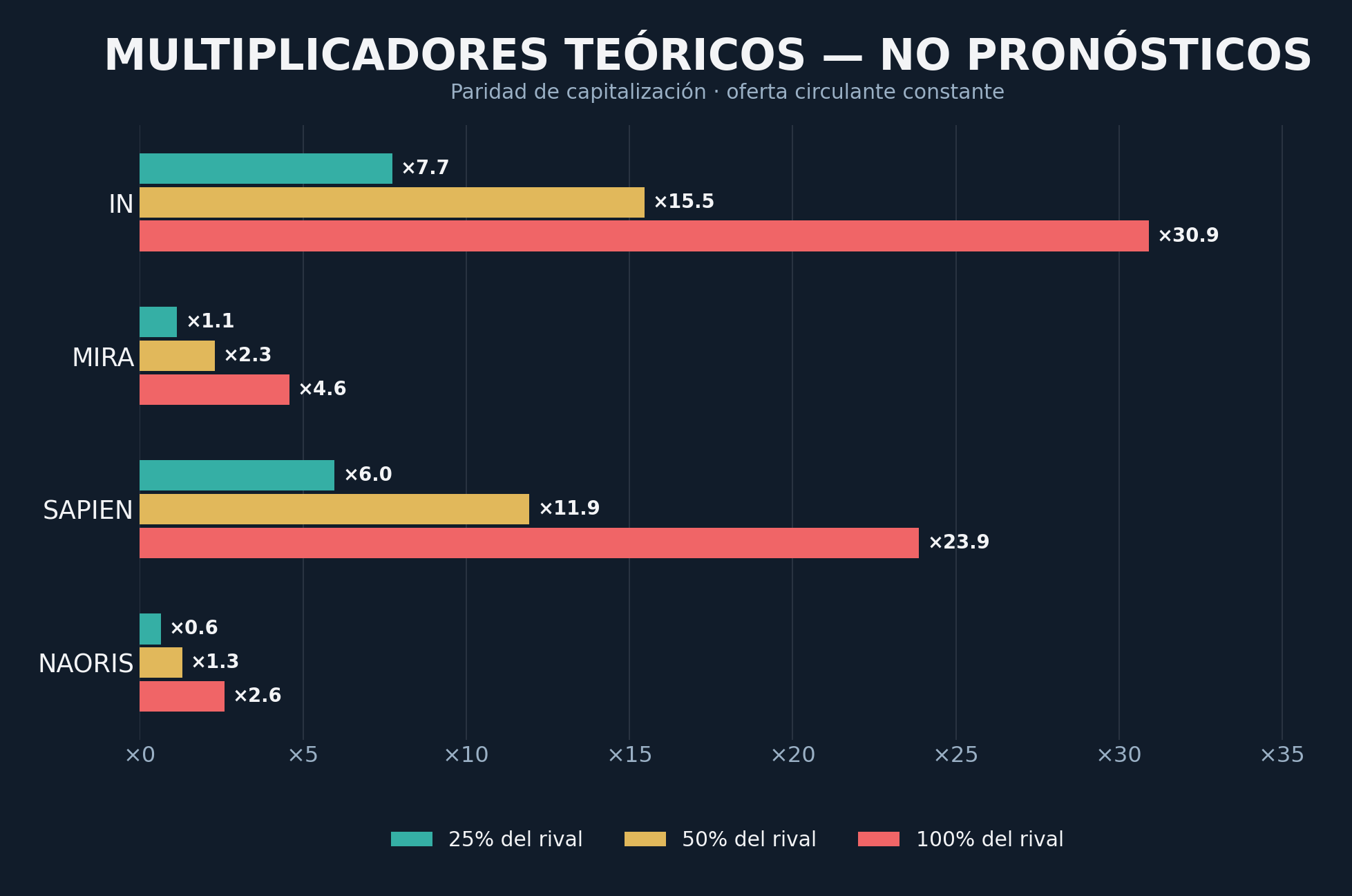
INFOGRAPHIC 2 · Hypothetical multipliers upon reaching 25%, 50%, or 100% of the competitor’s market capitalization.
For INFINIT or SAPIEN, closing that gap would require a huge leap in adoption, economic use, and trust. It is not enough for someone to buy the token for a week: demand must be able to sustain a much higher valuation.
3. INFINIT ($IN): AI agents that operate DeFi
QUALITATIVE RATING · 7/10
INFINIT enables the automation of decentralized finance tasks and strategies through artificial intelligence agents. The proposition is clear: reduce the complexity of connecting protocols, moving funds, and executing sequences of operations without having to develop everything manually.
The project reports more than 181,000 users and 456,000 operations executed. These are figures reported by the project, not an independent audit of the number of active economic users. In addition, the total value locked recorded by DefiLlama is extremely low at the time of review; that figure alone also does not measure all the operations an automation layer could coordinate.
Thesis: if DeFi automation attracts users who pay for tools, and if the token participates in that economy, IN could capture part of the sector’s expansion. The maximum supply is 1 billion IN, and around 34.5% was circulating at the time of the report.
Key risk: approximately 65.5% of the maximum supply was still not circulating. An unlock is scheduled for December 7, 2026. A promising idea can face selling pressure if demand growth falls short of token releases.
What to watch: verifiable active users, product-generated revenue, repeat operations, concrete token utility, and changes in circulating supply.
4. MIRA ($MIRA): Who verifies AI responses?
QUALITATIVE RATING · 6/10
Generative AI can produce convincing but incorrect answers. Mira is developing infrastructure to verify model outputs through decentralized mechanisms. The idea addresses a real technological problem: the reliability of automated information.
However, having an API and a verification proposition does not guarantee recurring revenue. MIRA still needs to demonstrate paid commercial demand and the ability to compete with conventional model evaluation and verification services.
Pay attention to supply: its November 26 unlock is estimated at between 16 million and 21.5 million MIRA, according to the data provider. The difference calls for checking which categories and releases each methodology includes before making decisions.
What to watch: production integrations, paying customers, completed verifications, revenue growth, and the impact of each release on liquidity and price.
5. SAPIEN ($SAPIEN): Human data in the AI race
QUALITATIVE RATING · 6/10
AI systems need datasets that have been evaluated, reviewed, and labeled. Sapien aims to organize this human work through incentives and validation mechanisms. Unlike many purely narrative-driven tokens, its sector has an understandable economic market: data services for AI training and evaluation.
Its real competition includes traditional data annotation and management companies, not just other coins. Therefore, comparing its market capitalization with GRASS provides an indicative sector benchmark, but not a validated price target.
Risk: around a quarter of the maximum supply was circulating at the time analyzed. Following the November 20 unlock, the next identified monthly event is scheduled for December 20, 2026, subject to change. The number of freely circulating tokens could continue to increase.
What to watch: commercial contracts, data delivered to clients, verifiable quality, net revenue, buyer retention, and token releases.
6. NAORIS ($NAORIS): Post-quantum security, potential, and extreme risk
QUALITATIVE RATING · 4/10
NAORIS is built around a powerful narrative: security infrastructure using cryptography resistant to quantum threats, and a network compatible with blockchain technologies. The launch of its mainnet represents technical progress, but an existing network does not amount to demonstrated commercial adoption.
The major red flag is supply. The stated maximum supply is 4 billion tokens, while approximately 15% was circulating at the time used for this analysis. The full release schedule had not been sufficiently verified.
Its theoretical price upon reaching GPS’s market capitalization would be US$0.0874 based on the reference circulating supply. But if all 4 billion tokens were circulating, the same market capitalization would imply approximately US$0.0131, below the initial price of US$0.0338.
The takeaway: a project can gain market capitalization and still deliver disappointing returns to holders if the increase in supply is too large.
7. The infographic that changes everything: how much supply remains to be released
The real difference between a theoretical multiplier and a viable investment often comes down to tokenomics.
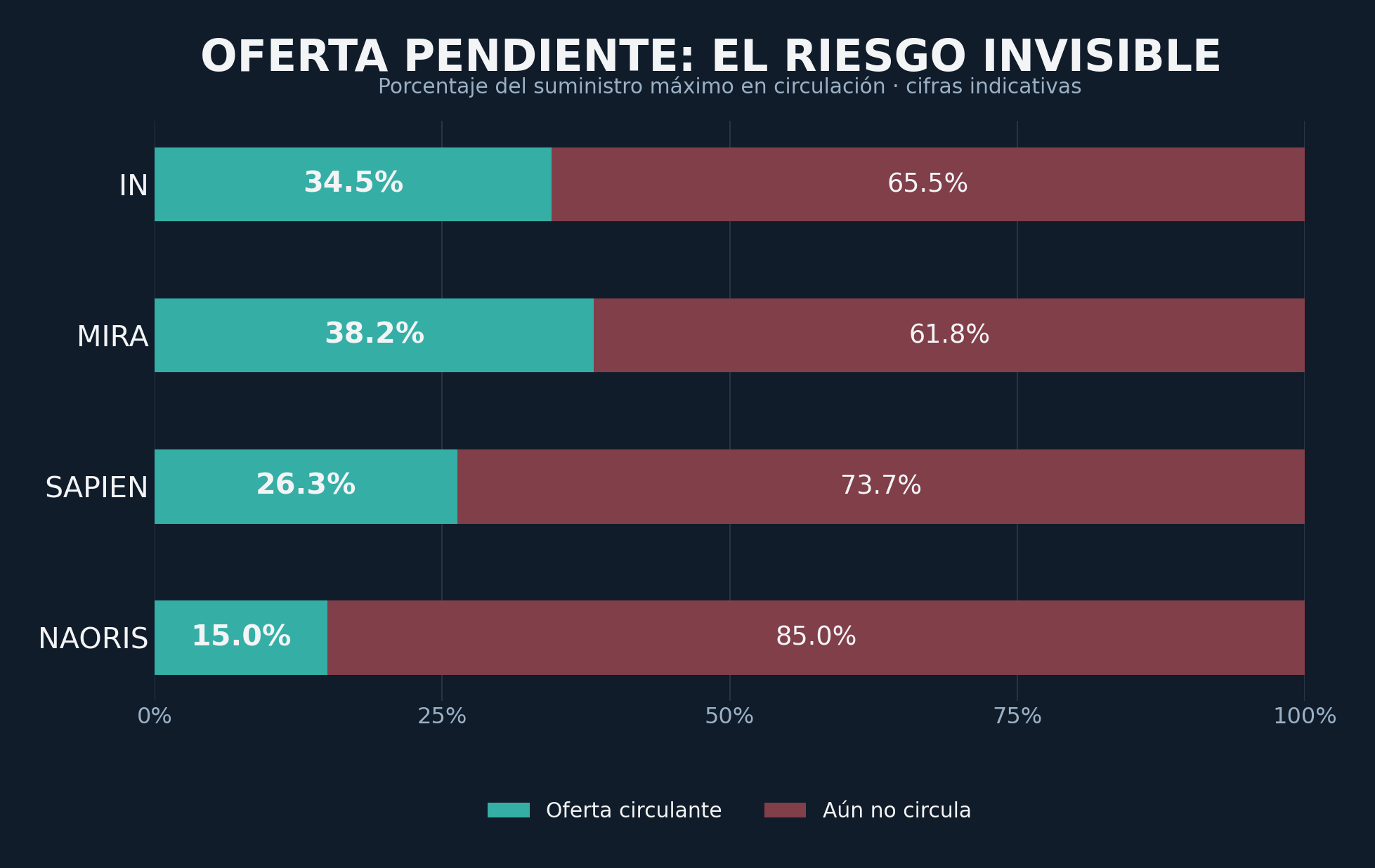
INFOGRAPHIC 3 · Approximate circulating supply versus stated maximum supply.
NAORIS has the largest potential share of supply yet to be released. SAPIEN and INFINIT also have a considerable portion of their supply still out of circulation. MIRA retains a material supply risk despite having a higher relative circulating share.
These percentages do not mean that all the remaining supply will be released over the next twelve months. They are a stress test of total dilution potential, not a vesting schedule.
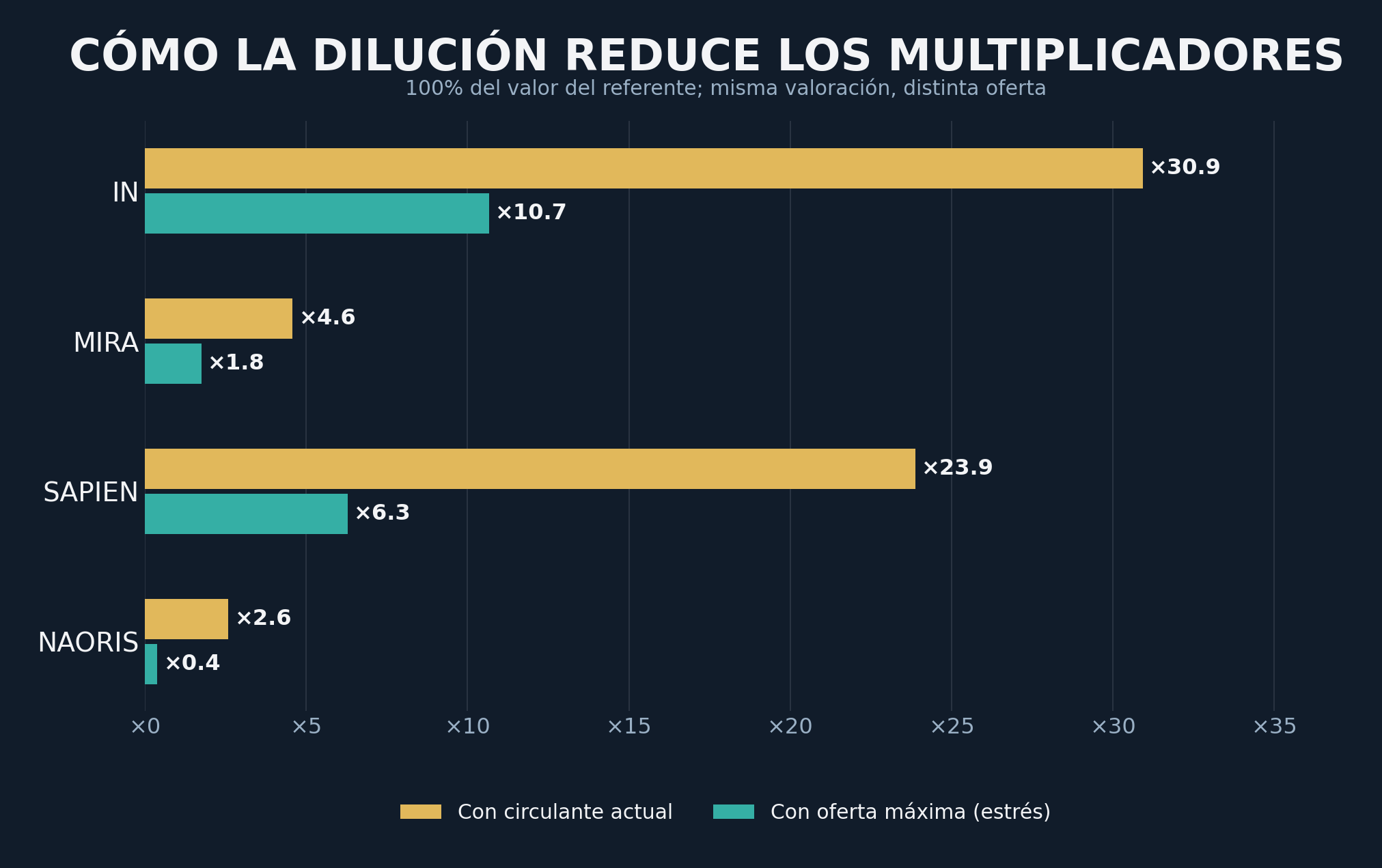
INFOGRAPHIC 4 · How multipliers change when assuming the maximum supply is fully circulating, with the reference market capitalization unchanged.
In this extreme scenario, IN’s theoretical multiplier falls from ×30.9 to approximately ×10.7; SAPIEN goes from ×23.9 to ×6.3; MIRA, from ×4.6 to ×1.7; and NAORIS, from ×2.6 to just ×0.39. The big multiplier on screen can disappear when the denominator changes.
8. Monitoring calendar: the dates that matter
TokenNext observed milestoneWhat it could affectMIRANov 26, 2026Estimated unlock: 16–21.5 million MIRAINDec 7, 2026Scheduled release; verify amountSAPIENDec 20, 2026Next estimated monthly releaseNAORISNo complete verified scheduleMonitor supply and concentration
The dates and amounts come from schedules consulted in November 2026. They should not be interpreted as automatic sell orders: some releases are distributed gradually, and data providers may differ.
9. Our ranking: speculative appeal ≠ safety
1st. INFINIT — 7/10. The group’s strongest speculative thesis, combining a concrete application, an expanding sector, and a small market capitalization. It must demonstrate revenue and overcome supply pressure.
2nd. MIRA — 6/10. The AI verification problem is real; the token’s ability to capture economic value and its resilience to unlocks still need to be confirmed.
3rd. SAPIEN — 6/10. A model linked to data and human work, but with significant exposure to dilution and competition from conventional businesses.
4th. NAORIS — 4/10. An ambitious technological thesis, but with the greatest supply risk and doubts about organic economic demand.
These ratings are qualitative assessments, not probabilities of success. In microcaps, losing 70–100% of your capital is a possible risk, even when a project seems technically interesting.
10. The question that separates an investor from a hype chaser
Before opening a position in a microcap, we would review five things: real tradable volume, order book depth and spread; wallet concentration; unlock schedule; verifiable commercial demand; and the mechanisms through which economic activity benefits the token.
The biggest opportunities are not necessarily in the coins that have fallen the most. They are where a small valuation coincides with an economic improvement that can be sustained.
And there’s still one more thing: a good 12-month thesis is not an entry signal today. The market could keep falling and punish small tokens much more than BTC.
🔥 Which one would you put on your radar: $IN, $MIRA, $SAPIEN, or $NAORIS? Are you looking for a potential ×10, or would you rather wait until unlock risk disappears?
Methodology: market-cap parity scenarios using imperfect sector comparables; current circulating supply for the first calculation and maximum supply for the dilution stress test. No calibrated Monte Carlo model or statistical probabilities that these targets will be met.
Sources: Binance Alpha — INFINIT and NAORIS announcements; CoinGecko; CoinMarketCap; DefiLlama; Tokenomist; Tokenomics.com; documentation from INFINIT, Mira, Sapien, and Naoris. Reference date: November 21, 2026. Verify updated figures before trading.