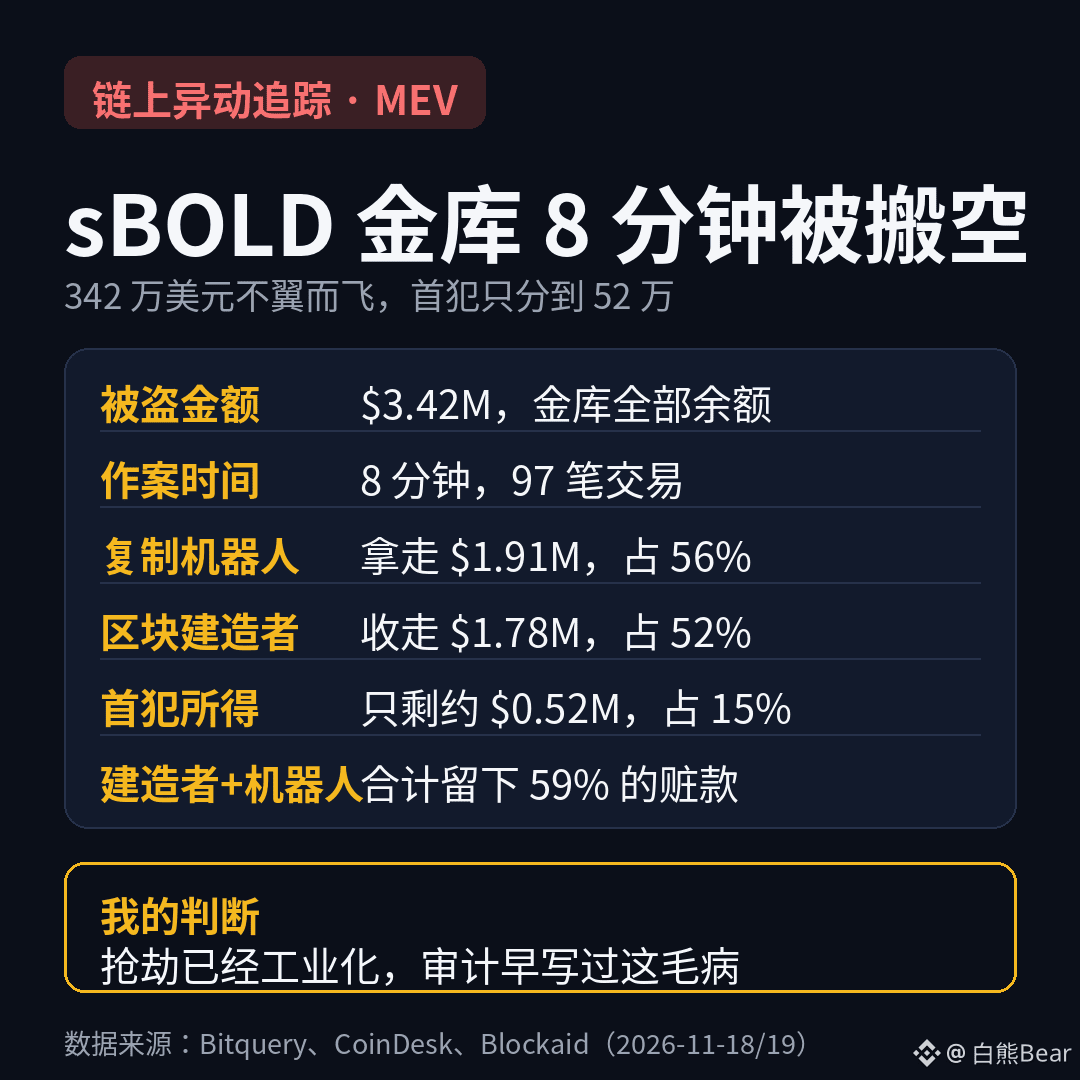
A vault was drained of $3.42 million in 8 minutes. The people who pulled it off only got $520,000—the rest went to frontrunning bots and block builders.
At midday on November 18, K3 Capital’s sBOLD vault was emptied between 12:25 and 12:33. In 97 transactions, all $3.42 million in the vault was gone. sBOLD is a product that earns interest on deposited BOLD stablecoins. The vulnerability was in the formula it used to calculate share prices: deposited wstETH wasn’t counted. The attacker flash-borrowed 10,000 wstETH from Morpho, minted about 9 million BOLD, then repeatedly deposited, swapped, and redeemed, cashing out other people’s BOLD. K3 didn’t announce that it was pausing the contract until 13:08. By then, the money was long gone.
The wildest part was how the proceeds were split. The wallet that first put the attack onchain got only about $520,000, then promptly routed it through THORChain and Maya and converted it to Bitcoin. An MEV bot that caught wind of the attack copied the whole exploit and swept up $1.91 million in 57 transactions—56% of the total. To get priority in transaction ordering, the bot paid Ethereum block builders $1.78 million in fees. The fee to jump the queue in a single block briefly reached 44 ETH. The builders and the bot’s receiving wallets kept 59% of the money between them.
To me, the most striking thing isn’t the $3.42 million figure. It’s that onchain robbery has become industrialized: within seconds of the attack code going onchain, six wallets, bots, and builders were all there to take their cut, while the original attacker got the least. Even more painful, ChainSecurity had already flagged a high-severity accounting issue in its May 2025 audit—the same kind of flaw, where collateral was omitted from share pricing. The audit report said it, but the vulnerability remained untouched until someone drained the vault. BOLD itself and Liquity were fine; the problem was in K3’s own wrapper. But users deposited into sBOLD, and those who can’t tell the difference between these layers are the ones who ultimately pay. Also, the builders collected $1.78 million in fees, but Bitquery says there’s no evidence they knew they were including attack transactions in their blocks. The MEV system doesn’t distinguish right from wrong: whoever pays more gets in first. That’s the hardest part to stomach.
Three things to watch next: K3 still hasn’t announced a compensation plan. For a small vault, $3.42 million is a total loss, so anyone who deposited into sBOLD should check how much of their position is left. Any yield-bearing vault that calculates its own share price should revisit the high-severity findings in its audit report. And on the same day, the Gonka bridge lost $1.05 million and Reental about $950,000. All three incidents add up to roughly $5.4 million, suggesting someone is sweeping through these kinds of vaults at scale.
Do you think block builders who collected $1.78 million in priority fees were accomplices to this robbery? Or is “pay us and we’ll do it” simply how things work onchain?
$BTC $ETH
#MEV #DeFi安全