Gold prices down 10% in six days, but counters are cutting just 34 yuan per gram
On Saturday, gold fell below $3,550 an ounce, while the price of 24-karat gold jewelry in China was cut by just 20 to 34 yuan per gram.
What’s posted at the counter isn’t the gold itself, but the workmanship charge wrapped around it.
This downturn has lasted six days.
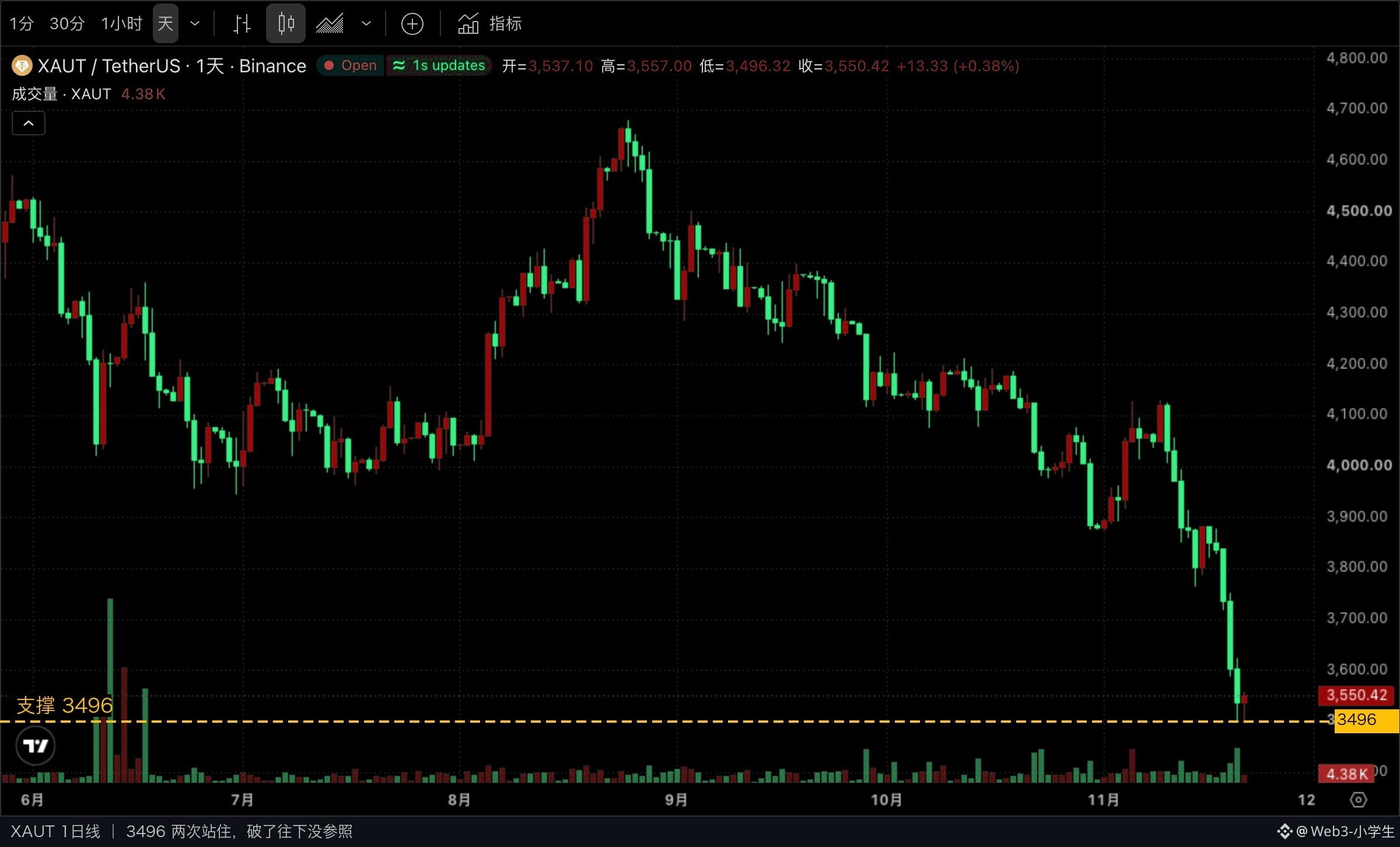
I went over the daily chart. $XAUT hit 3,883.36 on November 15, then fell to a low of 3,496.32 on the 21st.
That’s a drop of $387 in six trading days—exactly 10%.
At an onshore exchange rate of 6.67, the price of raw gold fell by 83 yuan per gram.
The selloff really hit over two consecutive days. On the 19th, it closed at 3,603.39, down 3.53% for the day.
On the 20th, it fell another 1.84%, breaking through the 3,550 threshold.
CCTV Finance reported on the 21st that spot and futures prices both fell below 3,550 during trading on the 20th, with futures briefly down nearly 5%.
That same day, several brands lowered their prices for 24-karat gold to between 1,056 and 1,068 yuan per gram.
The counters did make a cut of 20 to 34 yuan, but the remaining shortfall of 40 or 50 yuan was left in the posted price.
Just left there.
After a 10% drop in six days, they cut just 34 yuan per gram. How does that make sense?
It doesn’t.
Let’s do another calculation. At $3,550 an ounce, gold works out to 761 yuan per gram. The counter price is 1,056 to 1,068 yuan. Those 300 yuan in between have nothing to do with the actual gold price.
Gold shops aren’t willing to budge.
The reason is simple.
Their inventory was bought at higher prices, so lowering the posted price immediately shows a loss on the books. This markup is also the shop’s only gross margin. Slashing it in a single day would mean admitting defeat, so they’d rather sell a few fewer pieces than give ground. That’s why counter prices are always slow to follow when gold falls.
And the cost of that delay falls entirely on the buyer.
Meanwhile, the prices that update around the clock are those of $XAUT and $PAXG . Counters change their prices once a day; these two tokens update every second. By the time counters had just lowered their prices on Saturday, $XAUT had already climbed back from 3,496.32 to 3,550—up 1.53% from its low.
The two tokens are still $3.58 apart. Same ounce of gold, two prices—the difference comes down to market depth.
It’s not much.
$XAUT traded $25.84 million in 24 hours, and $PAXG a little over $16 million. That’s $42 million combined, all settled in $USDT.
This price machine is fast, but it can’t handle a few kilograms of physical gold. For anyone who wants to buy at the real-time gold price, it’s the only option left—but its daily trading volume is still less than the gold bangles sold by a single Shanghai mall over a weekend.
If you own gold jewelry, understand one thing first: buyback prices only count the raw-gold portion, which is 761 yuan.
No one will pay you back the 300 yuan in workmanship charges you originally paid in cash.
If you trade the tokens, don’t use market orders.
The market is this small; a single large order can skew the spread. Just place a limit order and wait.
If you’re looking to buy the dip in gold, watch 3,496. The low was 3,498.98 on the 20th and 3,496.32 on the 21st—both times it stopped around this level. If it breaks below, there’s no reference point further down.
Brands will post new prices again on Monday morning. Gold is back above 3,550 today, a little higher than when the counters set their prices on Saturday. Whether they’ll make up that 83 yuan is anyone’s guess—it’s up to them.
The direction is still unclear ahead of the December 9 rate decision.
What do you think that 300-yuan workmanship charge at the counter represents: a brand premium or the cost of inventory?