
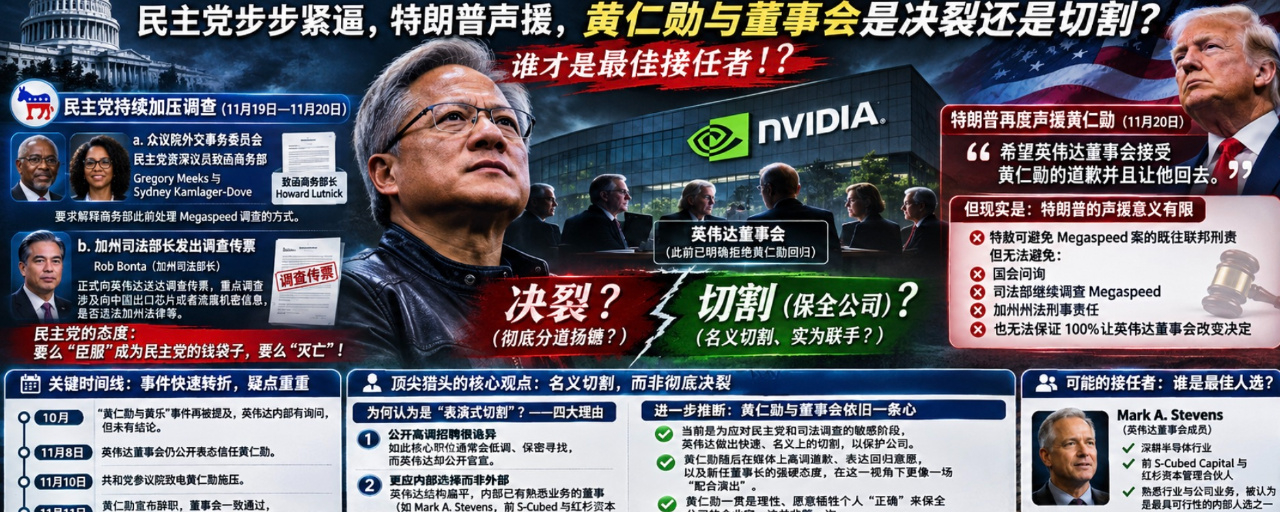

Democrats close in, Trump shows support: Is Jensen Huang breaking with the board or distancing himself from it? Who is the best successor?!
November 19–20 — Democrats continue to ramp up pressure and investigations targeting Jensen Huang
a. Gregory Meeks and Sydney Kamlager-Dove, senior Democratic members of the House Foreign Affairs Committee, formally wrote to Commerce Secretary Howard Lutnick, demanding an explanation for the Department of Commerce’s previous handling of the Megaspeed investigation.
b. California Attorney General Rob Bonta formally announced that a subpoena had been served on Nvidia, focusing on whether exporting chips to China or leaking confidential information violates California law, among other issues.
Clearly, now that Nvidia’s board has explicitly rejected Jensen Huang’s return, the Democrats have no intention of letting him off the hook. In their eyes, Huang must either “submit” and become the Democrats’ cash cow, or “perish.”
Trump voices his support for Jensen Huang! #英伟达一个半月市值减少2.7万亿美元
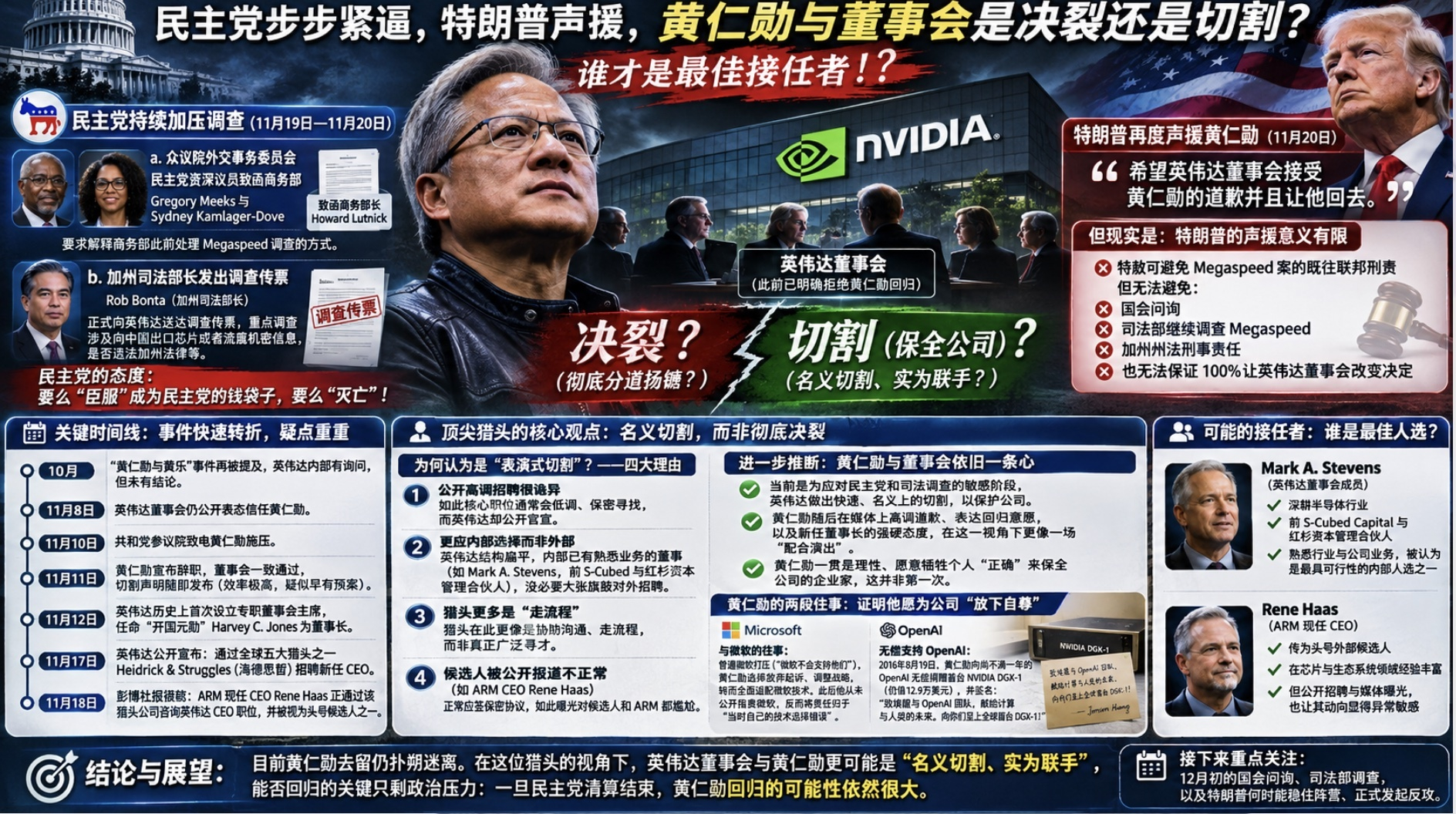
On November 20, Trump told the media that he hoped Nvidia’s board would accept Jensen Huang’s apology and let him return. I’ve lost count of how many times Trump has voiced his support since Huang resigned, but in reality, this kind of support doesn’t mean much.
Voicing support won’t solve the problem. The question is how to apply counterpressure in the political battle. At present, Trump seems to be struggling to cope with the Democrats’ attacks. He doesn’t have many tools at his disposal, while there are plenty of points he can be attacked on. He’s stuck playing defense.
Many people say Trump could ultimately pardon Jensen Huang. That’s certainly possible: a pardon could shield Huang from prior federal criminal liability related to the Megaspeed case. But it wouldn’t prevent congressional hearings or stop the Justice Department from continuing its Megaspeed investigation. Nor would it prevent criminal liability under California state law, much less guarantee that Nvidia’s board would change its decision. That’s the core issue.
So, at present, Trump’s own position is unfavorable, and he can’t do much to help Huang. Only if Trump can hold his ground against the Democrats’ attacks and effectively fight back will the current situation be reversed.
Have Jensen Huang and Nvidia’s board really split for good, or is this an epic show to protect the company?
This view comes from a senior headhunter at one of the country’s top headhunting firms. Since headhunters are familiar with the recruitment process, I think his perspective on Nvidia is well worth considering.
1. Why give such a critical role to a headhunting firm and announce it publicly?
On November 17, Nvidia announced that it had entrusted the search for a CEO to the world’s five largest headhunting firms, including Heidrick & Struggles. In this headhunter’s view, the move is very strange. His reasoning is that core roles at large companies are generally filled through discreet searches, and candidates typically sign nondisclosure agreements before discussions begin. Nvidia, by contrast, made a very public announcement.
What’s more, making such a high-profile announcement serves no purpose for the recruitment itself. There are only a handful of people in the field capable of succeeding Jensen Huang, and they would normally be approached directly. Clearly, this kind of “broadcasting it to everyone” looks more like recruiting ordinary employees. I agree with this headhunter’s doubts.
2. In terms of internal coordination and business capability, Nvidia would be better off choosing its CEO from within rather than looking outside. That’s the assessment of a professional headhunter. He believes that in Nvidia’s exceptionally flat organizational structure, the CEO would have at least 20 to 30 direct reporting lines. If an outsider were brought in, it would be quite difficult for them to take over all those reporting lines and operate effectively in the short term.
As for expertise, board member Mark A. Stevens is very familiar with the semiconductor industry and is a former managing partner at S-Cubed Capital and Sequoia Capital. Given his knowledge of and expertise in semiconductors, if Nvidia wanted an external candidate, he could likely name suitable people and approach them directly about the CEO position, rather than publicizing the search through media reports.
3. Therefore, this headhunter believes that at this level, a headhunting firm is really just there to facilitate the process and help both sides communicate. Nvidia’s public announcement of the search looks more like a performance for the outside world.
What is it trying to show the outside world? It seems to be signaling that Nvidia really is recruiting and really has no intention of letting Jensen Huang return. Is this more like making a statement?
4. On November 18, Bloomberg reported that ARM’s current CEO, Rene Haas, was consulting with this headhunting firm about Nvidia’s CEO position and was considered one of the leading candidates. But the fact that this news came out through Bloomberg makes the whole thing even stranger.
From a headhunter’s perspective, communications between candidates and companies are private, and both sides are supposed to sign nondisclosure agreements. But with such an open recruitment process, what are candidates supposed to think? What is ARM supposed to think? Its CEO is preparing to jump ship and apply for the CEO job at another company?
5. Based on Nvidia’s conduct over the past two weeks, it does seem to be drawing a clear line between itself and Jensen Huang, especially during this sensitive period of Democratic political scrutiny and judicial investigations. Nvidia’s actions are understandable. But given the recent recruitment process and media reports, this headhunter questions whether Huang and the board have really “split”—or whether it’s all an act.
This brings us to the headhunter’s central argument:
For Nvidia’s senior leadership, if a sensitive issue arises involving a core member of management, the theory is that they should quickly distance themselves from that person for the greater good. That’s reasonable. But an actual split and a formal distancing are two different things. This headhunter believes Jensen Huang has not split with the board; the distancing is only for show, and its purpose is to protect Nvidia.
He cited the following events as supporting evidence
a. The incident involving Jensen Huang and Huang Le came to light in October 2025. At the time, it prompted internal inquiries at Nvidia, but no results or conclusions came of them. The incident was brought up again this October, and until November 8, Nvidia’s board members continued to express their trust in Jensen Huang,
Then, two days after November 8, Republican senators called Jensen Huang to pressure him. The next day, Huang resigned, and the board unanimously approved it. From that day on, it repeatedly issued statements distancing itself from him. For such a pivotal CEO and central figure—a founder who was the very soul of the company—to leave, with the board approving it, all at astonishing speed: that is precisely the issue. Clearly, the two sides had already communicated and reached an understanding. I even suspect they had agreed on a Plan B in advance.
b. On November 12, just after Jensen Huang’s resignation, Nvidia’s board—which had never had a chair before—suddenly created a dedicated board chair position and appointed Harvey C. Jones to it. This was a first in Nvidia’s history.
Harvey C. Jones is practically a “founding father” of Nvidia. In other words, he had worked alongside Jensen Huang for at least 33 years—and he is just one example. Several board members have known Huang for decades. Given all that, Huang was still able to leave so smoothly, with nobody trying to keep him. Even more outrageous, everyone supported him before November 8, then the entire board turned against him two days later. Clearly, that’s not normal. I agree with this view, too.
c. So this headhunter’s inference is reasonable: Jensen Huang and Nvidia’s board are still on the same side, but what looks like “everyone turning against him” is really just a quick, calculated distancing—a reasonable response to protect the company. Huang’s subsequent high-profile apology in the media and his bid to return, alongside the new chair’s resolute stance, also look like “an act” from this perspective.
d. Could Jensen Huang really go this far for his company? The answer is yes. Huang is a rational figure at the heart of the company. This brings us to Nvidia’s early love-hate relationship with Microsoft.
In Nvidia’s early days, when it was just getting started with product development, Microsoft sent a key message to computer manufacturers interested in Nvidia: “Nvidia’s technology is very interesting, but Microsoft won’t support them.” At the time, those words were devastating for Nvidia, because if Microsoft didn’t support its technology, it would be unusable without Windows, no matter how good it was.
So Microsoft’s words seemed like praise, but were actually a threat and an attempt to suppress Nvidia. Nvidia could have sued Microsoft and fought back hard, but it didn’t. Jensen Huang chose to give up the fight, abandon the original technology roadmap, restructure Nvidia’s technology efforts, and focus entirely on developing technology compatible with Microsoft.
Most importantly, ever since that incident, whenever anyone brings it up, Jensen Huang has never accused Microsoft of bullying or suppressing Nvidia. Instead, he has always said that his own technology choices at the time were wrong.
So this incident shows that Jensen Huang is someone willing to set aside his own pride for the company’s growth. Looking at the situation now, if it were for Nvidia’s sake, he could just as well shoulder the stigma of an extramarital affair and even stage a split with the board. That would also be a reasonable move for Huang.
c. What is Huang really like? Apart from the people close to him, it seems difficult for anyone else to judge. But we can look at what he has done, especially what he has done for his peers and for artificial intelligence.
As early as August 19, 2016, at OpenAI’s office in San Francisco, the organization had been founded less than a year earlier, and Elon Musk was still a co-founder and a major funder.
That day, Jensen Huang brought the newly developed NVIDIA DGX-1 to the office and donated the $129,000 supercomputer free of charge. He also signed it with a marker: “To Elon and the OpenAI team, for the future of computing and humanity. Presenting the world’s first DGX-1 to you!”
This shows that, regardless of the long-term scope of Huang’s strategic vision, his willingness to provide OpenAI with the very first machine suggests that he is also an idealistic entrepreneur.
Conclusion:
The question of whether Huang will stay or go remains uncertain. This is especially true amid pressure from Democrats seeking to hold him accountable, with some Republicans also pressuring him. The situation is unfavorable, and history shows that putting aside what he believes is “right” to protect the company is not something Huang has done for the first time.
If we follow this headhunter’s reasoning, Nvidia’s board is still on the same side as Huang. In that case, the only major obstacle to his return is political pressure. Once the Democrats’ efforts to hold him accountable come to an end, the chances could still be high.
The things to watch next are the congressional hearings in early December, the Justice Department’s investigation, and when Trump will be able to stabilize his camp and formally launch a counterattack. I hope Huang can safely get through this sensitive period and return to Nvidia smoothly!
As for his successor, given the ongoing saga involving Nvidia’s board and Huang, the selection process will probably drag on for quite some time. Of course, if Huang and the board are still on the same side, there’s no need to worry that his departure will affect Nvidia’s orders or performance!