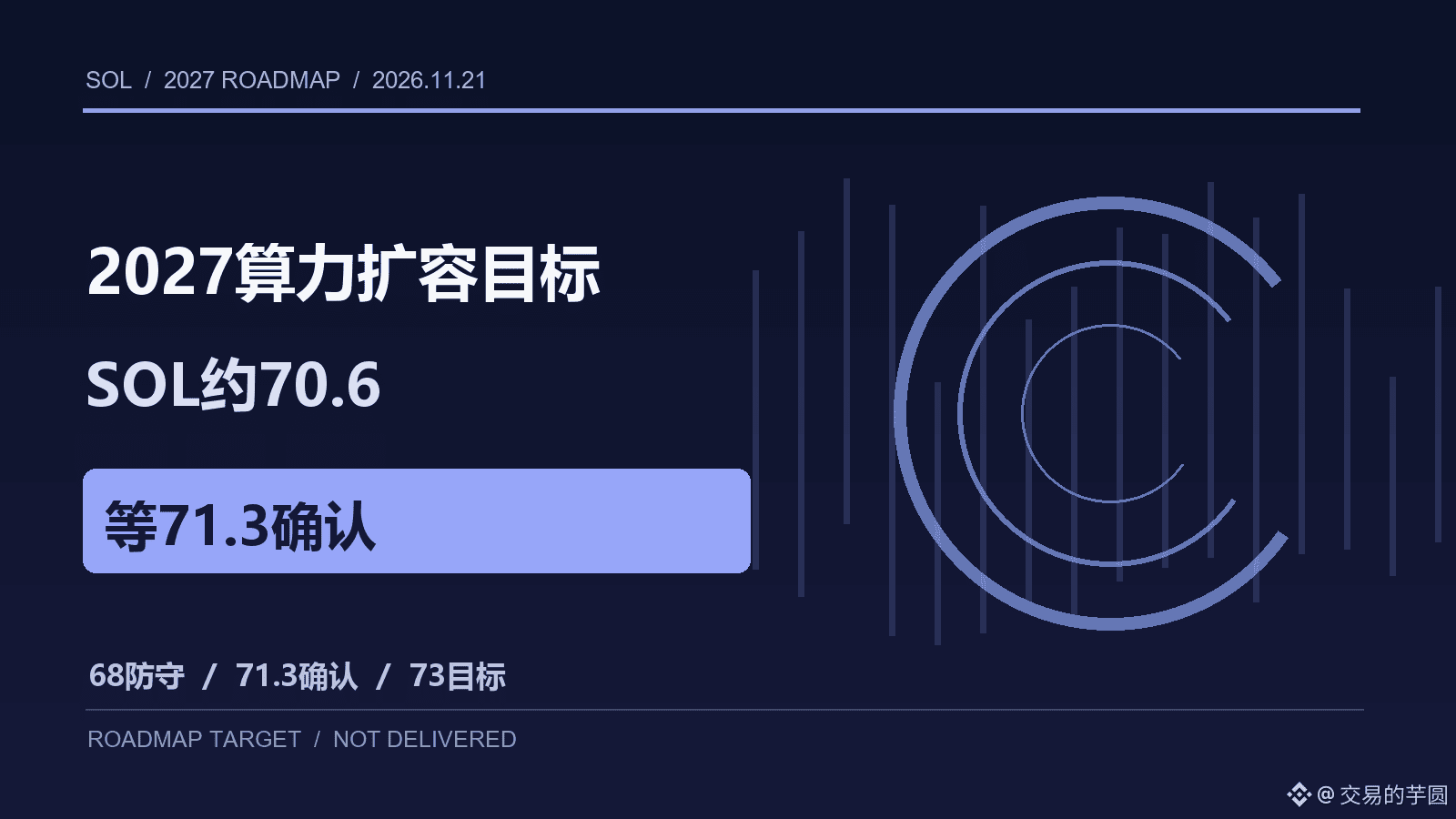
Solana sets 2027 computing capacity expansion target | SOL around $70.6 | A roadmap is not a delivery
My stance is to keep an eye on engineering progress, but for now, I won't buy on the assumption that “computing capacity has already doubled.” A review of Binance Square hot topic #Solana2027RoadmapTargetsDoubleComputeCapacity对应Solana官方对Breakpoint 2026 and public roadmap statements: The Anza team expects to increase the network's computing capacity by 2027, while advancing Rotor block propagation, Constellation block building, and transaction ordering designs. Solana's official account also listed doubling computing capacity and reducing the compute units consumed by token account transactions as goals. The key phrase here is “roadmap target”—not throughput measured on today's mainnet, and certainly not an 80% reduction in fees for every transaction. The Foundation's review also mentions some improvements already made, but it's important to distinguish features that have been deployed from plans for the next phase.
In principle, more available computing resources and more predictable transaction ordering could improve the transaction experience during peak periods and make it easier to scale payments, on-chain trading, and complex programs—if these changes are implemented and adopted by applications. However, increased capacity may also bring changes to validator hardware and network requirements; whether ecosystem demand can keep pace matters more. Simply doubling the capacity figure and inferring that SOL's price will double has no basis. To assess this roadmap, look at client releases, mainnet activation, independent performance data, actual fees, and node distribution—not just conference demos. Solana's status page currently shows mainnet operating normally. That only describes current operating conditions; it does not prove that the 2027 features have been delivered.
The market has already rebounded from its lows. I checked Binance SOL/USDT at around $70.63, with a 24-hour low of $64.87 and a high of $71.20; it was still down about 0.45% from 24 hours earlier. The recovery from $64.87 to above $70 suggests short-term buying support, but with the price near the $71.20 high, there is limited room to chase. Farside's November 20 table for U.S. Solana funds showed total net outflows of $5.9 million, so at least there was no confirmation of net fund inflows for that day. This is a single day's fund subscription and redemption data and does not represent all spot market flows. The levels I'm watching are whether $69.5 holds, whether $71.3 can be decisively broken, and then $73. A drop back below $68 would mean reassessing the strength of the rebound.
If I were trading this myself, I would sit out for now rather than chase the rally, and would only consider a leveraged-free spot long. I would wait for an hourly close above $71.3 and a retest near $70.7 that holds, then open a trial position using 2.5% of my trading capital. The first target is $73; I would take half off there and let the rest run toward $75. If an hourly close after entry falls below $69.5, or the price touches $69 intraday, I would stop out immediately and close the position. If $68 breaks first, I would cancel the plan; if the roadmap is later delayed or mainnet metrics fail to meet the targets, I would withdraw the expansion-bullish thesis. Engineering ambitions must be validated through delivery; position sizing comes first and must follow discipline.
#Solana2027RoadmapTargetsDoubleComputeCapacity #SOL
The above is solely my personal market observation and does not constitute investment advice.