Beginner Lesson 48: Before trading altcoins, why should you take a look at Bitcoin first?
One of the easiest habits to fall into when trading altcoins is focusing only on the coin you hold. If its chart is still going up, your mood rises along with it—but you might not notice that Bitcoin has already started weakening. Altcoins and the broader market don’t move in lockstep every day, but often, when the broader market turns, altcoins follow faster and fall harder.
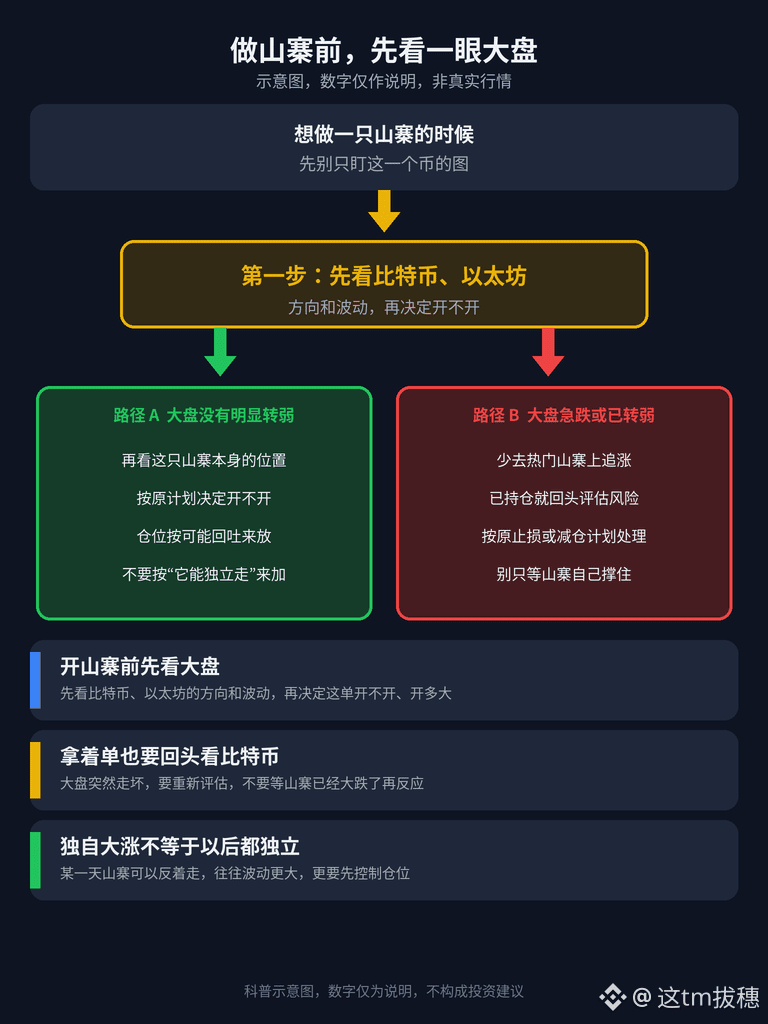
1. Check the broader market first, then your coin
1) Before opening an altcoin trade, take a look at the direction and volatility of $BTC and $ETH , then decide whether to enter and how large the position should be;
2) Even if you’re already holding an altcoin, don’t just keep refreshing its chart. If Bitcoin suddenly turns south, reassess your position instead of waiting to react until the altcoin has already plunged;
3) An altcoin can move against the broader market on a given day. This kind of “solo surge” often comes with greater volatility, so be sure to set your position size and stop-loss first. Don’t assume it will always move independently.
Take Binance spot market conditions at around 14:09 on November 20 (Taipei time), for example. The popular coin $MMT (Momentum) was up about 16.58% over 24 hours, with a trading volume of around 50.12 million USDT. Its high for the day was about 0.3177 and its low was about 0.1926, showing notably high volatility. At the same time, Bitcoin was down about 2.47% and Ethereum about 3.37%. Just because one altcoin is rising doesn’t mean the broader market is working in your favor. At times like this, check the broader market first, then decide whether to chase the move.
Before you read on, ask yourself: Before opening an altcoin trade, do you take a look at Bitcoin first? If you do, drop a 1.
2. How to look at them together in practice
You can start with a simple routine: check Bitcoin first, then the altcoin, and only then open a trade. If Bitcoin is plunging or has clearly started to weaken, avoid chasing gains in popular altcoins. If Bitcoin is relatively steady, then look at the altcoin’s position and your own plan. If you already have a position, check back in on the broader market regularly. If Bitcoin turns south, follow the stop-loss or position-reduction plan you set when you opened the trade. Don’t just keep watching the altcoin and hope it holds up on its own.
You don’t need to make checking the broader market complicated. You don’t have to predict exactly what Bitcoin will do next; just check whether it’s currently working in your favor or adding risk. Many losses don’t happen because someone misread the altcoin’s chart, but because the broader market had already turned while they were still fixated on that one coin. This doesn’t mean you can’t trade altcoins. Treat the broader market as a pre-trade check, rather than something you look at only afterward. You can trade short-term, but size your position for the possibility that it could suddenly give back its gains—not on the assumption that it will keep moving independently today.
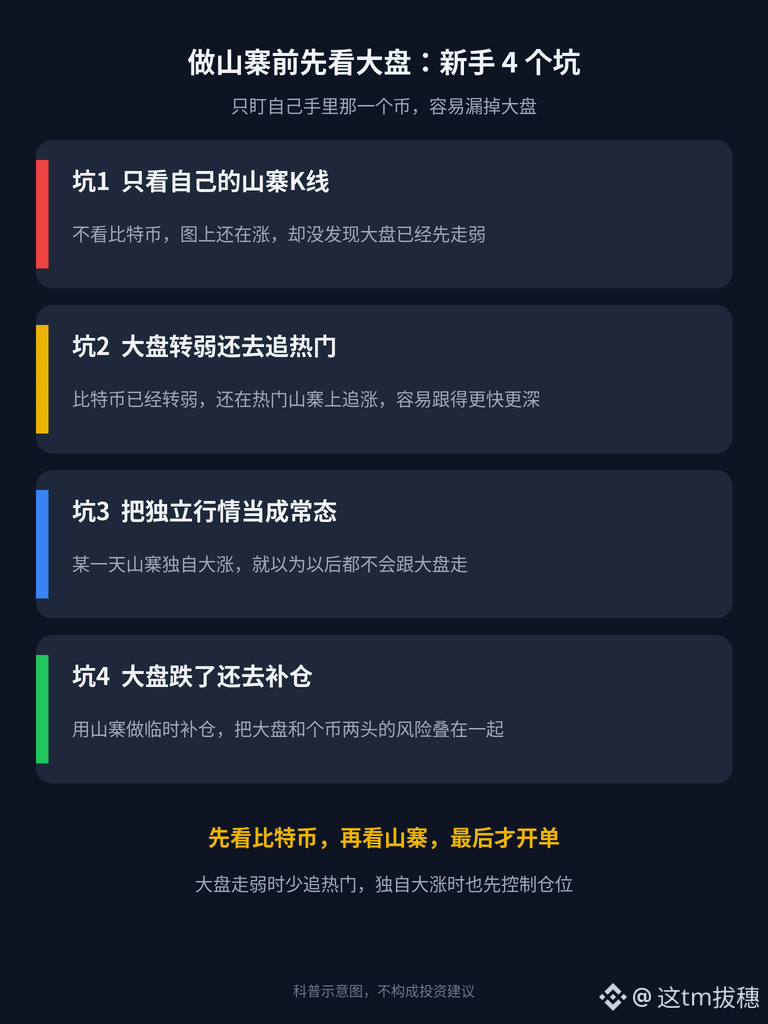
3. Common pitfalls for beginners
1) Looking only at the candlestick chart of the altcoin you hold, without checking Bitcoin;
2) Chasing gains in popular altcoins even though Bitcoin has already weakened;
3) Seeing an altcoin surge on its own one day and assuming it will never follow the broader market;
4) When the broader market falls, using an altcoin to make an improvised add-on purchase, stacking risks on both sides.
In short: Trading altcoins isn’t just about researching one coin. Check the broader market’s direction first, then decide whether to enter and how large the position should be. When the broader market weakens, be less eager to chase popular coins; even when one surges on its own, keep your position size under control.
A specific question: Before your next short-term altcoin trade, would you choose A: take a look at Bitcoin first and then decide, or B: look only at that altcoin’s chart? Just reply with a letter in the comments.
The content above is for educational purposes only and does not constitute investment advice. Crypto assets are extremely volatile, and futures trading carries even greater risks. Please participate only with money you can afford to lose.
#新手入门 #技术分析 #BinanceSquare