Hi everyone. Today, let’s talk about $SXT . The name Space and Time sounds pretty mysterious, but what it does is actually easy to understand.
For example, say I post a message in the Blockman Intelligence Agency saying that a certain wallet bought 10 ETH today. You ask me, “Jim, how did you work that out?” Well, I need to be able to show you something, right?
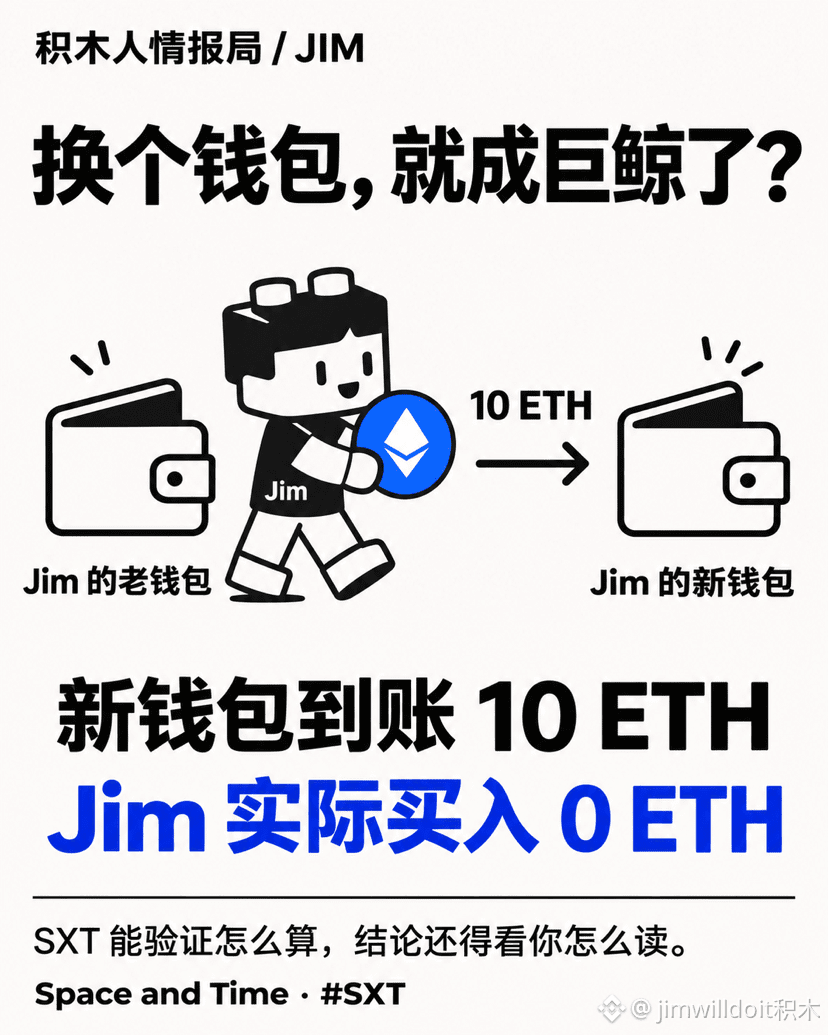
So what can it actually do? Suppose I transfer 10 ETH from my old wallet to a new one. An AI sees 10 ETH arrive at the new address and immediately writes, “Whale enters the market to buy the dip.” Come on, I just switched wallets—I didn’t even touch the buy button. To find out how much I actually bought, you have to look at the trade records.
Space and Time has a feature called Proof of SQL. Put simply, you ask it to calculate something based on the trade records, and it gives you the result along with a proof that can be verified. That way, you can check that the number really was calculated from those records according to the rules you specified. If the AI looked at a transfer but called it buying the dip, you’ll know what to ask it to double-check.
So why is this useful? Let’s use borrowing money as an example. A company is waiting to collect 1 million yuan in payments for goods and wants to turn those accounts receivable into on-chain credentials so it can borrow money against them. The protocol says it can borrow half of the amount that isn’t overdue. Suppose 200,000 yuan is already overdue. How much can it still borrow? Half of the remaining 800,000 is 400,000 yuan. Before releasing the funds, the contract can use Space and Time to verify how that 400,000 was calculated from the ledger. If the overdue amount is overlooked and the contract lends half of the full 1 million, it’ll pay out an extra 100,000 yuan. Of course, someone still has to verify the contracts and invoices to make sure those payments are real—that step can’t be skipped either.
So what do I think of @SpaceandTime ? Usually, if an AI mistakes Jim switching wallets for a whale buying the dip, everyone might laugh at me for a couple of days. But once someone uses a calculated figure to borrow or lend money, that 100,000 yuan difference has to come out of someone’s pocket. Being able to verify the numbers before the protocol sends the money—that’s why I think #SXT is useful. Makes sense now, right?
#sxt $SXT @SpaceandTime