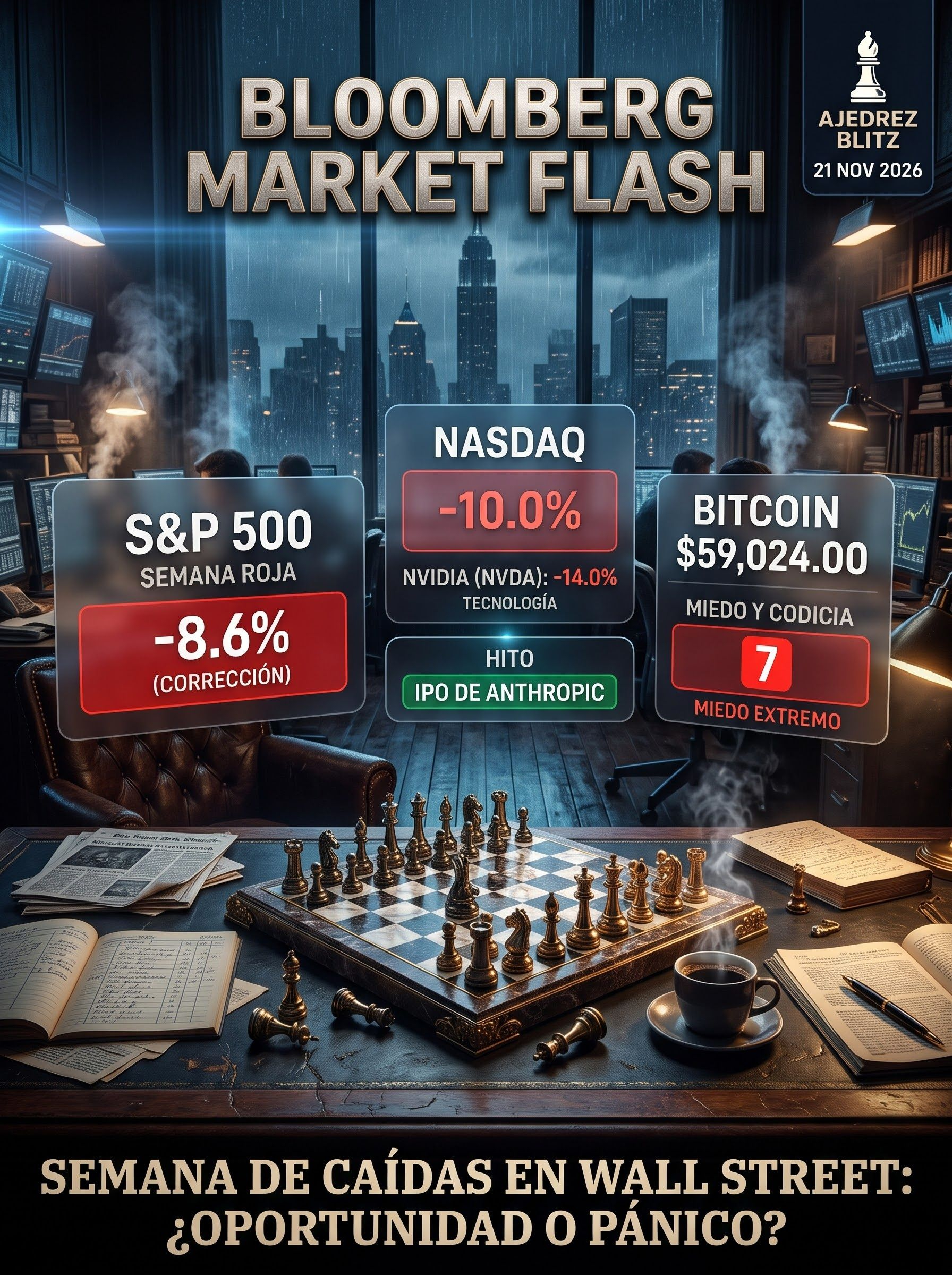

While this week’s headlines spoke of widespread panic on screens, institutional money carried out one of the most aggressive risk rotations in the past 18 months. At Blitz Chess, we’re putting the pieces in order to sum up the three fronts that defined the week of November 16–20, 2026:
1. Wall Street: The toughest week in 18 months and a hawkish Fed tone
U.S. indexes ended a week marked by heavy tech sell-offs and hawkish remarks from several Federal Reserve members (including Waller and Cook), who warned of the risk of falling behind on inflation while Chair Kevin Warsh remains silent on his interest rate guidance:
S&P 500: Fell 8.6% for the week (closing Friday at 6,910 points) and technically entered correction territory after accumulating a decline of more than 10% from its October 6 all-time high.
Nasdaq Composite: Fell 10.0% for the week (22,617 points), wiping out its year-to-date gains after a punishing session for the tech sector on Friday (-5.3%).
Dow Jones: Fell 8.0% for the week (48,147 points).
Commodities: Gold fell toward 14-month lows below $3,600/oz amid fears that interest rates could stay higher for longer, while crude oil dropped nearly 7% for the week as U.S. inventories increased.
2. Corporate Players: Nvidia’s turmoil and Anthropic’s stock market debut
The artificial intelligence sector experienced its most volatile week of the year, with two opposing stories taking center stage:
The blow to Nvidia ($NVDA): Following Jensen Huang’s recent departure, shares of the semiconductor giant plunged 14.01% on Friday (closing at $125.53) after reports emerged of an SEC accounting investigation and regulatory probes in the U.S., bringing its market value loss since its peak to nearly $2.5 trillion.
Anthropic’s IPO: Amid the turmoil, the artificial intelligence firm debuted on the market Thursday, initially jumping 17% above its offering price, though it gave up ground Friday as profit-taking swept across the AI sector.
Key corporate moves: In banking, Citigroup reported a $35 billion accounting error in risk-weighted assets at its UK subsidiary; while in consumer goods and industry, Procter & Gamble announced an automation plan involving cuts of up to 30% in its supply chain, and TPG and Corpay agreed to acquire financial platform Bill Holdings for approximately $6 billion.
3. Crypto Ecosystem: Retail capitulation in $BTC and ETF outflows
The crypto market felt the full force of global risk aversion (risk-off) and its short-term correlation with the Nasdaq:
Bitcoin ($BTC): Broke through the psychological $60,000 support level on Friday afternoon, trading around $59,024, pushing the Fear and Greed Index down to 7 (Extreme Fear) and sending global trading volume up 63.67%.
Institutional Flows: U.S. Spot Bitcoin ETFs recorded nearly $2.89B in net outflows during November (with daily outflows of up to $582.3M), though they still hold a structural base of $146.09B in net assets.
Valuation Outlook: Despite the panic on screens and liquidations in derivatives, the AHR999 indicator remains at 0.29 (historical opportunity zone), and the monthly chart (1M) retains its structural Bollinger support near $49,130.
Trading Desk Takeaway — Blitz Chess
When Wall Street corrects by 10%, AI giants face regulatory scrutiny, and $BTC registers a fear reading of 7, media noise tries to convince you that this is the end of the board. For the disciplined investor, however, these weeks of excess being flushed out and deleveraging are precisely when emotion and strategy in SPOT are separated.
Of this week’s three fronts—the correction on Wall Street, the semiconductor earthquake, or extreme fear in $BTC—which do you think will set the tone for Monday’s opening? Let me know below. 👇
(DYOR — Informational and educational summary of financial markets. This is not investment advice). 🛡️
#AjedrezBlitz #BloombergMarketFlash #WallStreetNews