
What Buffett Did During a Market Crash
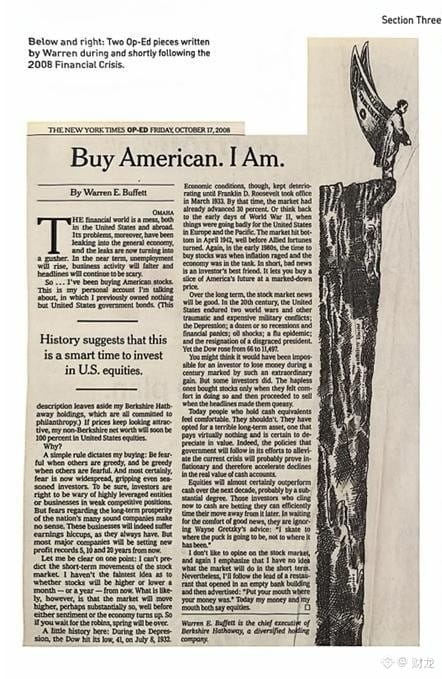
On October 16, 2008, as U.S. stocks were plunging, Buffett published an article in The New York Times. Its title said it all: “Buy American. I Am.”
The backdrop was clear to everyone: the subprime mortgage crisis had erupted in full force, and financial markets in the U.S. and abroad were in shambles. The trouble had spread from the financial system to the real economy. As he put it, “the leaks have become a torrent.” He didn’t gloss over the bad news, either. Unemployment would rise in the short term, business activity would stall, and the headlines would remain frightening.
At that very moment, he began buying U.S. stocks with his personal account. Until then, that account had held only U.S. Treasury bonds. His Berkshire holdings weren’t included; he had long ago decided to donate those to charity. He also said that as long as stock prices remained this attractive, he would soon have his entire net worth outside Berkshire invested in U.S. stocks.
The reason was simple: his familiar maxim—“Be fearful when others are greedy, and greedy when others are fearful.”
Fear was everywhere then, and even seasoned investors were struggling to hold on. He thought it made sense to avoid highly leveraged companies with weak competitive positions. But being afraid of the long-term prospects of a whole host of high-quality businesses didn’t make sense. Their earnings would fluctuate in the short term, as they always had, but looking five, ten, or twenty years ahead, most leading companies would be setting new profit records.
He also made one thing clear upfront: he didn’t know whether the stock market would be up or down a month or a year later. He was confident of only one thing: the stock market would recover before market sentiment and the real economy—and possibly much earlier, and much more sharply. He made the point with an analogy: if you wait until the robins arrive to act, spring will already be over.
He pointed to history.
During the Great Depression, the Dow Jones Industrial Average hit a low of 41 points on July 8, 1932. Yet the economy kept deteriorating until Roosevelt took office in March 1933. By then, the stock market had already risen 30%.
Early in World War II, U.S. forces suffered successive defeats in Europe and the Pacific. Yet the stock market had already bottomed in April 1942—well before the Allies turned the tide of the war.
In the early 1980s, with inflation out of control and the economy mired in a slump, it turned out to be an excellent time to buy stocks.
So his conclusion was that bad news is an investor’s best friend, because it lets you buy a piece of America’s future at a discounted price.
Now zoom out further. Over the course of the 20th century, the United States fought two world wars and several costly military conflicts. It endured the Great Depression, more than a dozen recessions and financial panics, oil crises, flu pandemics, and a president forced to resign over a scandal. And yet the Dow Jones index still rose from 66 to 11,497.
After more than a century of gains, you might think it would be hard to lose money, but plenty of people did. The reason was simple: they kept buying when the market felt comfortable and they felt secure, then selling when the news was frightening and they felt panicked.
Buffett thought people who felt safe holding cash had misplaced that sense of security. Cash earns almost nothing, and its value is bound to shrink. Add in the policies governments introduced to rescue the economy, which were likely to drive up inflation, and cash’s real purchasing power would be eroded even faster.
His view was that stocks were almost certain to outperform cash over the next ten years, often by a wide margin. Those who clung to cash were effectively betting that they could time their return to the market perfectly later, waiting for good news to give them the courage to act. He quoted hockey great Wayne Gretzky: “I skate to where the puck is going to be, not where it has been.”
At the end of the article, he reiterated that he didn’t like commenting on the stock market and truly didn’t know where it would go in the short term. He borrowed a slogan from a restaurant in an empty bank building: “We do what we say, and our money goes where our mouth is.” That day, both his money and his convictions were invested in stocks.
Whenever the article resurfaces during a major market slump, the most useful lesson is still his approach: he admitted he couldn’t predict short-term ups and downs, but he backed his long-term view with real money.
On October 16, 2008, as U.S. stocks were plunging, Buffett published an article in The New York Times. Its title said it all: “Buy American. I Am.”
The backdrop was clear to everyone: the subprime mortgage crisis had erupted in full force, and financial markets in the U.S. and abroad were in shambles. The trouble had spread from the financial system to the real economy. As he put it, “the leaks have become a torrent.” He didn’t gloss over the bad news, either. Unemployment would rise in the short term, business activity would stall, and the headlines would remain frightening.
At that very moment, he began buying U.S. stocks with his personal account. Until then, that account had held only U.S. Treasury bonds. His Berkshire holdings weren’t included; he had long ago decided to donate those to charity. He also said that as long as stock prices remained this attractive, he would soon have his entire net worth outside Berkshire invested in U.S. stocks.
The reason was simple: his familiar maxim—“Be fearful when others are greedy, and greedy when others are fearful.”
Fear was everywhere then, and even seasoned investors were struggling to hold on. He thought it made sense to avoid highly leveraged companies with weak competitive positions. But being afraid of the long-term prospects of a whole host of high-quality businesses didn’t make sense. Their earnings would fluctuate in the short term, as they always had, but looking five, ten, or twenty years ahead, most leading companies would be setting new profit records.
He also made one thing clear upfront: he didn’t know whether the stock market would be up or down a month or a year later. He was confident of only one thing: the stock market would recover before market sentiment and the real economy—and possibly much earlier, and much more sharply. He made the point with an analogy: if you wait until the robins arrive to act, spring will already be over.
He pointed to history.
During the Great Depression, the Dow Jones Industrial Average hit a low of 41 points on July 8, 1932. Yet the economy kept deteriorating until Roosevelt took office in March 1933. By then, the stock market had already risen 30%.
Early in World War II, U.S. forces suffered successive defeats in Europe and the Pacific. Yet the stock market had already bottomed in April 1942—well before the Allies turned the tide of the war.
In the early 1980s, with inflation out of control and the economy mired in a slump, it turned out to be an excellent time to buy stocks.
So his conclusion was that bad news is an investor’s best friend, because it lets you buy a piece of America’s future at a discounted price.
Now zoom out further. Over the course of the 20th century, the United States fought two world wars and several costly military conflicts. It endured the Great Depression, more than a dozen recessions and financial panics, oil crises, flu pandemics, and a president forced to resign over a scandal. And yet the Dow Jones index still rose from 66 to 11,497.
After more than a century of gains, you might think it would be hard to lose money, but plenty of people did. The reason was simple: they kept buying when the market felt comfortable and they felt secure, then selling when the news was frightening and they felt panicked.
Buffett thought people who felt safe holding cash had misplaced that sense of security. Cash earns almost nothing, and its value is bound to shrink. Add in the policies governments introduced to rescue the economy, which were likely to drive up inflation, and cash’s real purchasing power would be eroded even faster.
His view was that stocks were almost certain to outperform cash over the next ten years, often by a wide margin. Those who clung to cash were effectively betting that they could time their return to the market perfectly later, waiting for good news to give them the courage to act. He quoted hockey great Wayne Gretzky: “I skate to where the puck is going to be, not where it has been.”
At the end of the article, he reiterated that he didn’t like commenting on the stock market and truly didn’t know where it would go in the short term. He borrowed a slogan from a restaurant in an empty bank building: “We do what we say, and our money goes where our mouth is.” That day, both his money and his convictions were invested in stocks.
Whenever the article resurfaces during a major market slump, the most useful lesson is still his approach: he admitted he couldn’t predict short-term ups and downs, but he backed his long-term view with real money.