
What would Nvidia have left without Jensen Huang?
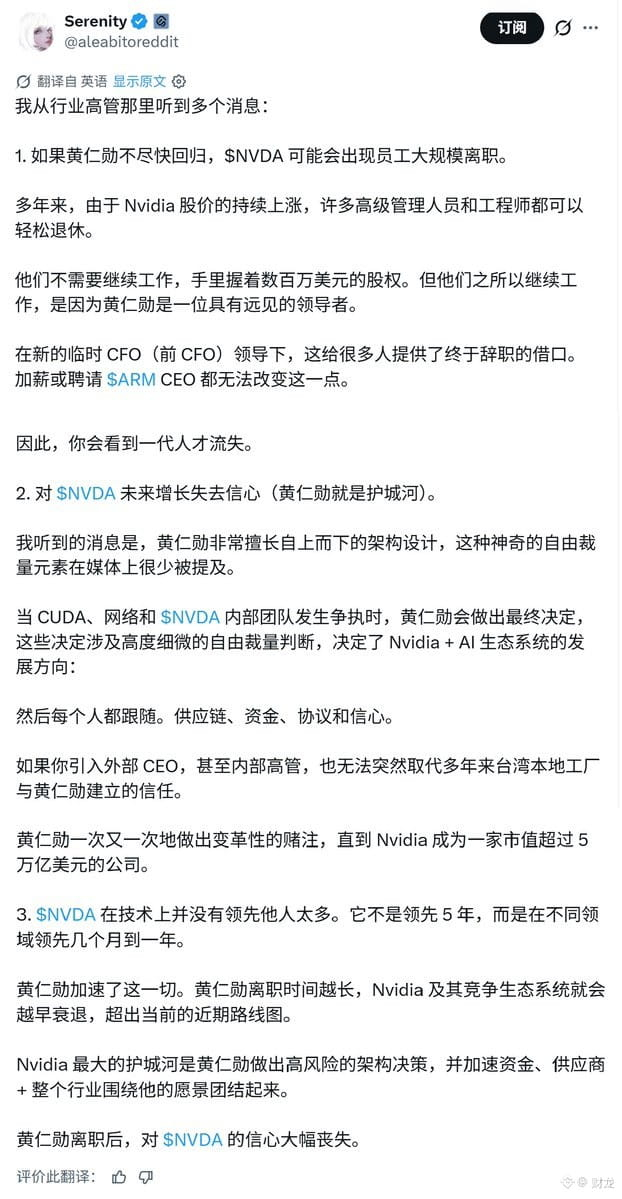
A white-haired blogger in the U.S. stock market community recently posted a tweet warning people to watch out for a possible sharp drop ahead. Her warning was based on three things she’d heard from industry executives, all under the same assumption: Jensen Huang leaves, and an interim CEO takes over.
First, the people. Many Nvidia executives and engineers hold millions of dollars’ worth of stock and could have retired long ago. Money isn’t what keeps them there; it’s Jensen Huang himself. An interim CEO taking the helm would give many of them a graceful reason to leave. A pay raise might keep them around for a while, but it won’t change their desire to go.
Next, decision-making. When CUDA, networking, and internal teams clashed, it was Huang who made the delicate architectural trade-offs. Decisions about where to direct the supply chain and capital also followed his judgment. Many partnerships were built on a handshake with Huang, and the terms may not be clearly spelled out in contracts. A new outside CEO would have a hard time inheriting that trust.
The third point stings the most: Nvidia isn’t really five years ahead of everyone else, as many people think. In individual segments, it’s actually only a few months to a year ahead—and it’s Huang who keeps pushing the pace forward. The longer he’s gone, the sooner Nvidia—and the entire ecosystem around it—will start to decline.
Some people have drawn a comparison with Huawei. Xu Zhijun, Huawei’s rotating chairman, wrote an article for the U.S. magazine Time specifically about how Huawei retains its people. Some believe this was a way of getting ahead of a potential wave of departures at Nvidia. Both companies use equity to retain employees, but their approaches are very different: Nvidia’s equity is more like a retirement ticket after making a fortune—you can leave once you’ve earned enough. Huawei’s system is more like a binding mechanism: even after you leave, the system keeps making money for you.
The blogger saw the risk of talent leaving, but didn’t say much about a possible split at the board and capital levels. By this logic, Silicon Valley engineers may not go along with pushing out the founder and replacing him with a compliant stand-in. Executive retirements are just the surface; once trust starts to erode, all that’s left is a contract manufacturer and CUDA.
If that happens, Nvidia’s valuation will be revised downward, and the retail investors watching stock charts will probably be the ones left holding the bag. Everything above is based on executives’ remarks relayed in the tweet and hasn’t been verified. Consider your own position carefully.