
Intel’s new 350W card claims to be 5.9 times faster than Nvidia—but the fine print tells a different story
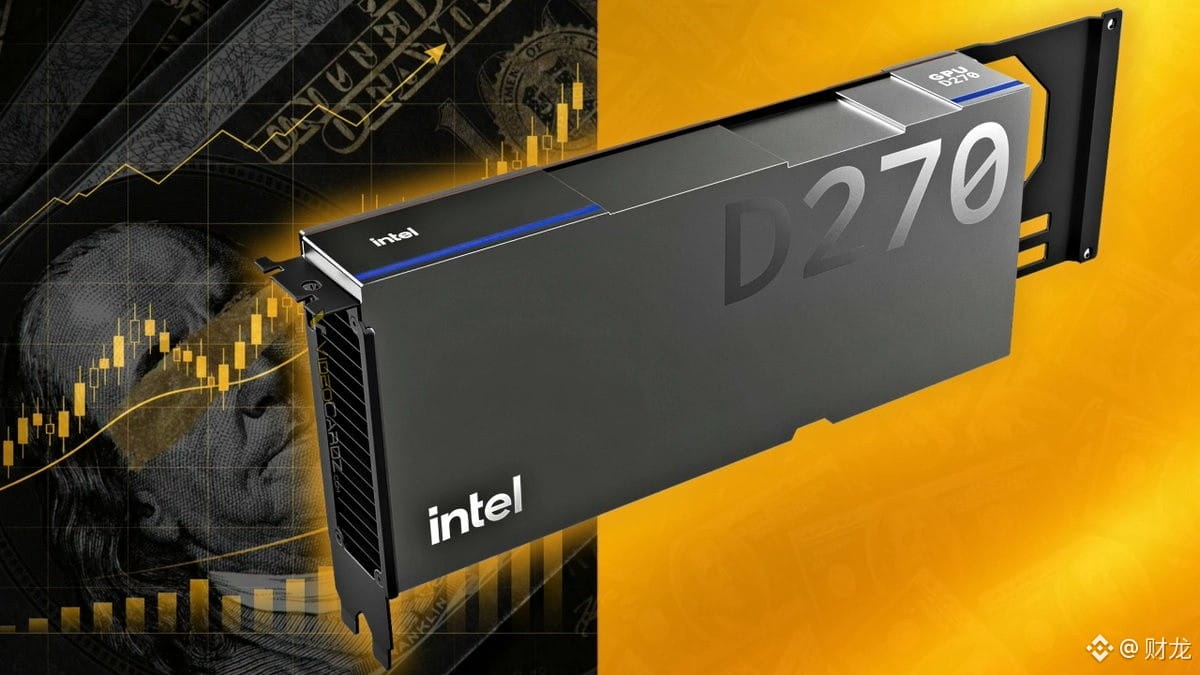
Intel has released a set of benchmark results: its 350W D270 is up to 5.9 times faster than Nvidia’s 600W RTX PRO 6000 Blackwell.
That figure sounds outrageous at first glance. But after reading through the test report and its appendices, it’s clear Intel picked its battleground carefully—and zeroed in on a genuine weakness for Nvidia.
First, where does the 5.9x figure come from?
The tests with the biggest leads are all double-precision floating-point (FP64) options pricing benchmarks commonly used in quantitative finance. European Monte Carlo simulation is 5.9 times faster, Black-Scholes is 5.6 times faster, and binomial tree pricing is 4.6 times faster.
The reason for such a huge gap lies with Nvidia itself. To protect the margins on data center cards like the B200 and H200, Nvidia cut the FP64 performance of its workstation flagship, the RTX PRO 6000 Blackwell, to 1:64. The D270 uses the Xe3P architecture and delivers full-speed native FP64, with 64 FP64 FMAs per core. Naturally, you’re likely to win when you compete in an area your rival has deliberately crippled.
There’s another detail in the appendix. Intel’s test system had one D270 and three Arc Pro B70 cards, while Nvidia’s had eight RTX PRO 6000 cards. The report doesn’t say how many cards each side used for the finance tests. So take that 5.9x figure with a grain of salt.
The results are more substantial when it comes to large language model inference.
Running Qwen3-30B-A3B (FP8) on a single card, the D270 delivers 1.12 times the output throughput of the RTX PRO 6000 Blackwell. On Drex 2.0, latency is 29% lower.
A 1.12x advantage doesn’t look dramatic, but power consumption matters. At 350W versus 600W, it uses just over half the power and still beats Blackwell’s top workstation card on a 30B-class MoE model. That’s impressive power efficiency.
But the most enticing feature is memory.
The RTX PRO 6000 draws 600W and has just 96GB of GDDR7 memory. Instead of chasing expensive, supply-constrained HBM, Intel has packed LPDDR5X onto a 350W, air-cooled PCIe card. The reference model starts at 160GB, with 1.5 TB/s of bandwidth. Custom versions from board partners can reach up to 480GB on a single card.
What does it mean to fit 480GB on a single air-cooled card? Until now, loading the weights for a fully sized, massive model meant assembling an entire rack of cards or paying for an eye-wateringly expensive cluster. Now, one 350W card can do the job. For people who want to run large models locally, that capacity is more useful than any benchmark multiplier.
Intel has already shown how to put it to use. At SC26, Intel and SambaNova put together a split-workload setup. The D270’s large memory handles the Prefill stage for massive contexts, then hands the work over to the high-bandwidth SambaNova SN50 to generate tokens. Each handles a different part of the job: capacity on one side, bandwidth on the other.
Nvidia has kept a tight grip on memory capacity for years, carefully carving the market into tiers. If it keeps going down this path, Intel products like this—using LPDDR5X to pack in more memory—could take a share of the lucrative large-memory inference market.
Intel has released a set of benchmark results: its 350W D270 is up to 5.9 times faster than Nvidia’s 600W RTX PRO 6000 Blackwell.
That figure sounds outrageous at first glance. But after reading through the test report and its appendices, it’s clear Intel picked its battleground carefully—and zeroed in on a genuine weakness for Nvidia.
First, where does the 5.9x figure come from?
The tests with the biggest leads are all double-precision floating-point (FP64) options pricing benchmarks commonly used in quantitative finance. European Monte Carlo simulation is 5.9 times faster, Black-Scholes is 5.6 times faster, and binomial tree pricing is 4.6 times faster.
The reason for such a huge gap lies with Nvidia itself. To protect the margins on data center cards like the B200 and H200, Nvidia cut the FP64 performance of its workstation flagship, the RTX PRO 6000 Blackwell, to 1:64. The D270 uses the Xe3P architecture and delivers full-speed native FP64, with 64 FP64 FMAs per core. Naturally, you’re likely to win when you compete in an area your rival has deliberately crippled.
There’s another detail in the appendix. Intel’s test system had one D270 and three Arc Pro B70 cards, while Nvidia’s had eight RTX PRO 6000 cards. The report doesn’t say how many cards each side used for the finance tests. So take that 5.9x figure with a grain of salt.
The results are more substantial when it comes to large language model inference.
Running Qwen3-30B-A3B (FP8) on a single card, the D270 delivers 1.12 times the output throughput of the RTX PRO 6000 Blackwell. On Drex 2.0, latency is 29% lower.
A 1.12x advantage doesn’t look dramatic, but power consumption matters. At 350W versus 600W, it uses just over half the power and still beats Blackwell’s top workstation card on a 30B-class MoE model. That’s impressive power efficiency.
But the most enticing feature is memory.
The RTX PRO 6000 draws 600W and has just 96GB of GDDR7 memory. Instead of chasing expensive, supply-constrained HBM, Intel has packed LPDDR5X onto a 350W, air-cooled PCIe card. The reference model starts at 160GB, with 1.5 TB/s of bandwidth. Custom versions from board partners can reach up to 480GB on a single card.
What does it mean to fit 480GB on a single air-cooled card? Until now, loading the weights for a fully sized, massive model meant assembling an entire rack of cards or paying for an eye-wateringly expensive cluster. Now, one 350W card can do the job. For people who want to run large models locally, that capacity is more useful than any benchmark multiplier.
Intel has already shown how to put it to use. At SC26, Intel and SambaNova put together a split-workload setup. The D270’s large memory handles the Prefill stage for massive contexts, then hands the work over to the high-bandwidth SambaNova SN50 to generate tokens. Each handles a different part of the job: capacity on one side, bandwidth on the other.
Nvidia has kept a tight grip on memory capacity for years, carefully carving the market into tiers. If it keeps going down this path, Intel products like this—using LPDDR5X to pack in more memory—could take a share of the lucrative large-memory inference market.