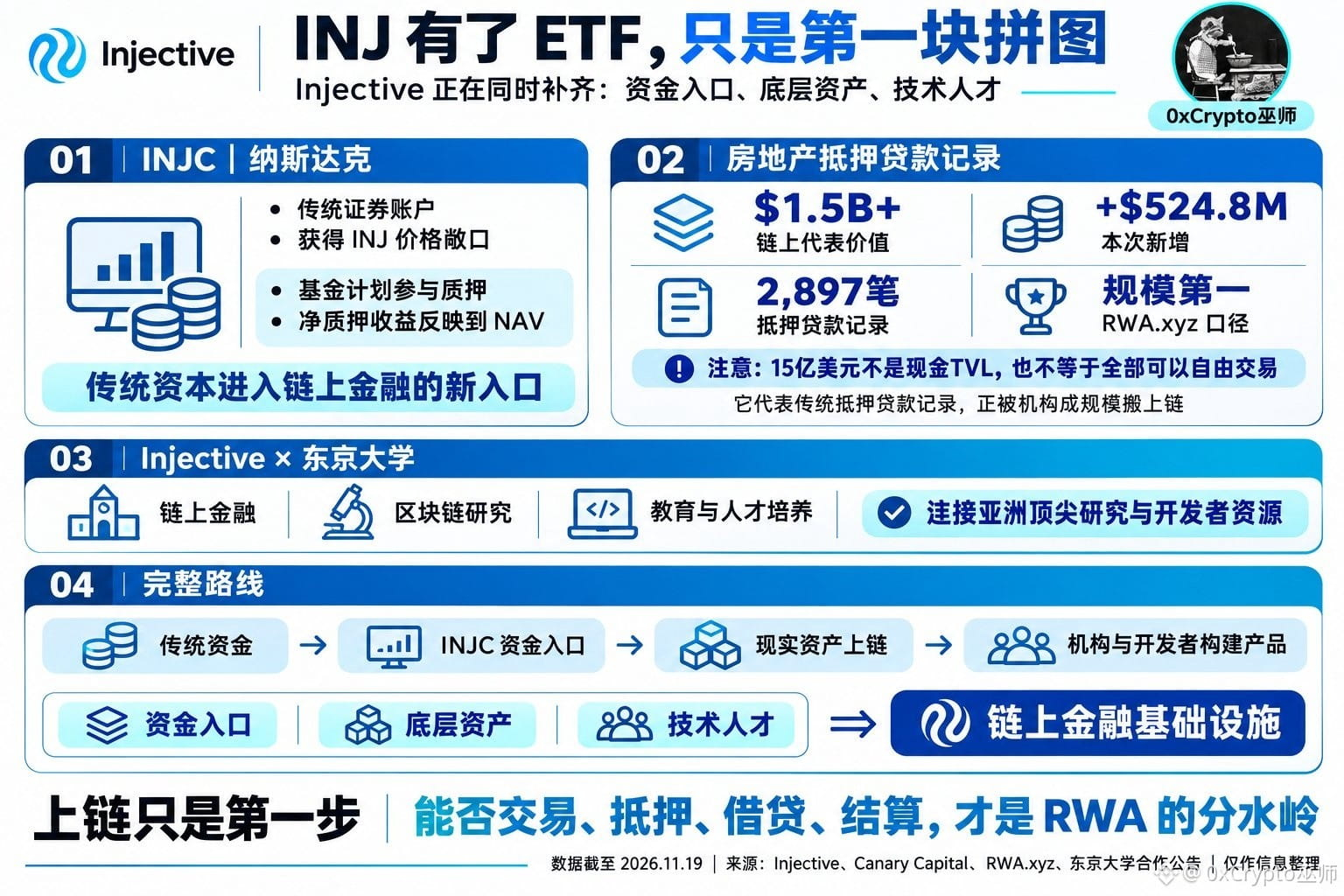

If you understand this only as “$INJ now has an ETF,” you’re missing the bigger picture.
What INJC really opens up is a gateway for capital.
Traditional investors don’t need to create a wallet; they can gain exposure to INJ’s price directly through their brokerage accounts.
The fund also plans to participate in staking, with net staking rewards reflected in the fund’s NAV.
Meanwhile, mortgage records backed by real estate on the Injective chain have surpassed $1.5 billion.
Pentiv added $524.8 million this time, bringing the number of on-chain registered mortgages to 2,897. Based on the represented value tracked by http://RWA.xyz, Injective has become the largest blockchain by tokenized real estate value.
One thing needs to be made clear:
The $1.5 billion isn’t $1.5 billion in cash locked on-chain, nor does it mean these assets can all be freely traded right now.
It represents traditional mortgage records being brought on-chain at scale by institutions.
This week, Injective also partnered with the University of Tokyo to explore on-chain finance, blockchain research, and talent development.
Taken together, this recent series of developments reveals something interesting: three pieces of the puzzle—a gateway for capital, underlying assets, and technical talent—are all falling into place at the same time.
So I think what Injective is doing now is trying to build a complete pathway:
to let traditional capital flow in, bring real-world assets on-chain, and give institutions and developers a place to keep building products.