$BTC $ZEC $SOL
It wasn’t panic that pulled out $541 million. It was a redemption order from BlackRock.
Tonight, let’s go through three receipts. By the end, you’ll see that what’s falling in this sell-off isn’t crypto—it’s the on-ramp.
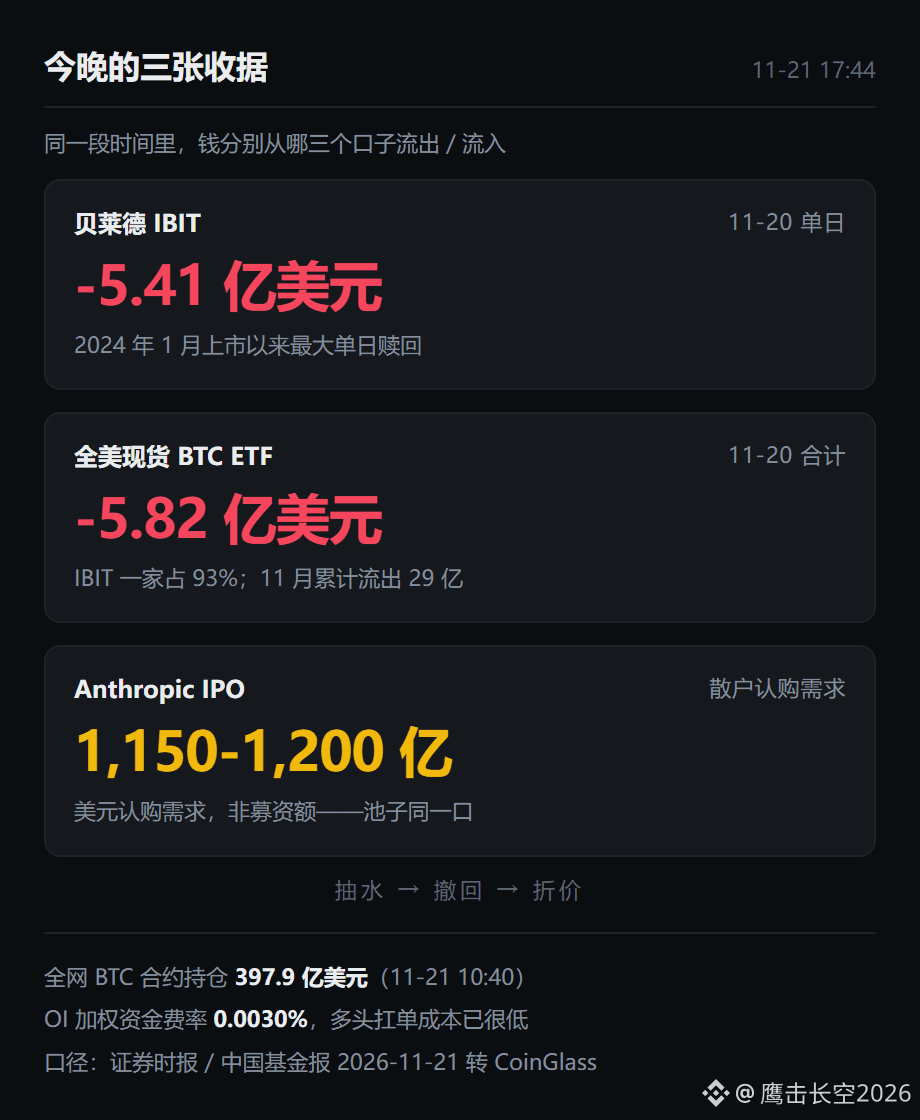
First: BlackRock’s IBIT. On November 20, it saw a single-day redemption of $541 million—the largest single-day outflow since the fund launched in January 2024. On the same day, U.S. spot Bitcoin ETFs saw total net outflows of $582 million, with IBIT accounting for 93% of that. Cumulative outflows in November reached $2.9 billion, and net outflows have exceeded $3 billion year to date. This isn’t retail dumping—it’s someone redeeming shares. (Securities Times, 2026-11-21)
Second: Anthropic. Its IPO drew $115 billion to $120 billion in retail subscription demand. Note: that’s not the amount being raised; it’s the money looking to get in. And note, too, that it has nothing to do with crypto. There’s only so much money in the market. When one side pulls hard, the other has to give way.
Third: open interest. Bitcoin futures open interest across the market stands at $39.79 billion, down again from a week ago. The OI-weighted funding rate has fallen to around 0.0030%—the cost of holding long positions is already very low, suggesting that most of the positions that needed cutting have been cut. (Securities Times, citing Coinglass, 11-21 10:40)
Put the three receipts together, and here’s how the chain reaction works:
Step one: the drain. With $120 billion in subscription demand on the table, where will the money come from? From the marginal buying power across all risk assets.
Step two: the pullback. When ETF shares are redeemed, the fund has to sell spot—that’s a mechanical process, unaffected by sentiment or the charts. IBIT has seen $1.65 billion in net outflows over six months, its first real reversal since the product launched.
Step three: the discount. The aftershocks of the late-October Binance hack haven’t faded, and the Democrats’ midterm-election landslide has dampened expectations for looser regulation. It’s not that compliant capital doesn’t want to come in; it’s that investors can’t find a reason they can put in a risk-control report.
Once those three steps play out, you get the market we’re seeing today: BTC fell from 62,341.94 to 55,130, down 11.6%—more than the Nasdaq fell that night.
Where do I stand? On the side of “the discount hasn’t fully corrected yet”—but I’m not chasing shorts tonight.
Here’s why: there’s no counterparty tonight. It’s Saturday night trading: no U.S. stock-market open, no ETF creations or redemptions, and the pool is so thin you can see the bottom. At times like this, it only takes a few million dollars to drive the price down in a flash—and just as little to bring it back up. I’m holding my short, but I’m not adding around 58,000. Same logic as not chasing longs at the top: get the timing wrong, and even the right direction can lose you money.
Tonight, I’m watching just three numbers: 58,066.71 is the rebound high from today’s 16:00 candle; a move above it would count as a potential bottom. 59,030.85 is the range with the densest cluster of hourly closes today; if we close above it, I’ll cover half. 55,130 is today’s low; if it breaks, this whole narrative is invalidated, and I’ll turn my attention to 53,000.
A line to remember: Money doesn’t disappear. It just goes somewhere you can’t track it.
Wen Tingyun wrote, “Cockcrow at the thatched inn, moonlight; frost on the bridge, footprints of travelers.” That’s what night trading is like: few people, heavy frost, and only your own two lines of footprints.
Are you holding a long, waiting for 58,066, or a short, waiting for 55,130? Tell me your position size, leverage, and stop-loss level—I’ll keep an eye on the chart for you through the night.
If you want to stay up together until the close, tap the group-chat link on my profile: Eagle Soaring the Skies · Crypto Study Club. We’re a small group, but someone always replies.